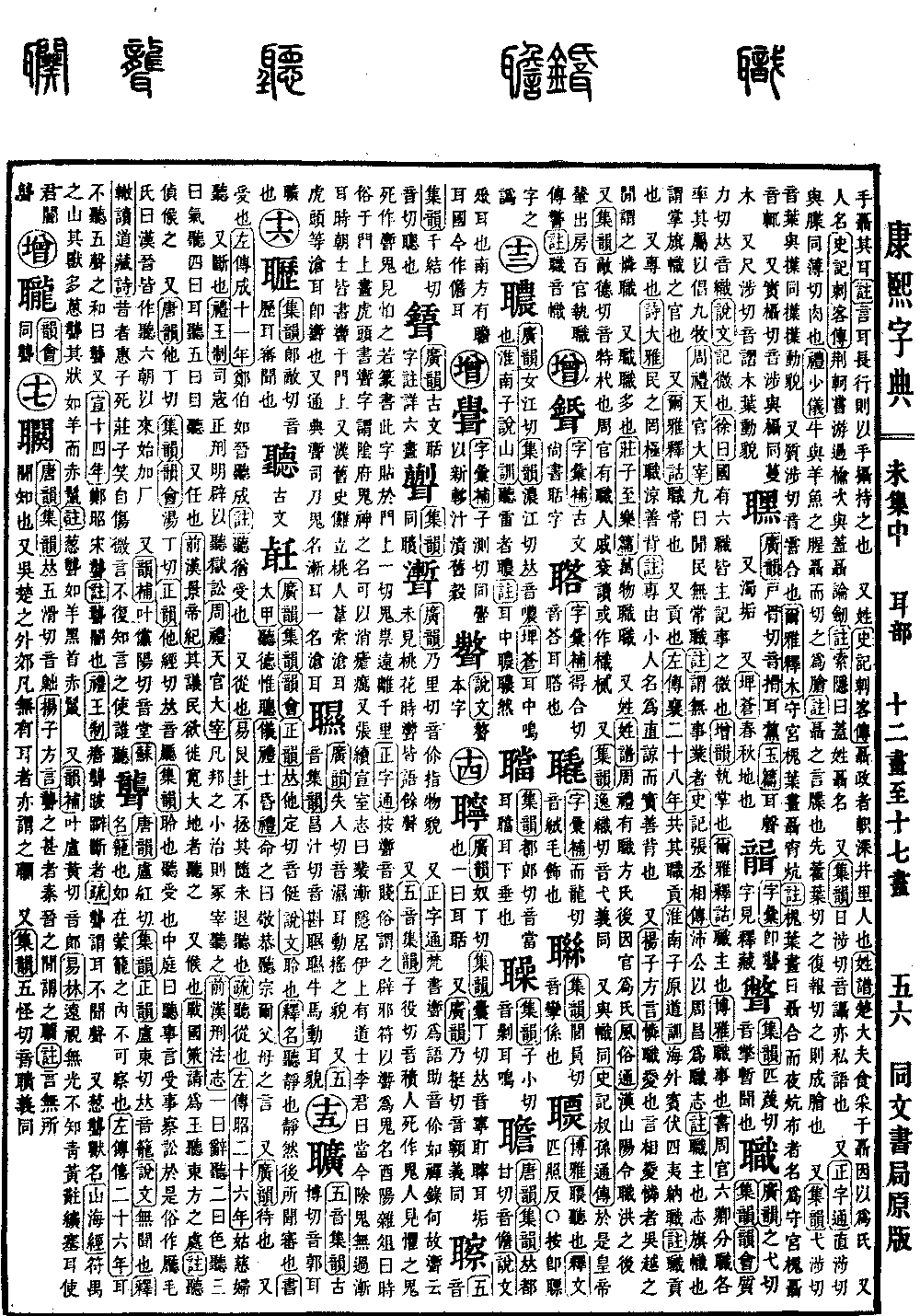
Wei Collection, Middle Volume
Radical: Ear (ěr)
Kangxi Strokes: 18
Page 970, Entry 01
Pronounced zhi.
Shuowen Jiezi (Explanation of Simple and Compound Characters): To record the subtle.
Xu states: The state possesses six duties, all of which govern the subtleties of recorded affairs.
Zengyun (Additional Rhymes): To hold in charge.
Erya (Approaching Elegance), Interpretation of Ancient Words: Duty means to govern.
Boya (Broad Elegant Expressions): Duty means affair.
Book of Documents (Shujing), Zhou Offices: The six ministers divide their duties, each leading their subordinates to take the lead over the nine regional governors.
Rites of Zhou (Zhouli), Offices of Heaven, Grand Minister: The ninth is the idle populace, those without constant duty.
Commentary: This refers to those who have no established occupation.
Records of the Grand Historian (Shiji), Biography of Chancellor Zhang: Lord Pei appointed Zhou Chang to the position of banner-bearer.
Commentary: Duty means to govern. Zhi refers to banners. This refers to the official in charge of banners.
Also: Constant.
Also: Tribute.
Zuo Tradition (Zuo Zhuan), 28th Year of Duke Xiang: To supply their duty and tribute.
Huainanzi (Huainan Masters), Exposition on the Original Way: Guests from overseas submit and bow, and the four barbarian tribes pay tribute.
Commentary: Duty means tribute.
Also: Solely or exclusively.
Classic of Poetry (Shijing), Greater Odes: The people have no limits; they exclusively rely on those who are seemingly honest but good at turning their backs.
Commentary: They exclusively rely on petty men who claim to be upright and sincere but are in fact good at betraying others.
Also: Yang Xiong, Regional Dialects (Fangyan): Lianzhi means to sympathize. When people sympathize with one another, in the regions of Wu and Yue this is called lianzhi.
Also: Zhizhi means many or abundant.
Zhuangzi (Zhuangzi), Chapter on Supreme Joy: The ten thousand things are numerous.
Also: A surname.
Genealogy of Surnames: In the Rites of Zhou, there is the Office of the Registrar (Zhifangshi); later, people took their official title as their surname.
Customs of the People (Fengsutong): Descendants of Zhi Hong, the Prefect of Shanyang during the Han dynasty.
Also: Pronounced te. A wooden stake. The Rites of Zhou mentions the position of "staker" (zhiren). People from Qi and Yan read it this way. Sometimes written as a variant form (zhi) or a variant form (er).
Also: Pronounced yi. The meaning is the same.
Also: Used interchangeably with the character for banner (zhi).
Records of the Grand Historian (Shiji), Biography of Shusun Tong: At this time the Emperor’s carriage emerged from the chamber, and the hundred officials held their banners to signal for vigilance.
Commentary: Zhi is pronounced zhi.