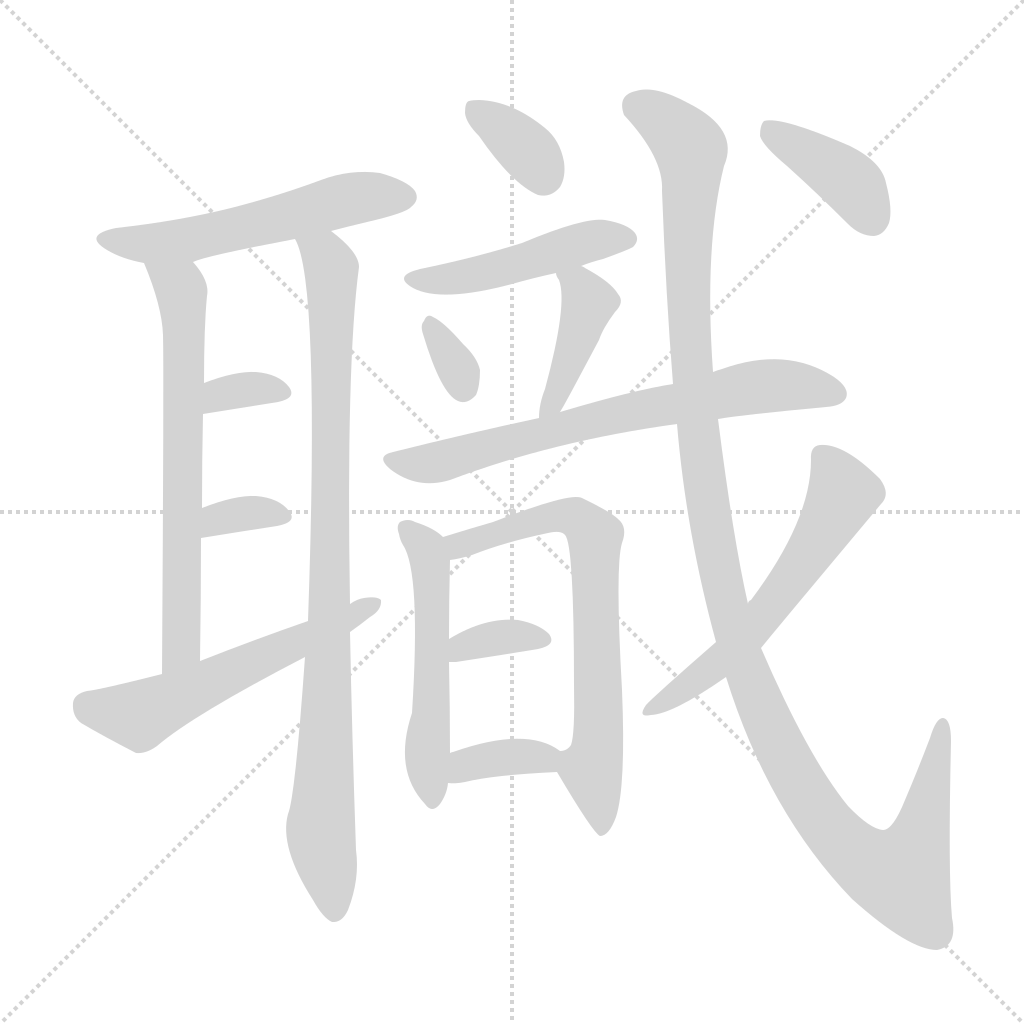
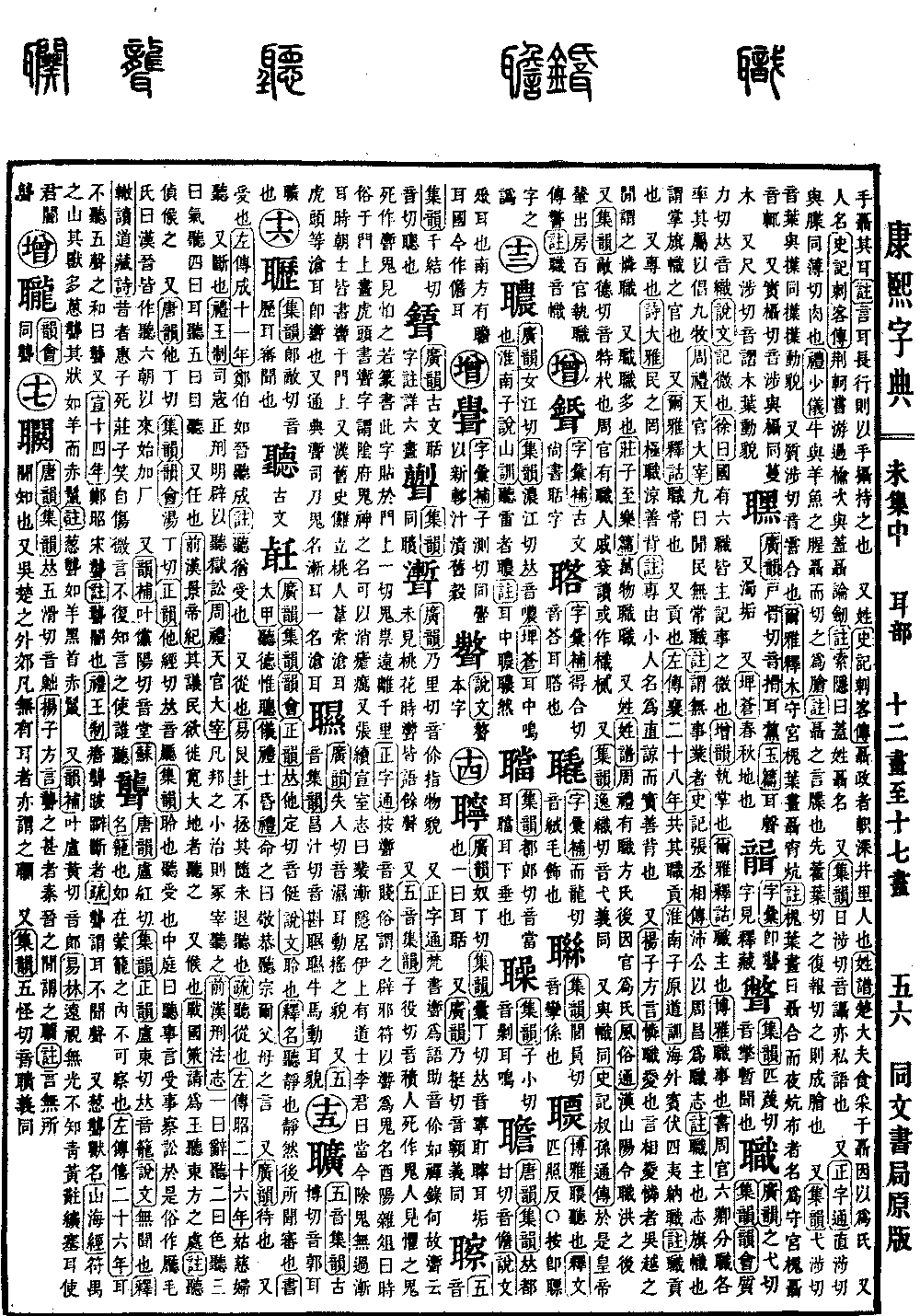
Wei Collection, Middle Volume
Radical: Ear (ěr)
Kangxi stroke count: 18
Page 970, Entry 04
Guangyun (Guangyun): Pronounced zhi. Jiyun (Jiyun) and Yunhui (Yunhui): Pronounced zhi, pronounced zhi.
Shuowen (Shuowen): To record minute details.
Xu (Xu) states: The state has six official positions, all of which are responsible for recording the minutiae of affairs.
Zengyun (Zengyun): To manage or hold office.
Erya (Erya): Explaining ancient words: Zhi means to manage.
Boya (Boya): Zhi means an affair.
Book of Documents (Shujing): The six ministers divided their duties, each leading their subordinates to guide the nine provinces.
Rites of Zhou (Zhouli): Heaven Official, Grand Minister: The ninth is the idle populace, those without constant occupation.
Commentary: This refers to those without work.
Records of the Grand Historian (Shiji): Biography of Chancellor Zhang: The Duke of Pei appointed Zhou Chang to the position of flag officer.
Commentary: Zhi means to manage. Zhi refers to banners. This refers to the official in charge of banners.
Also: Erya (Erya): Explaining ancient words: Zhi means constant.
Also: Tribute.
Zuo Tradition (Zuozhuan): Providing their tribute.
Huainanzi (Huainanzi): Original Way Training: Foreigners submit and obey, the four barbarian tribes pay their tribute.
Commentary: Zhi means tribute.
Also: Exclusively.
Book of Odes (Shijing): The people have no limits; they are exclusively small-minded and prone to betrayal.
Commentary: This means they are exclusively led by small-minded men who claim to be upright and sincere but are actually prone to betrayal.
Also: Yangzi (Yangzi): Dialects: To pity, to be fond of. Those who have pity for one another are called lianzhi in the regions of Wu and Yue.
Also: Zhizhi means many.
Zhuangzi (Zhuangzi): Supreme Joy chapter: All things are numerous.
Also: A surname.
Surname Genealogy: The Rites of Zhou mentions the Officer of Geography; later, the office became a surname.
Customs and Traditions: Descendants of Zhi Hong, the Prefect of Shanyang during the Han Dynasty.
Also: Jiyun (Jiyun): Pronounced te. A small wooden stake. The Rites of Zhou mentions the position of Zhiren. Read as qie or yan. Sometimes written as zhi or er.
Also: Jiyun (Jiyun): Pronounced yi. Meaning is the same.
Also: Same as zhi (banner).
Records of the Grand Historian (Shiji): Biography of Shusun Tong: At this time, the Emperor's carriage emerged from the chamber, and the hundred officials held their banners to signal for vigilance.
Commentary: Zhi is pronounced zhi.