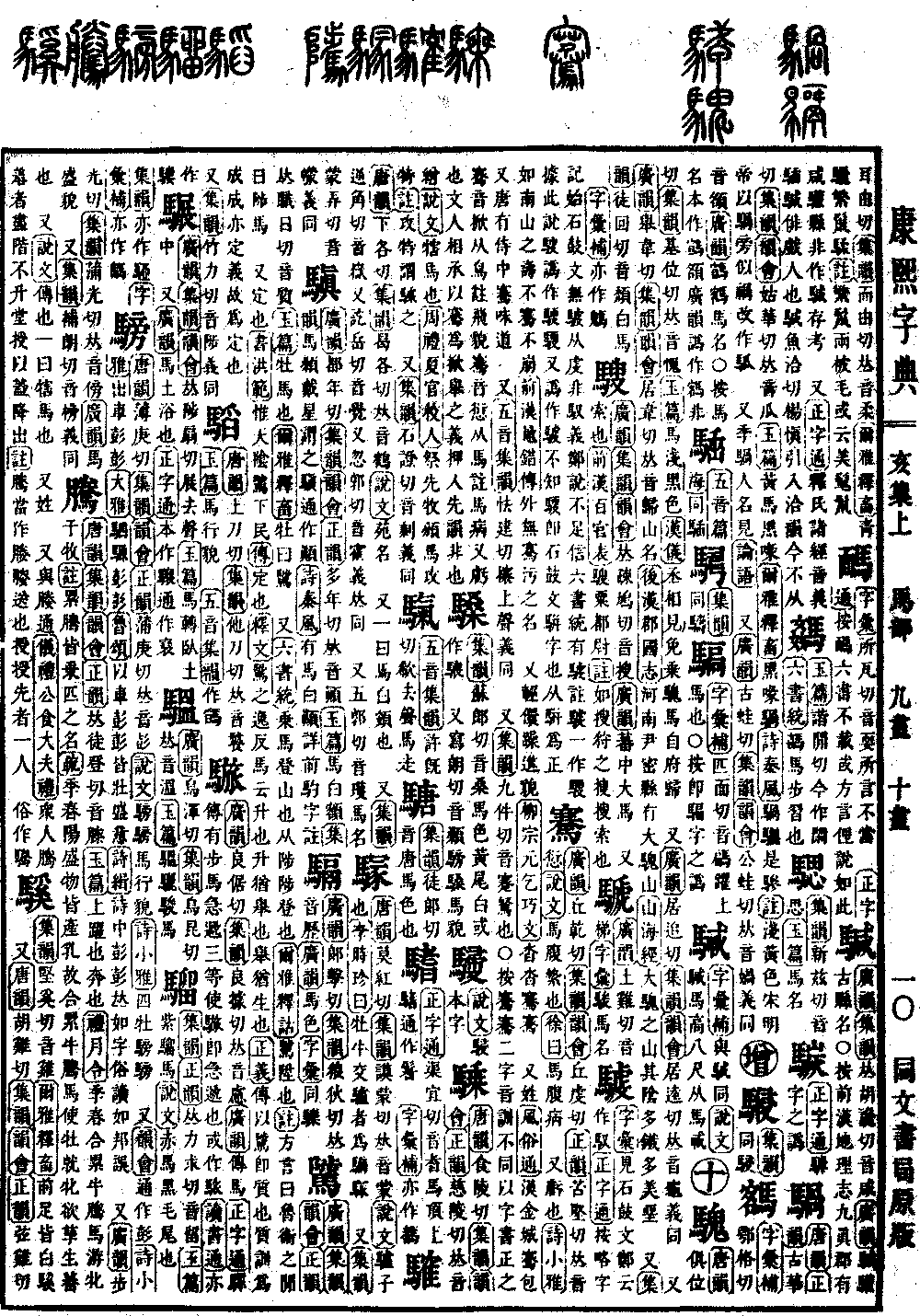
Hai Collection, Upper Volume
Radical: Horse (mǎ)
Entry: Zhi
Kangxi strokes: 20
Page 1442, Entry 01
Broad Rhymes (Guangyun), Collected Rhymes (Jiyun), Rhyme Compendium (Yunhui), and Orthodox Rhymes (Zhengyun) pronounce this as zhi (entering tone). The sound is identical to zhi.
Jade Chapters (Yupian) defines this as a stallion.
Erya: Explanation of Animals (Erya Shichu) states: A stallion is called zhi.
Furthermore, Six Books Unification (Liushutong) indicates riding a horse up a mountain. The character form derives from zhi (to ascend). Zhi means to climb high.
Erya: Explanation of Words (Erya Shigu) states: Zhi implies the meaning of ascending. The commentary notes that the Regional Dialect (Fangyan) states: In the regions of Lu and Wei, zhi is used for the word to ascend.
It also carries the meaning of to settle.
Book of Documents (Shujing): Great Plan (Hongfan): The Heaven secretly settles (zhi) the people below. The commentary defines this as to settle.
The Explanation of the Text (Shiwen) states: Zhi is pronounced yi (falling tone). Ma Rong states the meaning is to ascend. To ascend is like to raise, and to raise is like to give birth.
The Correct Meaning (Zhengyi) commentary holds that zhi is equivalent to zhi (substance/quality). Zhi is defined as to complete, and to complete also carries the meaning of to settle, hence it means to settle.
Furthermore, Collected Rhymes (Jiyun) gives the pronunciation as zhi (entering tone). The meaning is the same.
Textual Verification: Erya: Explanation of Words (Erya Shigu) states: Zhi, to ascend. The commentary notes: The Regional Dialect (Fangyan) states: In the regions of Lu and Wei, this is referred to as zhi (to ascend). Note: The two characters zhi ma (to ascend horse) are an error for the character zhi (to ascend). We have now amended the two characters zhi ma to read zhi in accordance with the original text.