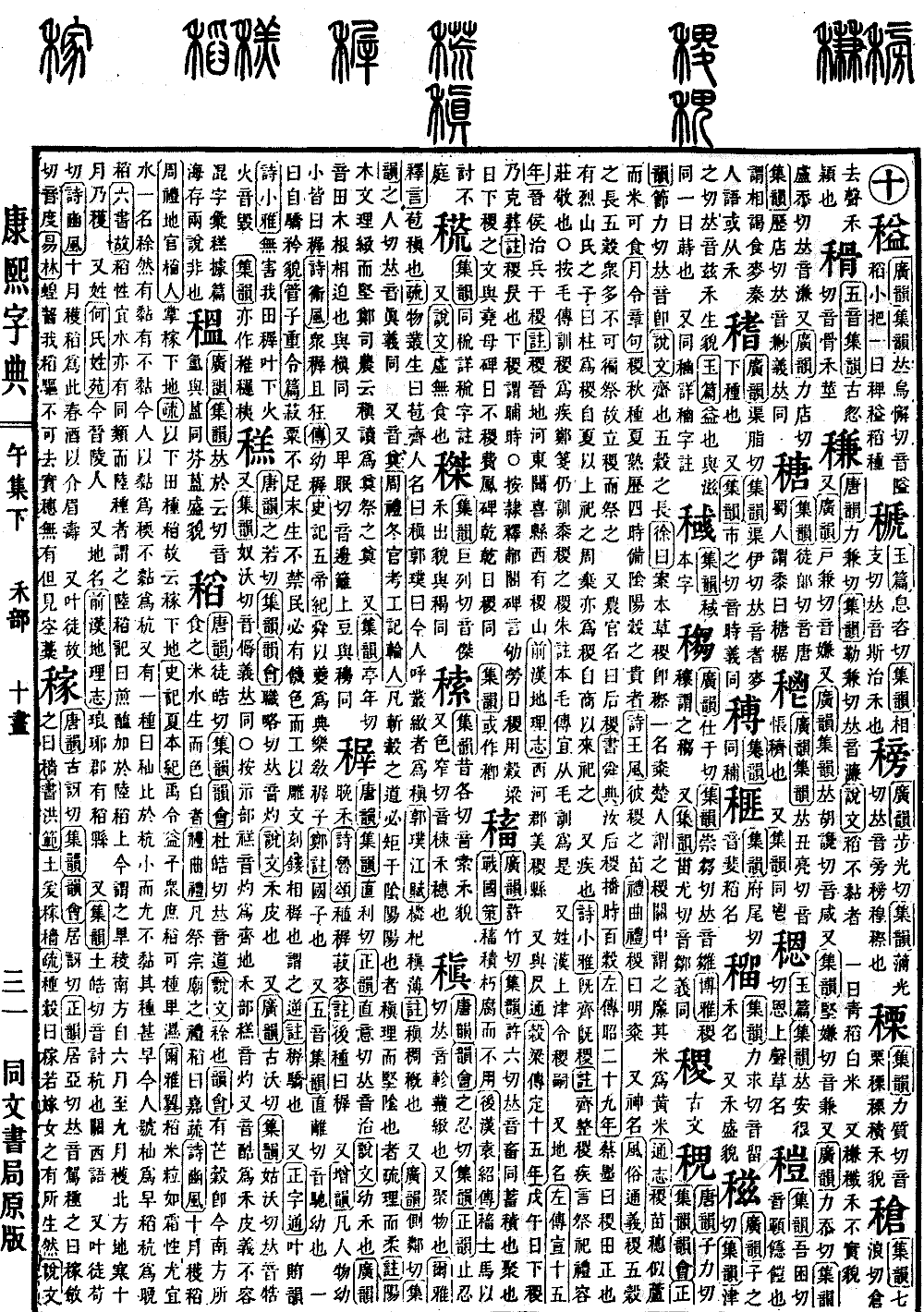
Wu Collection, Lower Volume
Radical: Grain (hé)
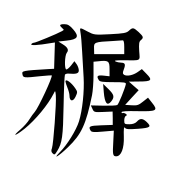
Zhi
Kangxi strokes: 15
Page 857, Entry 26
According to the Tang Rhymes (Tangyun) and the Collected Rhymes (Jiyun), it is pronounced zhi (falling tone). According to the Correct Rhymes (Zhengyun), it is pronounced zhi (falling tone).
According to the Explaining Graphs and Analyzing Characters (Shuowen), it refers to young grain. According to the Expanded Rhymes (Guangyun), it refers to late-ripening grain.
In the Book of Odes (Shijing), it is written that one should plant early and late-ripening legumes and wheat. The commentary states that those planted later are called zhi.
Furthermore, according to the Augmented Rhymes (Zengyun), all things that are young or small are called zhi. In the Book of Odes (Shijing), it is written that the multitude are young and impulsive. The commentary says this means youthful and immature.
In the Records of the Grand Historian (Shiji), it is written that the legendary Emperor Shun appointed Kui to be the Minister of Music to teach the young. The commentary by Zheng Xuan states that this refers to the sons of the nobility.
Also, according to the Five Sounds Collected Rhymes (Wuyin Jiyun), it is pronounced chi (rising tone). It also means young. Another interpretation is the appearance of being arrogant and conceited.
In the Guanzi, in the section on the importance of commands, it is written that if there are not enough legumes and grains, and the production of non-essential luxury goods is not prohibited, the people will inevitably appear hungry, and the artisans will compete in using intricate carvings and engravings to emulate one another, which is called rebellious. The commentary states that zhi means arrogant.
According to the Collected Characters (Zhengzitong), it may be read with the rhyme hui. In the Book of Odes (Shijing), it is written, do not harm my fields. Zhi, with the rhyme hui, is pronounced hui (rising tone).
According to the Collected Rhymes (Jiyun), it is also written in the variant form zhi (zhi).
Examination and verification: In the Book of Odes (Shijing), the passage regarding the multitude being young and impulsive has been corrected from the Weifeng section to the Yongfeng section, in accordance with the original text.