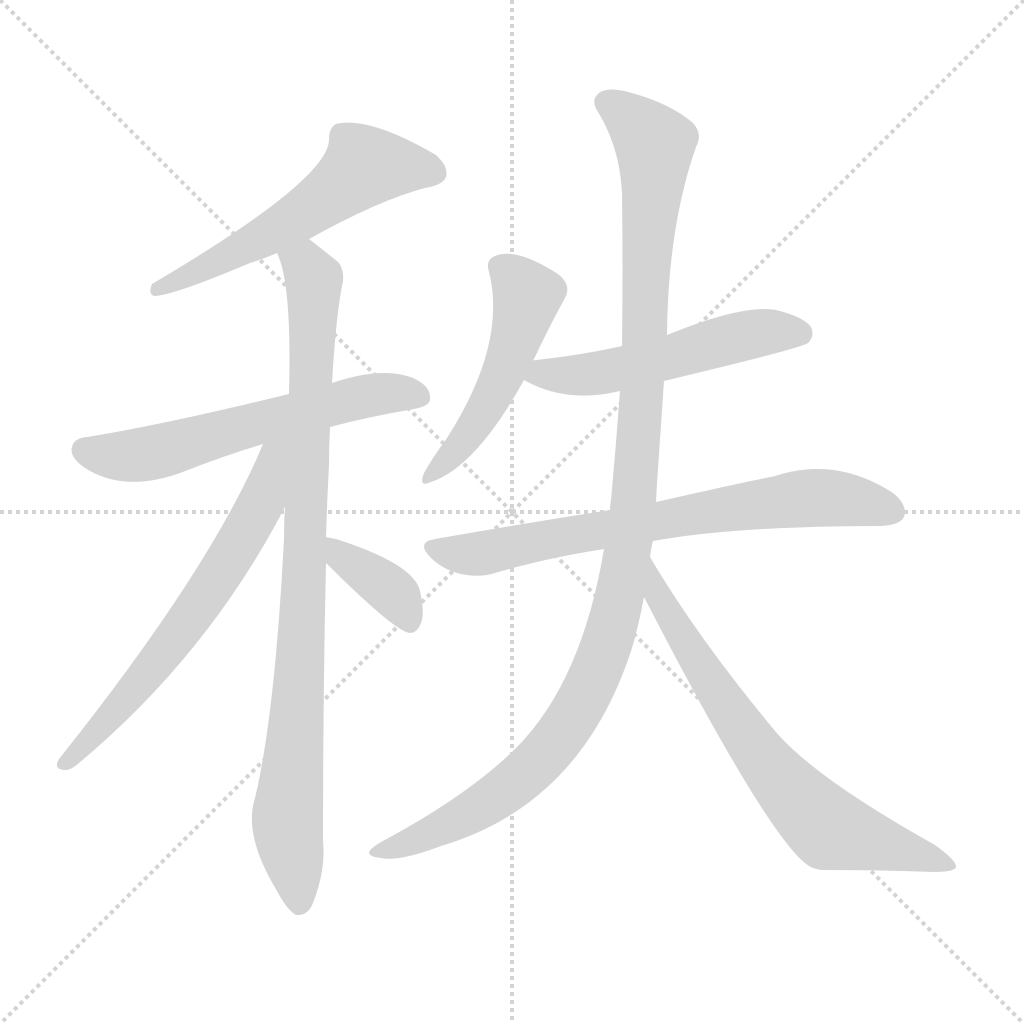
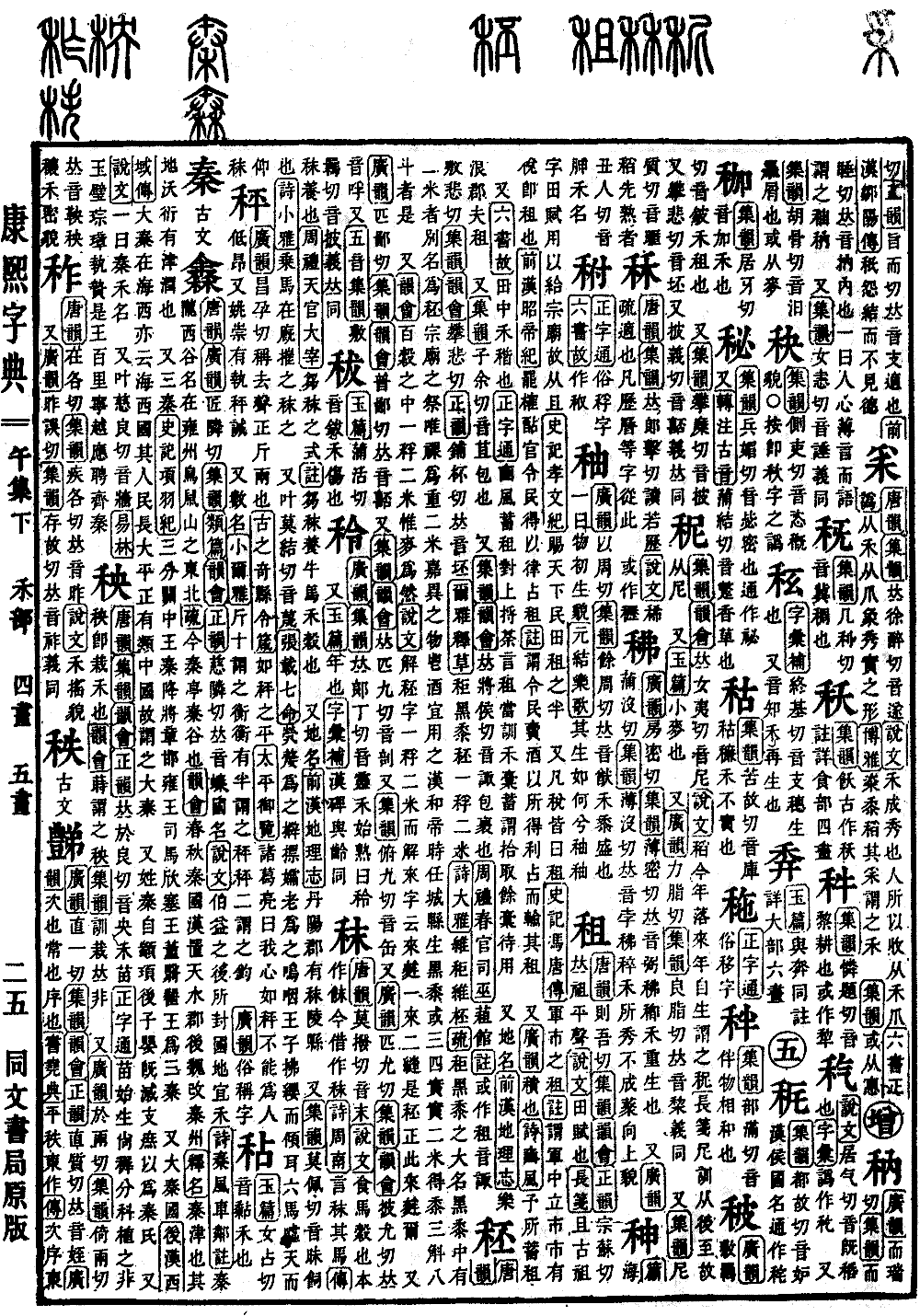
Wu Collection, Lower Volume
Radical: Grain (hé)
Kangxi Strokes: 10
Page 851, Entry 34
In archaic script written as the character for a sacrificial pig.
According to Broad Rimes (Guangyun), pronounced zhi.
According to Rhyme Collection (Jiyun), Collected Rhymes (Yunhui), and Correct Rhymes (Zhengyun), pronounced zhi, same reading as zhi.
According to Broad Rimes (Guangyun), defined as: order, routine, sequence.
Book of Documents (Shangshu), Canon of Yao: Arrange the spring agricultural work in order.
Commentary: Refers to arranging farming duties according to sequence.
Book of Documents (Shangshu), Canon of Shun: Perform the observation sacrifice to mountains and rivers according to rank.
Commentary: Refers to performing mountain and river sacrifices according to their order of precedence.
Also, according to Augmented Rimes (Zengyun), defined as: duty, official position, to arrange.
Book of Rites (Zhouli), Heaven Officials: Execute their duties and arrangements.
Commentary: Refers to salary and provisions.
Exegesis: Refers to receiving salary according to official rank.
Commentary of Zuo (Zuo Zhuan), Sixth Year of Duke Wen: Entrust it to the regular duties.
Commentary: Refers to standard official government duties.
Also, according to Literary Expositor (Erya), Explanation of Teachings, "zhi zhi" means wisdom.
Commentary: Refers to deep and far-reaching strategic thought.
Also, according to Literary Expositor (Erya), Explanation of Teachings, "zhi zhi" means clear and upright.
Commentary: Refers to a clear and noble moral reputation.
Book of Odes (Shijing), Greater Odes: His virtuous reputation is pure and noble.
Annotation: Refers to clear and bright government policies and laws.
Also, Book of Odes (Shijing), Lesser Odes: Flowing is this stream.
Commentary: Refers to the appearance of flowing water.
Annotation: Refers to water gushing out without end.
Also, Book of Odes (Shijing), Lesser Odes: Arranged are the rows.
Commentary: Refers to an orderly, serious, and respectful appearance.
Also, an official title.
Book of Documents (Shangshu), Canon of Shun: You shall serve as Minister of Order (Zhi Zong).
Exegesis: An official in charge of sacrifices in ancestral temples, arranging the order of spirits and deities.
History of the Later Han (Hou Hanshu), Treatise on Officialdom: In the villages, "you zhi" officials were appointed, along with village elders and patrolmen.
Commentary: "You zhi" was an official position set by the commandery. It carried a salary of one hundred shi of grain and was responsible for village affairs.
Common Customs (Fengsu Tong): Refers to a local village official, meaning the position was just enough to reach a salary grade.
Also, a surname.
Vocabulary (Zihui) records: Yi Zhi is a compound surname.
Also refers to a period of ten years as one zhi.
Rongzhai Essays (Rongzhai Suibi) records: Bai Juyi wrote in a poem: Already entered the seventh decade, eat my fill and sleep in peace.
He also wrote: Entering my seventh decade, how many are left to count on fingers. This was written on New Year's Day when he was sixty-two.
Also, according to Collected Rhymes (Yunhui), Mr. Mao says: The character is formed with grain as the semantic component and the character for lose as the phonetic component. The original meaning is rice that grows a second time, sprouting after the harvest, one after another in succession, thus it is borrowed to represent the concept of order.
Note: Analytical Dictionary of Characters (Shuowen Jiezi) defines this as accumulation, citing the Book of Odes (Shijing) phrase "zhi zhi." As the modern version of the Book of Odes (Shijing) does not contain this phrase, it is not adopted.
Also, according to Collected Rhymes (Jiyun), pronounced yi.
Literary Expositor (Erya), Explanation of Birds: "Zhi zhi" refers to the sea pheasant.
Commentary: Resembles a pheasant but is black in color, living on mountains in the sea, read as Shi Qian.
Also, used as a rhyme word, pronounced die.
Zhang Heng, Rhapsody on the Eastern Capital (Dongjing Fu): The primary strategies are set and hidden paths taken, combining two and nine to form deceptions. Ascending the holy emperor to the celestial steps, manifesting the order of the Han mandate.
Also, used as a rhyme word, pronounced zhi.
He Yan, Rhapsody on the Jingfu Hall (Jingfu Dian Fu): The barracks and offices are lined up, thirty-two in total. Situated like stars in constellations, intricate like fish scales. Xin, Ren, Gui, Jia are used to designate their rank.
Commentary: "Two" is pronounced as "er," "scales" is pronounced as "pi," and "zhi" is pronounced as "zhi."
Verification: In Literary Expositor (Erya), Explanation of Teachings, "zhi zhi" means clear. The commentary says virtuous reputation is cool and clear. Carefully following the original text, "cold" is changed to "clear and cooling."