Wu Collection, Upper Volume
Radical: Jade (yù)
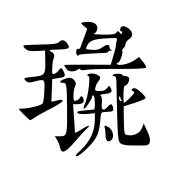
Zhi
Kangxi stroke count: 17
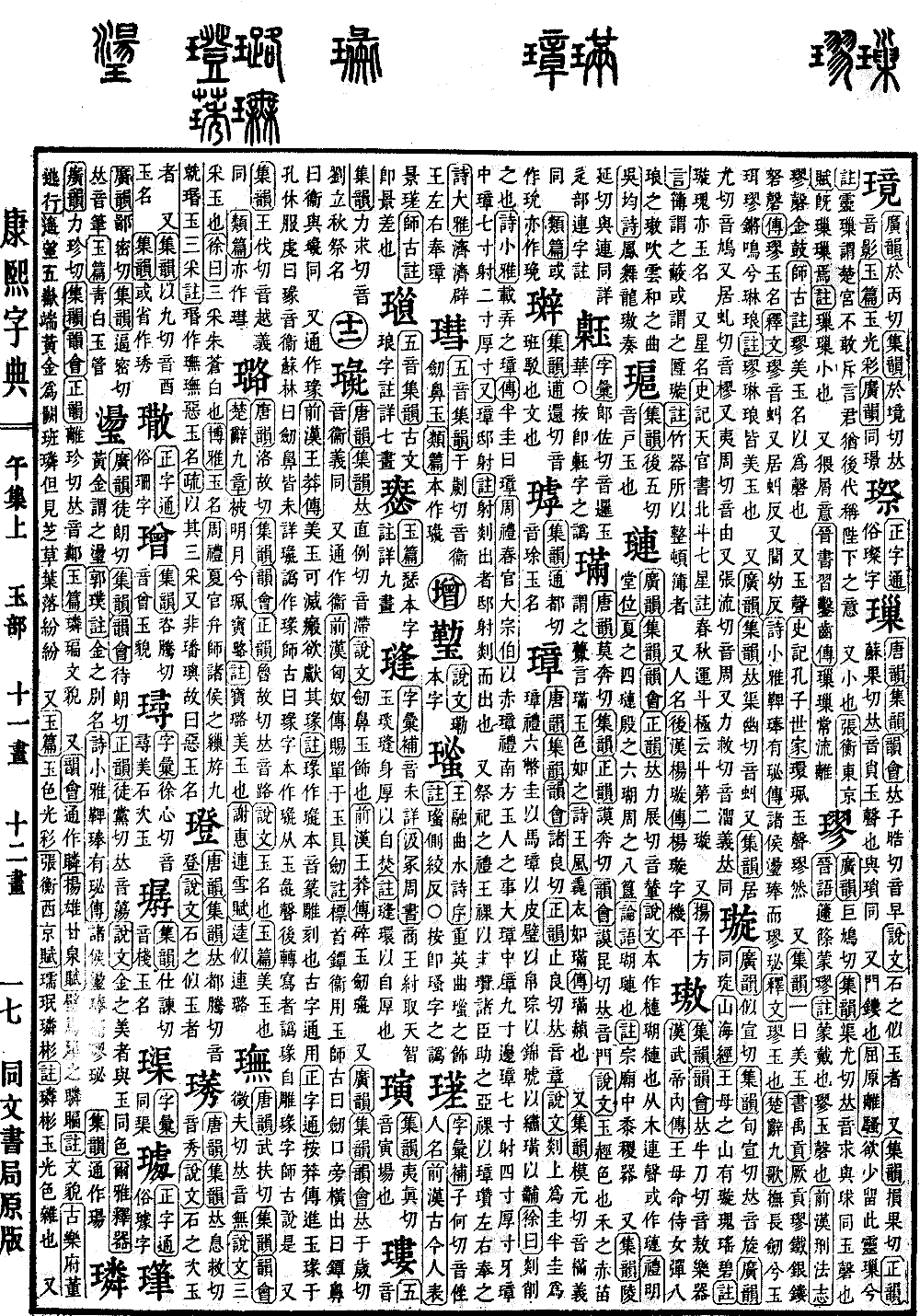
Page 741, Entry 23
Tang Rhymes (Tangyun) and Collected Rhymes (Jiyun) state: Pronounced zhi (falling tone), same as the sound of the character for stagnant.
Shuowen Jiezi explains: This is a jade ornament on a sword scabbard used for threading a belt.
History of the Former Han (Qian Hanshu), Biography of Wang Mang records: Smashed the jade sword ornament.
Also, Guangyun, Collected Rhymes (Jiyun), and Rhyme Compilation (Yunhui) state: Pronounced wei (falling tone), same sound. The meaning is the same.
Also used as a phonetic loan for the character for defense (wei). History of the Former Han (Qian Hanshu), Biography of the Xiongnu, notes on the jade-adorned sword gifted to the Chanyu record: The pommel, the guard, and the sword ornament are all decorated with jade. Shigut states: The protruding part on both sides where the sword blade connects to the hilt is called the guard (tan), and the nose-shaped attachment used for threading a belt is called a defense (wei), which is the same as this character.
Also used as a phonetic loan for the character for engraving (zhuan). History of the Former Han (Qian Hanshu), Biography of Wang Mang records: Fine jade can remove scars; he wished to present his engraving (zhuan). Note: This engraving is the same as the sword ornament. The original pronunciation is zhuan (falling tone), which means to carve. Ancient characters could be used interchangeably.
Correction of Characters (Zhengzitong) notes: In the Biography of Wang Mang, an engraved jade was presented to Kong Xiu. Fu Qian states: Pronounced wei (falling tone). Su Lin states: It is a sword nose. Neither is sufficiently detailed. This character was erroneously written as the character for engraving. Shigut states: The character for engraving was originally written as this character, composed of the radical for jade and the phonetic component for pig. Later copyists made a mistake; the character for engraving originally meant to carve. Shigut's explanation is correct.
Also, Collected Rhymes (Jiyun) states: Pronounced yue (falling tone), same sound. The meaning is the same.
Categorized Compendium (Leipian) also records it in a variant form.