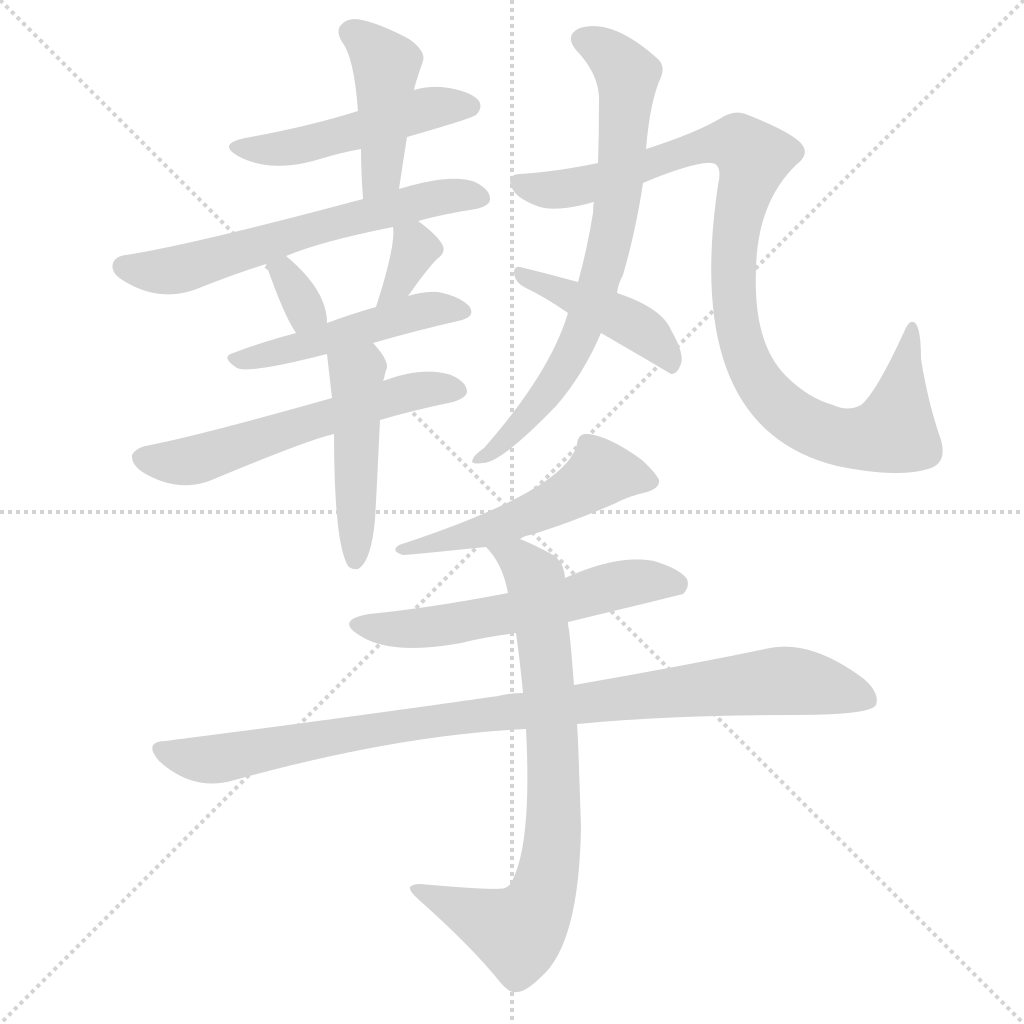
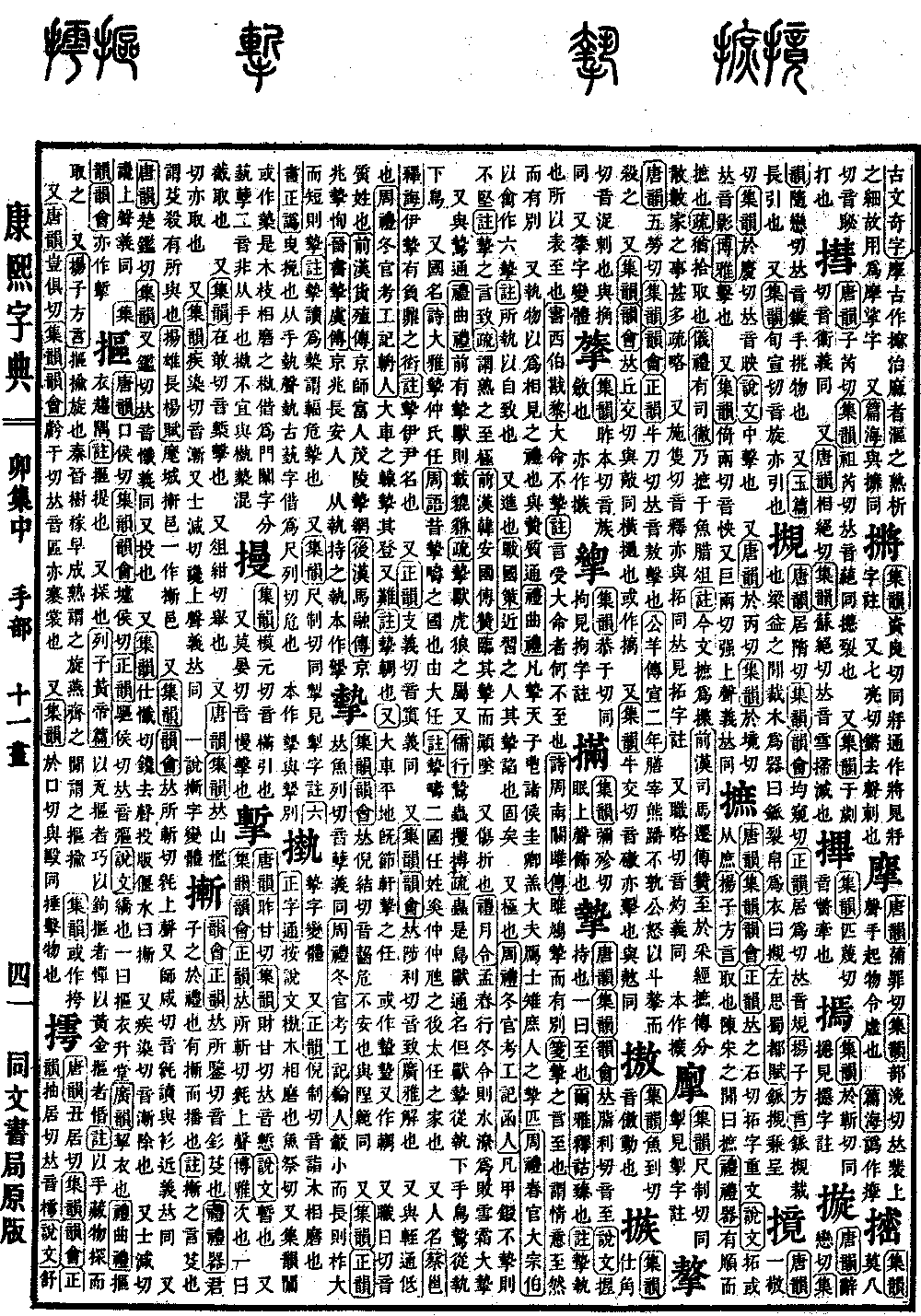
Mao Collection, Middle Volume
Radical: Hand (shǒu)
Kangxi stroke count: 15
Page 451, Entry 18
Pronounced zhì. According to the Shuowen Jiezi (Explaining Graphs and Analyzing Characters), it means to grasp or hold. Another meaning is to arrive.
According to the Erya (Approaching Elegance), it means to reach. The commentary states that to arrive is to hold, which expresses the act of reaching a destination.
In the Book of Documents (Shujing), the chapter regarding the conquest of Li by the Western Count states, "The great mandate does not arrive." The commentary asks why those who receive the great mandate do not arrive.
In the Book of Odes (Shijing), the commentary on the Guanju poem states that the osprey are attentive and maintain propriety. The notes explain that the term implies arrival, suggesting that emotional intentions are sincere and yet maintain clear distinctions.
It also refers to the act of holding an object as a gesture of courtesy when meeting someone. This is interchangeable with the terms for a gift or a pledged offering.
In the Book of Rites (Liji), it is stated that for all formal gifts, the Son of Heaven uses aromatic wine, feudal lords use jade tablets, ministers use lambs, grand masters use wild geese, scholars use pheasants, and commoners use pieces of cloth.
In the Rites of Zhou (Zhouli), the office of the Grand Minister of State uses birds and animals to form the six categories of formal gifts. The commentary explains that these are things held to express one's own sincerity.
It also means to advance. In the Strategies of the Warring States (Zhan Guo Ce), it is noted that those close to the ruler are naturally fawning in their approaches.
It also means to reach the extreme. In the Rites of Zhou, the chapter on the armorer states that if armor is not forged to the extreme, it will not be sturdy. The commentary explains that this sense of reaching is synonymous with perfection. The sub-commentary states this refers to the tempering being pushed to its ultimate limit.
In the history of the Former Han (Hanshu), it is mentioned that when one reaches the extreme, one may fall.
It also means to injure or break. In the Book of Rites, the chapter on the Monthly Ordinances states that if winter policies are implemented in the first month of spring, there will be floods and devastating frost and snow.
It is also interchangeable with the character meaning a bird of prey. In the Book of Rites, it is noted that if one encounters a predatory beast, one should carry the image of a mythical tiger. The sub-commentary states that predatory beasts include tigers and wolves. Furthermore, in the Confucian Conduct chapter, it mentions predatory insects that seize and strike. The sub-commentary notes that the term for insects refers to both birds and beasts, but for beasts, the character is written with the hand radical, while for birds, it is written with the bird radical.
It is also the name of a state. In the Book of Odes, there is a reference to the lady of the Zhi clan. In the Discourses of the States (Guoyu), it mentions the ancient states of Zhi and Chou, both of the Ren surname, descendants of Xizhong and Zhonghui, the family of Tai Ren.
It is also a personal name. In the writings of Cai Yong, it is mentioned that Yi Zhi displayed himself carrying a tripod. The commentary notes that Zhi was the name of Yi Yin.
Pronounced zhì. Same meanings as above.
Pronounced zhì. According to the Guangya (Broad Elegance), it means to untie or release.
It is also interchangeable with a character meaning to lower the front of a carriage. In the Rites of Zhou, the chapter on the carriage maker states that the shafts of a heavy cart are lowered, making it difficult to ascend. The commentary explains this as the dipping or lowering of the carriage pole. It also discusses the balance of the carriage when on level ground. It is sometimes written in variant forms.
Pronounced zhì. A surname. In the history of the Former Han, the biography of merchants mentions Zhi Gang of Maoling. In the history of the Later Han, there is a mention of Zhi Xun of Jingzhao. In the Book of Jin (Jinshu), the biography of Zhi Yu mentions that he was from Chang'an, Jingzhao. Originally written with the hand radical, it is derived from the character meaning to hold.