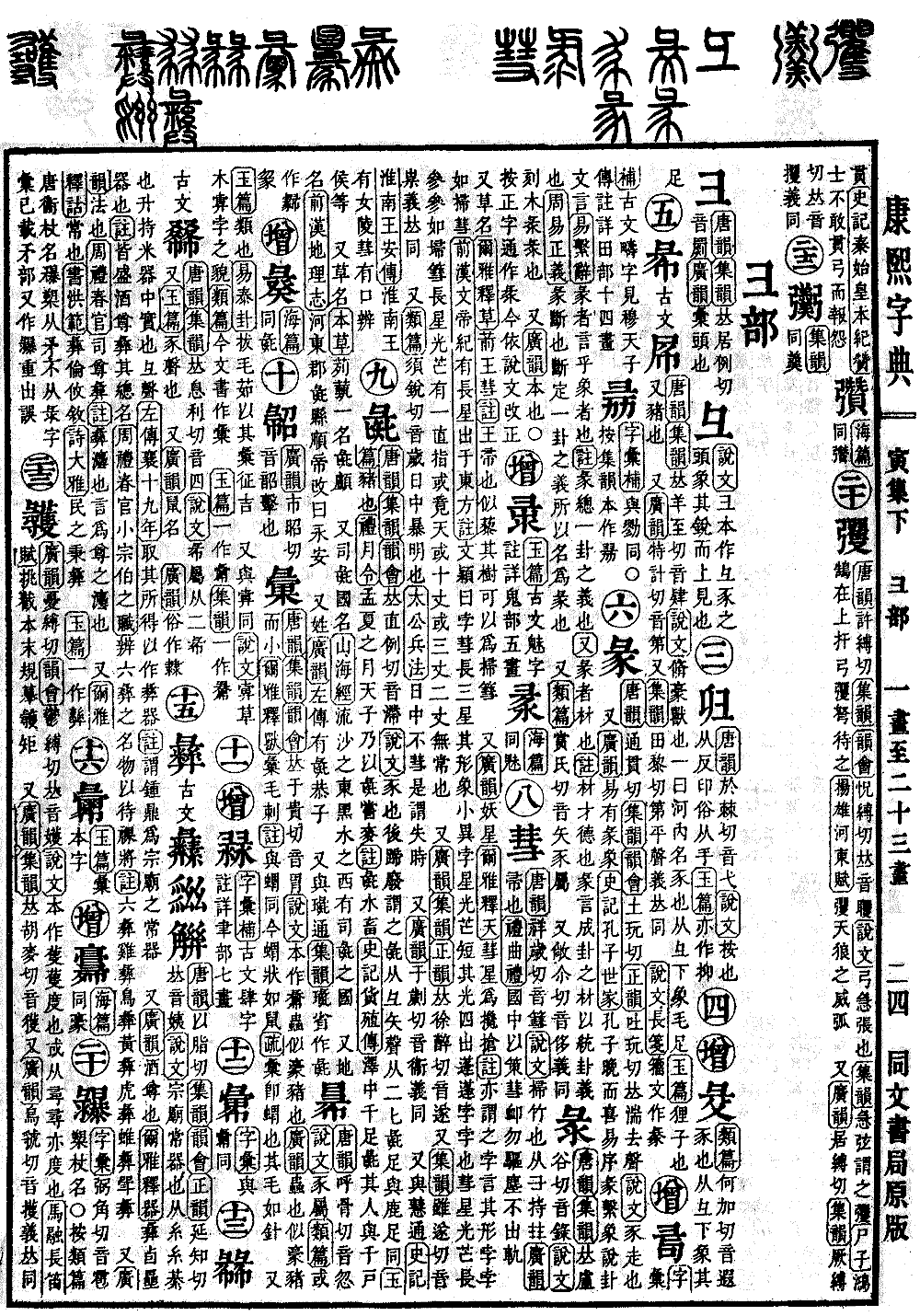
Yin Collection, Lower Volume
Radical: Snout (jì)
Page 362, Entry 12
Pronounced zhi (falling tone).
Shuowen Jiezi (Explaining Graphs and Analyzing Characters) defines it as a pig. Hind hooves that are crippled and cannot move are referred to as zhi. The character shape uses the snout as a semantic indicator and the arrow as a phonetic indicator. It contains two spoon-shaped symbols; the hoof shape of a zhi is similar to that of a deer.
Yupian (Jade Chapters) defines it as a pig.
Book of Rites (Liji), Monthly Ordinances: In the fourth month of early summer, the Son of Heaven uses zhi to taste the new wheat.
Note: The zhi is a domestic animal that lives near the water.
Records of the Grand Historian (Shiji), Biographies of Money Makers: Raising one thousand pigs in the marshes, one's wealth can be equivalent to that of a lord with a thousand households.
Also refers to a type of plant.
Compendium of Materia Medica (Bencao Gangmu) records: Liezhen, also known as zhilu.
Also refers to a country name, Sizhi.
Classic of Mountains and Seas (Shanhaijing) records: To the east of the shifting sands and to the west of the black water, there is the country of Sizhi.
Also refers to a place name.
History of the Former Han (Qian Hanshu), Treatise on Geography: Hedong Commandery had Zhi County, which was renamed Yong'an during the reign of Emperor Shun of Han.
Also serves as a surname.
Guangyun (Broad Rhymes) records: In the Zuo Tradition (Zuo Zhuan), there is a figure named Zhi Gongzi.
Also used as a variant form for the character zhi.
Jiyun (Collection of Rhymes) records: The character zhi can be written in abbreviated form as zhi.