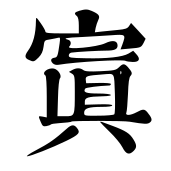
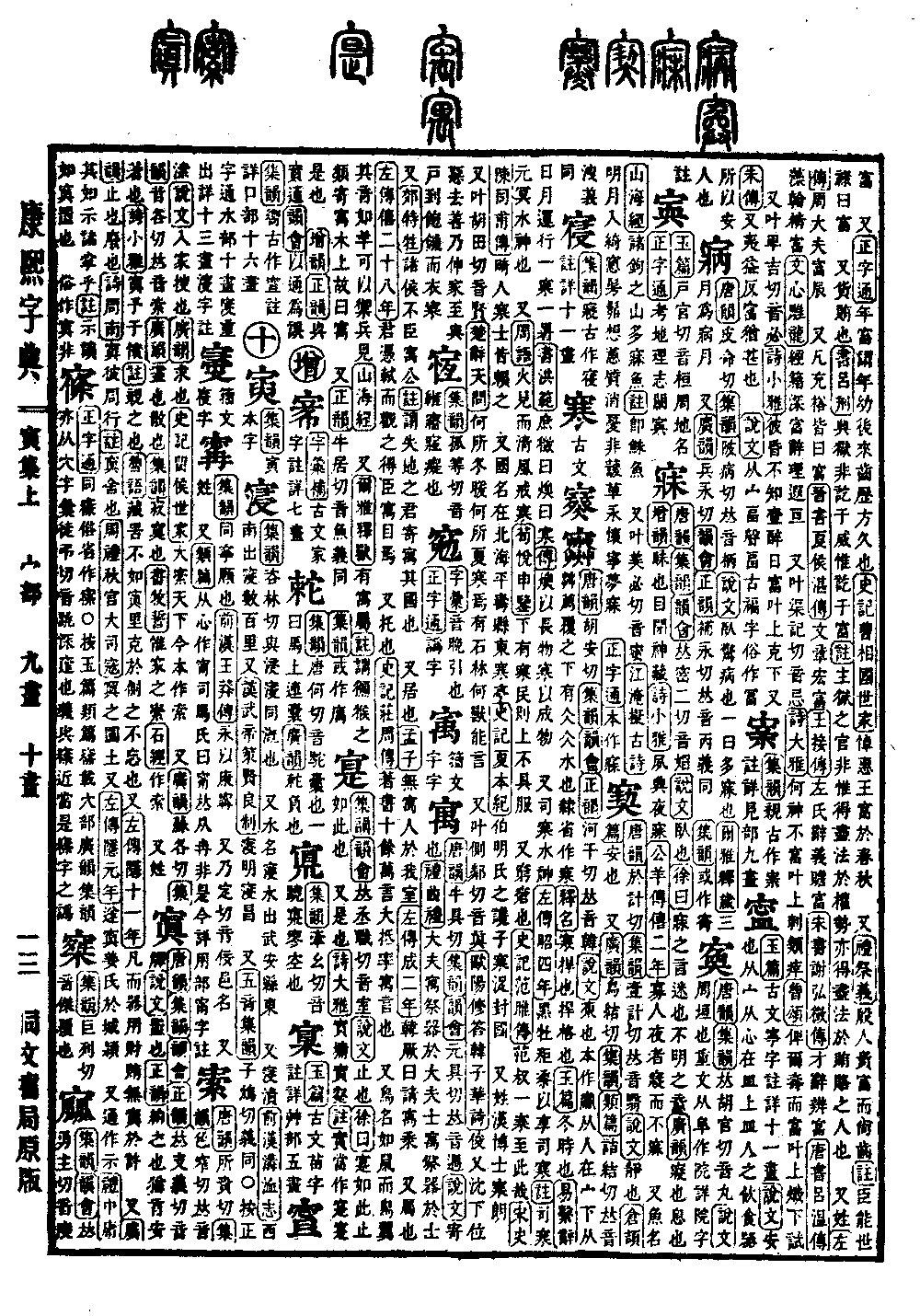
Yin Collection, Upper Volume
Radical: Roof (bù)
Zi
Kangxi stroke count: 13
Page 289, Entry 27
Tang Rhyme (Tangyun), Collected Rhymes (Jiyun), Dictionary of Rhymes (Yunhui), and Correct Rhymes (Zhengyun) state the pronunciation is zhi.
According to Explaining Graphs and Analyzing Characters (Shuowen), it means to place.
According to Correct Rhymes (Zhengyun), it means to insert, similar to the meaning of settling or putting down.
Book of Odes (Shijing), Lesser Odes of the Kingdom: Place the child in my bosom. Commentary states: This means to treat with affection.
Discourses of the States (Luyu): Storing fishnets is not as good as keeping Lǐ Kè by one's side so as not to forget him.
Also, Zuo Tradition (Zuozhuan), Eleventh Year of Duke Yin: Do not place all your implements and wealth in Xu.
Also, Broad Rhymes (Guangyun) states: It means to stop or to abandon.
Book of Odes (Shijing), Zhou Nan: Abandoned their ranks. Commentary states: Zhi means to discard.
Rites of Zhou (Zhouli), Autumn Official, Minister of Justice: Place them in the round prison.
Also, Zuo Tradition (Zuozhuan), First Year of Duke Yin: Then placed Lady Jiang in Chengying.
It is also used interchangeably with shi.
Book of Rites (Liji), Doctrine of the Mean: Is it not like looking at one's own palm? Commentary states: Shi is read like zhi, meaning to place. The common form is written as zhi, which is incorrect.
Textual Research: Zuo Tradition (Zuozhuan), First Year of Duke Yin: Then placed Lady Jiang in Chengying. Per the original text, Ying has been corrected to Ying.