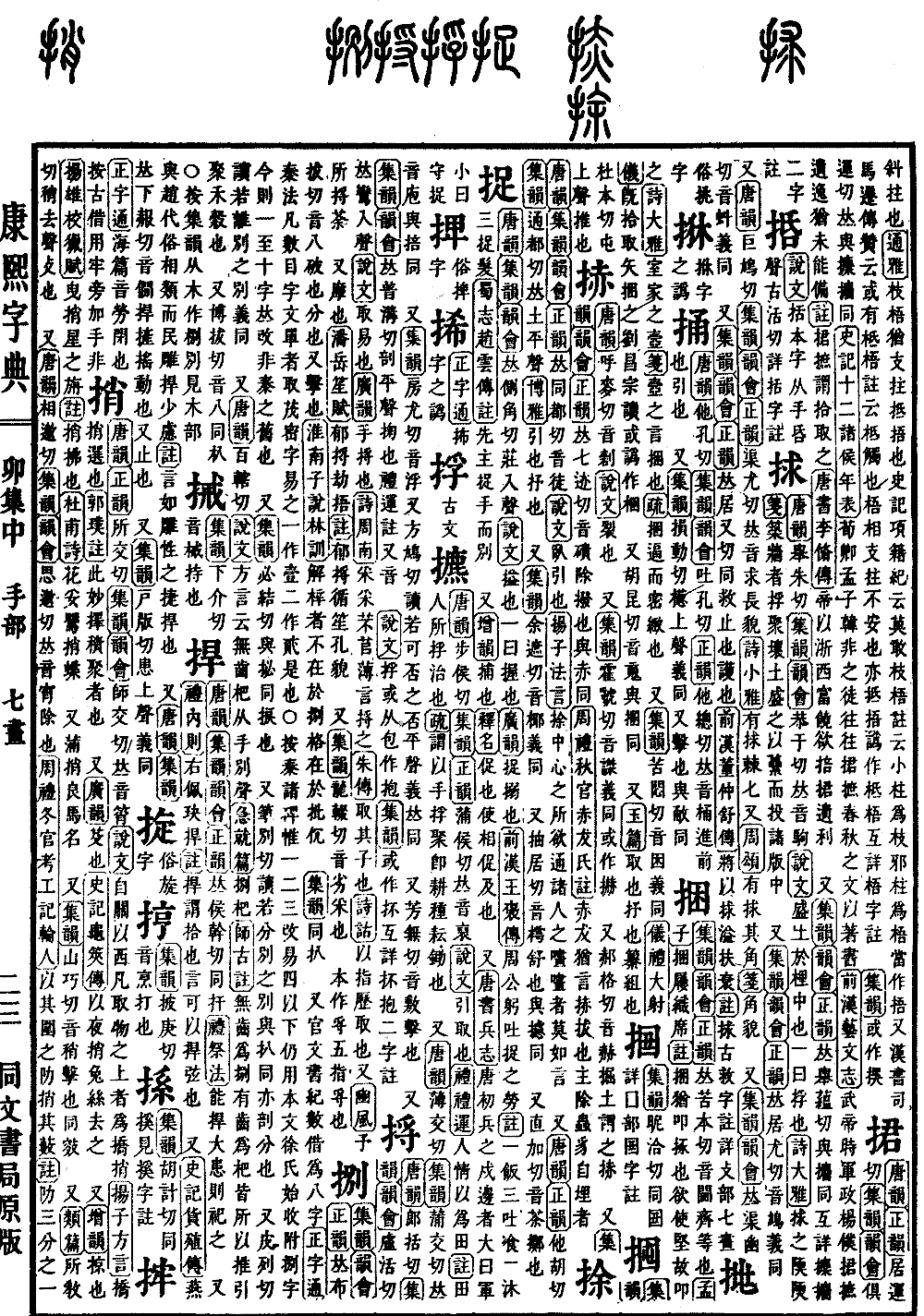
Mao Collection, Middle Volume
Radical: Hand (shǒu)
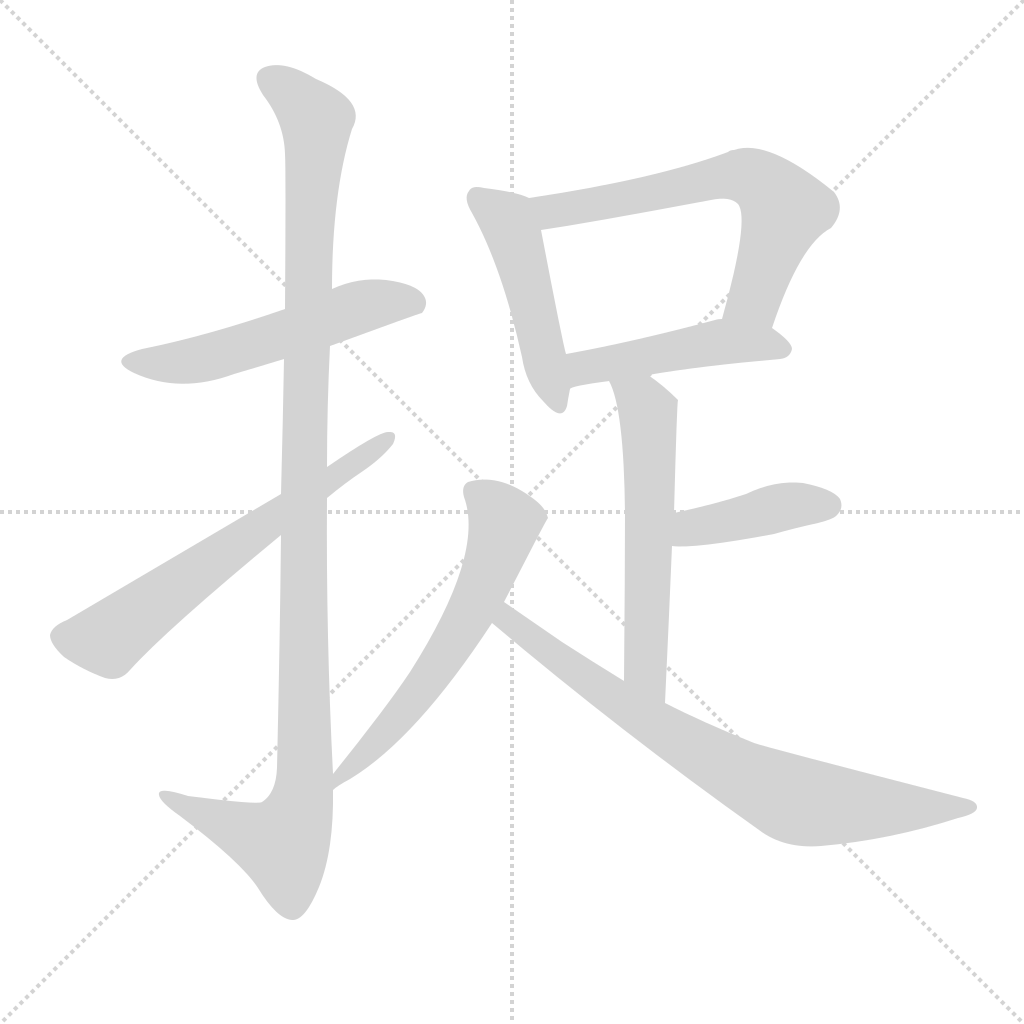
捉
Kangxi stroke count: 11
Page 433, Entry 12
Tang Rhymes (Tangyun), Collected Rhymes (Jiyun), and Rhyme Directory (Yunhui) define this as pronounced zhuo (entering tone).
Shuowen Jiezi (Shuowen) defines this as to grip or restrain. Another source defines it as to grasp.
Guangyun (Guangyun) defines this as to arrest, capture, or grasp.
In the Biography of Wang Bao from the History of the Former Han (Qianhan Shu): The Duke of Zhou exerted himself personally; when receiving worthy scholars, he would spit out his food multiple times and grasp his wet hair.
Note: To spit out food multiple times while eating one meal, and to grasp one's wet hair multiple times while washing one's hair, in order to attend to affairs immediately.
In the Annotation to the Biography of Zhao Yun in the Records of Shu (Shuzhi): The First Ruler grasped his hand to bid farewell.
Additionally, Zengyun (Zengyun) defines this as to capture or hunt.
Shiming (Shiming) defines this as to urge. It means to cause one another to urge and approach.
Additionally, in the Treatise on Military Affairs from the Old Book of Tang (Tangshu): During the early Tang Dynasty, troops guarding the borders were organized such that larger units were called armies and smaller units were called shouzhuo (garrison posts).