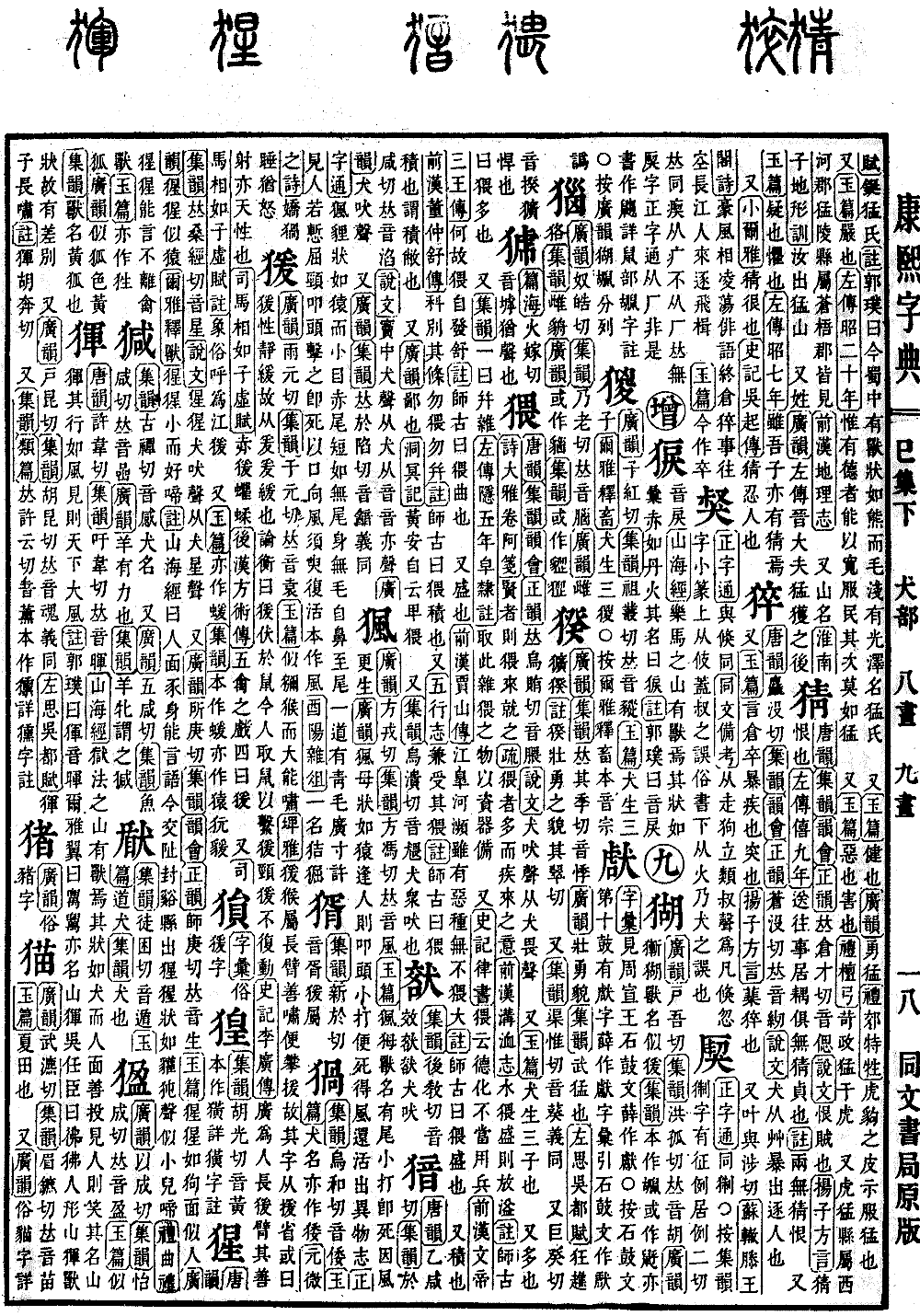
You Collection, Middle Volume
Radical: Swine (shǐ)
Page 714, Entry 01
Pronounced zhu (level tone).
Pronounced zhu (level tone), phonetically identical to the level tone of the character zhu.
Shuowen Jiezi (Explanation of Graphs and Analysis of Characters): Refers to a pig with long hair, growing in clumps of three.
Erya (Approaching Elegance), Interpretation of Beasts: A small pig is called zhu.
Commentary: Currently also called zhi. In the Jiangdong region, it is called xi. These are all commonly used names.
Yangzi Fangyan (Regional Dialects): In the Wu and Yangzhou regions, it is called zhuzi.
Piya (Amplified Expositions on Elegant Usage): The nature of the pig is rough and straightforward.
Yangzi Taixuanjing (Canon of Supreme Mystery): Walking into the wild, one sees a vast open space where a tiger is grazing pigs.
There is also the mountain pig, which is the porcupine. Detailed explanation is found in the preceding commentary for the character hao.
Additionally, there is the lazy-woman pig in Lingnan.
Guihai Yuhengzhi (Notes from the Bureau of Weights and Measures in Guilin): The lazy-woman pig resembles a mountain pig but is smaller in size, and it likes to eat rice seedlings. When farmers hang weaving looms and other textile tools near the fields, it will no longer approach.
There is also the cat-pig.
Yang Shen, Danqianlu (Records of Cinnabar and Lead): The hairy rhinoceros is the tuan. It can predict good or bad fortune. Ancient people called it the cat-pig. People in the Jiaozhou and Guangzhou regions call it the pig-spirit.
There is also the stone pig.
Shuzhi (Records of Shu): In Qingling County, there are stone pigs, with mothers and young numbering in the thousands. Legend says that the Yi people formerly grazed pigs here, and one day, the pigs all turned into stone.
It is also a government title.
Weizhi (Records of Wei), Biographies of the Eastern Barbarians: The Fuyu kingdom used the names of the six domestic animals to designate government titles, one of which is the pig-jia.
It is also a type of grass.
Boya (Broad Refinement): The fuzhu is the muhe (a type of grain).
It is also the name of a medicinal substance.
Bencao Gangmu (Compendium of Materia Medica): Tao Hongjing stated: Regarding zhuling, its tuberous form is black like pig excrement, hence the name. Detailed cross-references can be found in the preceding commentaries for the characters shi and xi.
It is also the name of a mountain and a river.
Shanhaijing (Classic of Mountains and Seas): There is Quzhu Mountain; the Quzhu River originates here and flows south into the Yellow River.
It is also the name of a water pool.
Beimeng Suoyan (Trifling Talks of Northern Dreams): In Qiongzhou, there is a water pool where a sow appears and disappears, called the Zhulongqiu (Pig Dragon Pool).
It is also the name of a prefecture.
Tangshu (Book of Tang), Treatises on Geography: Zhuba Prefecture, affiliated with the Longyou Circuit.
Additionally, Guangyun (Broad Rhymes) lists Zhukou as a place name. It is also written in a variant form.
Jinshu (Book of Jin), Biography of Gan Zhuo: The army was stationed at Zhukou.
Also, in the Min Gong Cheng Zhuan, it is written with the mouth radical.
According to Yunhui (Collection of Rhymes), it is often used as a variant of zhu, referring to a place where water collects.
Shangshu (Book of History), Yu Gong (Tribute of Yu): Daye has already become a zhu (a place where water collects).
Kong Zhuan (Kong's Commentary): Daye is the name of a marsh. A place where water collects is called a zhu.
Cai Zhuan (Cai's Commentary): Areas where water accumulates and then flows out are called zhu.
Zuozhuan (Chronicle of Zuo), 25th Year of Duke Xiang: Plan for the low-lying areas to collect water.
Commentary: Refers to low and damp places.
There is also Mengzhu, the name of a marsh. It is commonly used as a variant of zhu.
Shangshu (Book of History), Yu Gong (Tribute of Yu): Arrived at Mengzhu.
Cai Zhuan (Cai's Commentary): According to the Treatises on Geography, it is located northeast of Suiyang in the Liang state, which is the present-day Mengzhu Marsh, northwest of Yucheng County in Nanjing.
In the Zuozhuan (Chronicle of Zuo), 28th Year of Duke Xiang, as well as in the Erya (Approaching Elegance), Interpretation of Lands, it is written as Mengzhu.
Also, according to Zihuibu (Supplement to the Collection of Characters), it is pronounced zhe (level tone).
Zuozhuan (Chronicle of Zuo), 14th Year of Duke Ding: The wild folk of the Song state sang: Since you have already settled your sow, why not return our boar? Gan Bao read it this way.
Guangyun (Broad Rhymes) notes that the common form of this character is written as zhu.