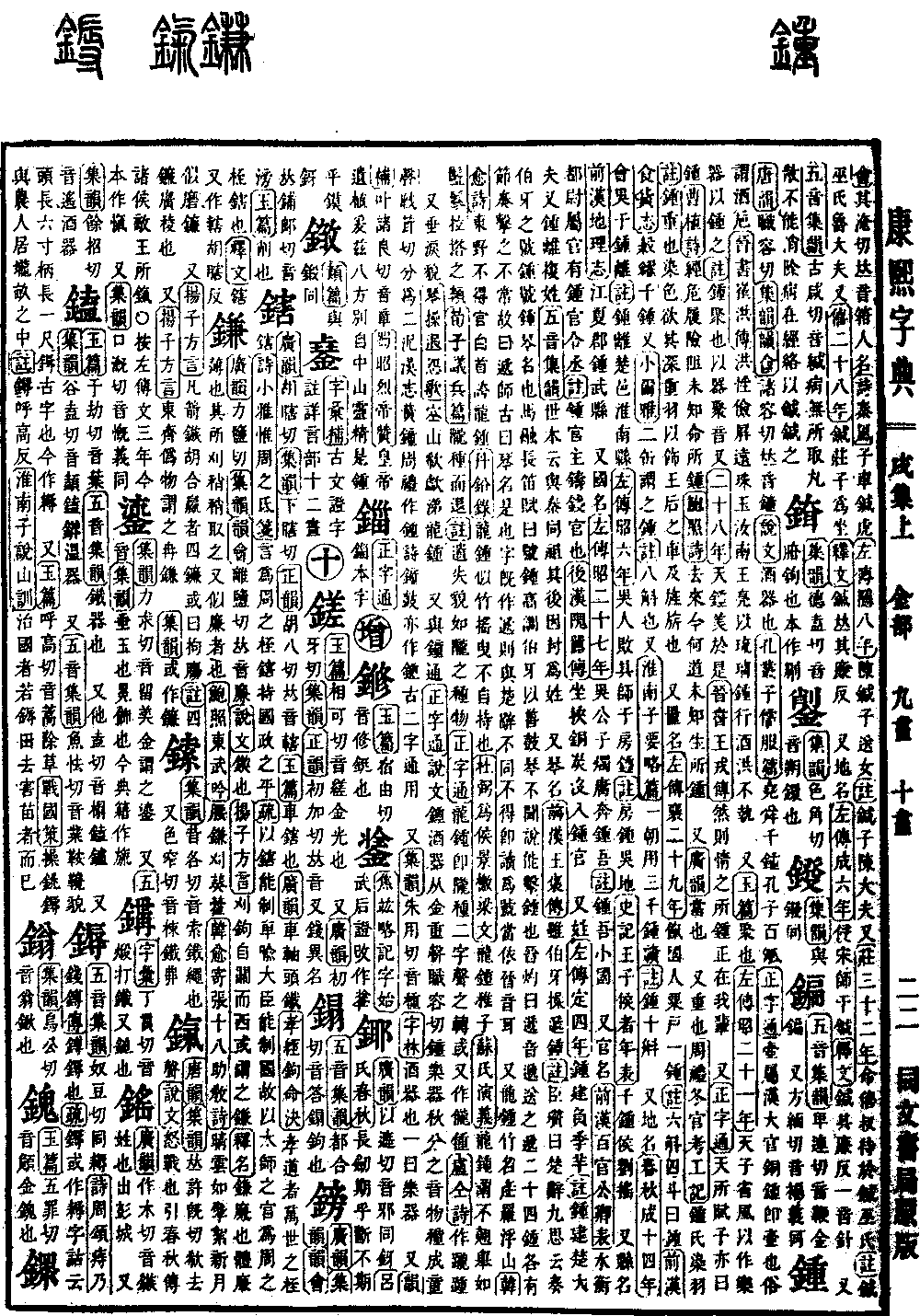
Xu Collection, Upper Volume
Radical: Metal (jīn)
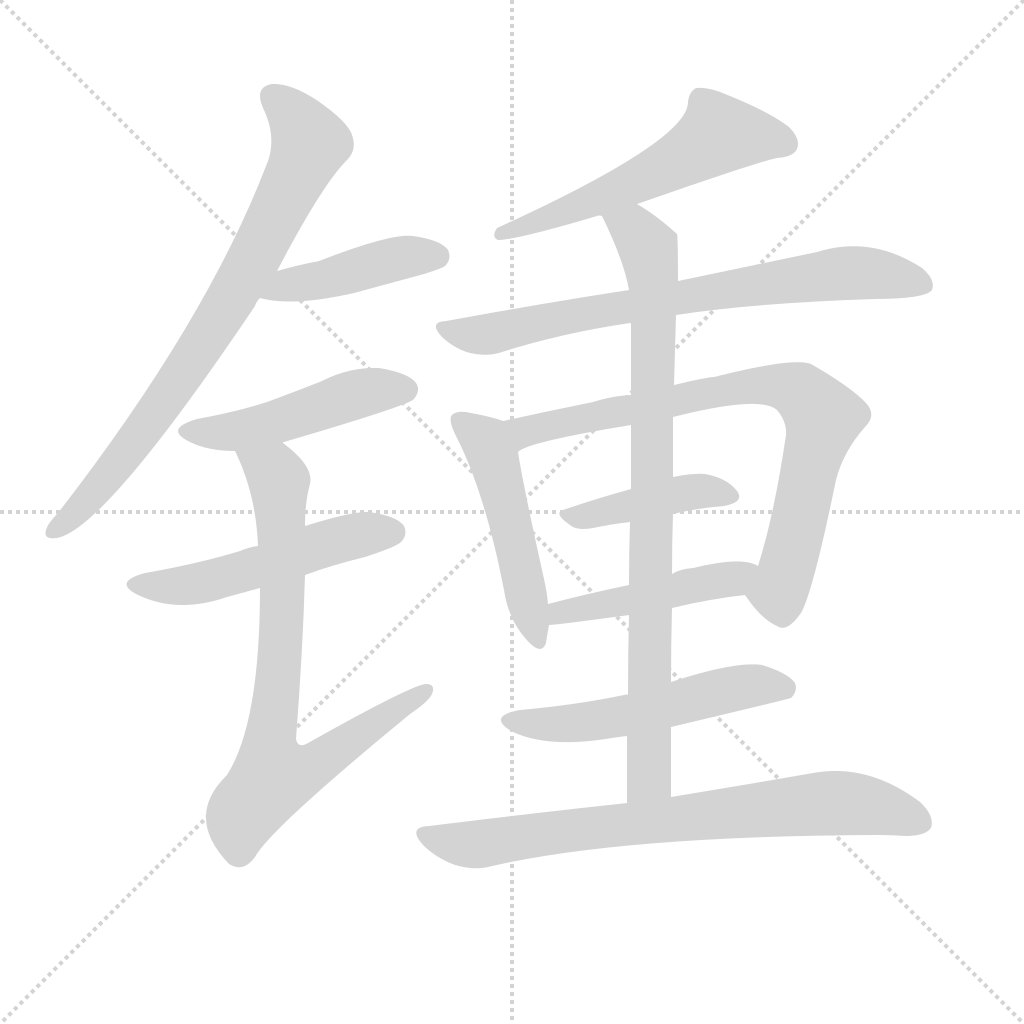
Zhong (鍾)
Kangxi stroke count: 17
Page 1316, Entry 01
Pronounced zhong
According to the Explaining and Analyzing Characters (Shuowen Jiezi), it is a vessel for wine.
From the Book of the Kong Family (Kongcongzi), section on Confucian attire: For the rulers Yao and Shun, it was one thousand zhong; for Confucius, it was one hundred gu.
In the Correct Interpretation of Characters (Zhengzitong), it is categorized as a type of jar. During the Han dynasty, the copper vessel used by high officials was this type of jar. Colloquially, it refers to a wine goblet.
In the Book of Jin (Jinshu), biography of Cui Hong: Hong was naturally frugal and shunned pearls and jade. When the Prince of Runan, Liang, used a glass vessel to serve wine, Hong refused to hold it.
Also, meaning to gather or accumulate.
From the Zuo Tradition (Zuo Zhuan), twenty-first year of Duke Zhao: The Son of Heaven examined the customs to create music, using instruments to gather (zhong) the sounds. Annotation: Zhong means to gather. Using instruments to gather the sounds.
Also, twenty-eighth year: Heaven gathered (zhong) beauty here.
From the Book of Jin (Jinshu), biography of Wang Rong: Thus, where feelings are gathered (zhong), that is precisely among our generation.
Also, what is bestowed by Heaven is also called zhong.
Poem by Cao Zhi: Passing through danger and stepping over obstacles, not knowing where fate is gathered (zhong).
Poem by Bao Zhao: Coming and going, what is the way now, not knowing where life is gathered (zhong).
Also, pronounced zhong (meaning to correspond to or meet).
Also, meaning heavy.
From the Rites of Zhou (Zhou Li), Winter Offices, Records of Tradesmen: The Zhong family dyes feathers. Annotation: Zhong means heavy. Dyeing requires deep and heavy colors; feathers are used to decorate the empress's carriage and flags.
Also, a unit of measurement.
From the Zuo Tradition (Zuo Zhuan), twenty-ninth year of Duke Xiang: Distributing grain to the people of the state, one zhong per household. Annotation: Six hu and four dou make a zhong.
From the History of the Former Han (Qian Han Shu), Treatise on Food and Money: Buying one thousand zhong of grain.
Also, from the Small Erya: Two fou equals one zhong. Annotation: Eight hu.
Also, from the Huainanzi, Essentials and Summaries: Using three thousand zhong of grain in one morning. Annotation: One zhong is ten hu.
Also, a place name.
From the Spring and Autumn Annals (Chunqiu), fourteenth year of Duke Cheng: Meeting Wu at Zhongli. Annotation: Zhongli was a Chu state town in Huainan County.
From the Zuo Tradition (Zuo Zhuan), sixth year of Duke Zhao: The Wu people defeated their army at Fangzhong. Annotation: Fangzhong was a Wu location.
From the Records of the Grand Historian (Shiji), Table of the Princes and Marquises: Marquis of Qianzhong, Liu Yao.
Also, a county name.
From the History of the Former Han (Qian Han Shu), Treatise on Geography: Zhongwu County in Jiangxia Commandery.
Also, a state name.
From the Zuo Tradition (Zuo Zhuan), twenty-seventh year of Duke Zhao: The Prince of Wu, Zhuyong, fled to Zhongwu. Annotation: Zhongwu was a small state.
Also, an official title.
From the History of the Former Han (Qian Han Shu), Tables of Officials and Ministers: Among the subordinate officials of the Superintendent of Waterways, there was the Zhongguan Prefect and his assistant. Annotation: Zhongguan was the official in charge of minting currency.
From the History of the Later Han (Hou Han Shu), Biography of Wei Xiao: Implicated for harboring copper and charcoal, he was consigned to the Zhongguan office.
Also, a surname.
From the Zuo Tradition (Zuo Zhuan), fourth year of Duke Ding: Zhong Jian carried Ji Qi. Annotation: Zhong Jian was a high official of Chu.
Also, Zhongli, a double-character surname.
From the Five Sounds Collection (Wuyin Jiyun): According to the Genealogical Records (Shiben), they share the same ancestor as the Qin, and later took their fief as a surname.
Also, a zither name.
From the History of the Former Han (Qian Han Shu), Biography of Wang Bao: Although Boya played the Di-zhong. Annotation: Chen Zan says: The Nine Sighs of the Songs of Chu (Chucix) says: Play the Hao-zhong of Boya. Hao-zhong is the name of a zither. In the Long Flute Rhapsody by Ma Rong, it is written: The Hao-zhong has a high pitch. Since Boya was famous for playing the zither, it is not recorded that he was able to strike bells. Jin Zhuo says: Di refers to the di of sending; there are twenty-four zhong that each have their own rhythm, and because they are not struck uniformly, it is called di. Shigu says: It refers to a zither name. Since the character is written as di, it differs from the Songs of Chu (Chuci), so it should not be read as hao, but should follow the Jin pronunciation.
Also, long-zhong. A type of bamboo. Produced in Mount Luofu.
Poem by Han Yu: Dongye did not get a government position, with white hair he boasts of being long-zhong.
From the Danqian Records (Danqianlu): Long-zhong means looking like bamboo swaying and unable to hold itself upright.
From the War Manifesto by Du Bi for Hou Jing: Long-zhong is like an immature child.
From the Su Family Explication (Sushi Yanyi): Long-zhong means not held high, like something hanging or sagging.
From the Xunzi, chapter on Arguing Military Affairs: Long-zhong and retreated. Annotation: The appearance of losing things, like seeds scattered on a ridge.
From the Correct Interpretation of Characters (Zhengzitong): Long-zhong is a sound shift of the two characters long and zhong. Sometimes it is written as long-zhong.
In a poem by Lu Tong, it is written as long-zhong.
Also, the appearance of shedding tears.
From the Music Anthology (Qin Cao), Song of Retiring Resentment: In the empty mountains, sobbing and weeping, tears are long-zhong.
Also, interchangeable with the character for bell (zhong).
From the Correct Interpretation of Characters (Zhengzitong): The Shuowen Jiezi states zhong (vessel) is a wine vessel; from metal with the sound zhong. Pronounced zhong. Zhong (bell) is a musical instrument, the sound of the autumn equinox, when things are ripe, with a child-like sound. Pronounced zhong. They were divided into two, but this is pedantic. In the Han History, it is written as Huang-zhong. In the Rites of Zhou (Zhou Li), it is written as zhong. In the Book of Odes (Shijing), bell and drum are also written as zhong. In antiquity, the two characters were interchangeable.
Also, pronounced zhong.
From the Character Forest (Zilin): A wine vessel. Alternatively, a musical instrument.
Also, in the Rhyme Supplement (Yunbu), rhyming with zhi-liang, pronounced zhang.
From the Eulogy to the Later Han Emperor (Shu Zhaoliedi Zan): The Emperor left behind a legacy, reaching the eight directions. Separated from Mount Zhong, the spiritual essence is gathered (zhong).