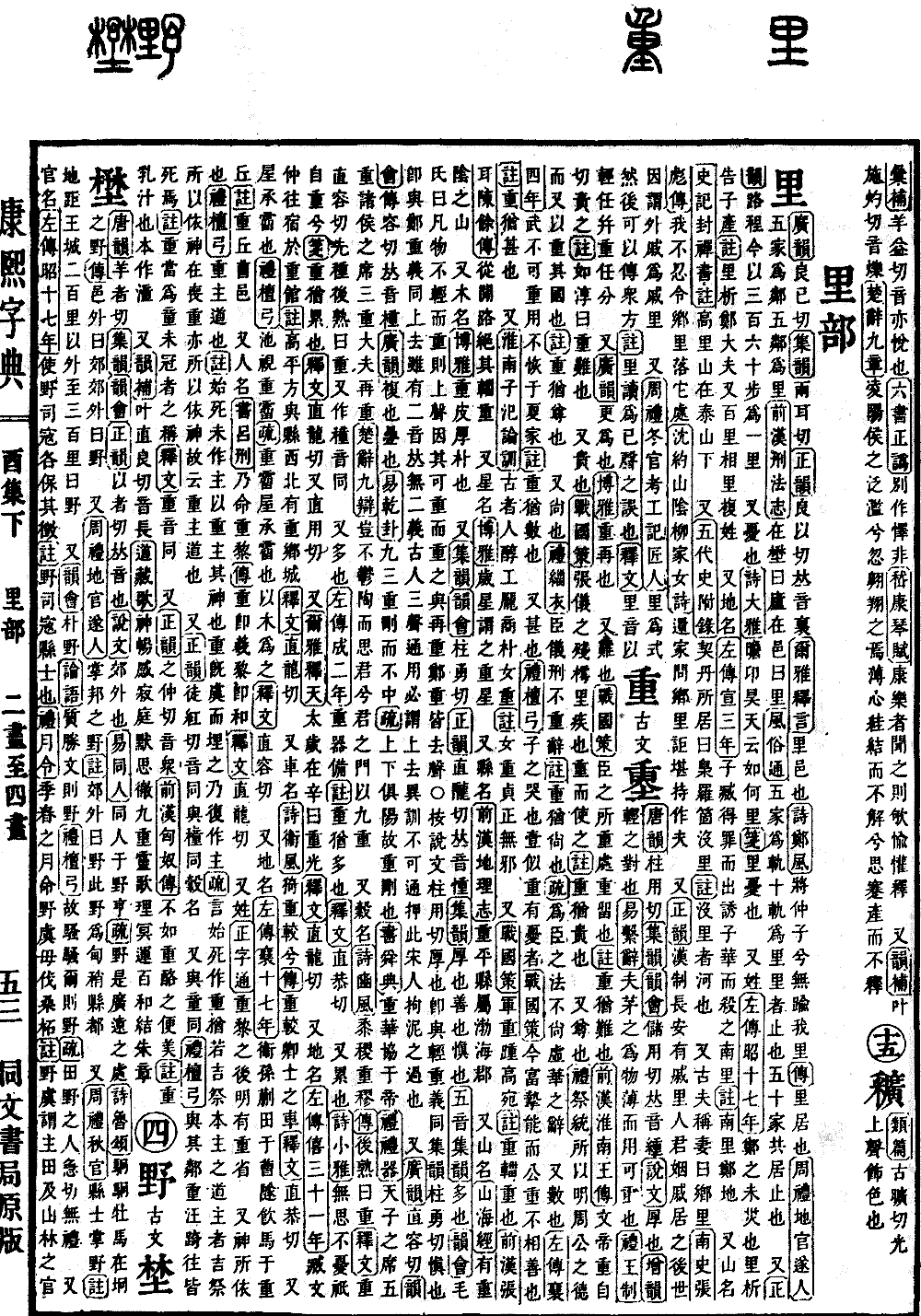
You Collection, Lower Volume
Radical: Village (lǐ)
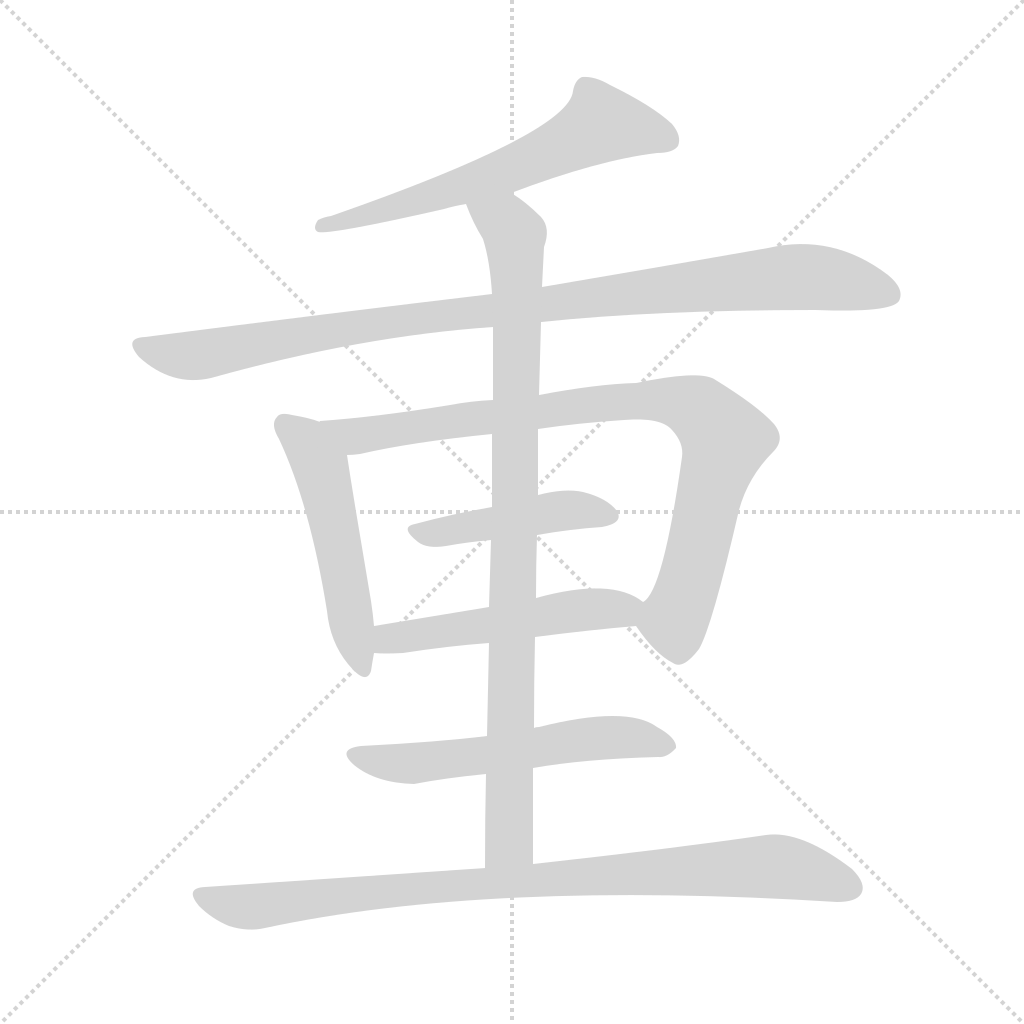
Pronounced chong
Kangxi stroke count: 9
Page 1291, Entry 03
In ancient texts, according to Tang Rhymes (Tangyun), pronounced chong; according to Collected Rhymes (Jiyun) and Rhyme Collection (Yunhui), pronounced chong, sounds like chong.
According to Explaining Graphs and Analyzing Characters (Shuowen Jiezi), it means thick.
According to Amplified Rhymes (Zengyun), it is the opposite of light.
I Ching (Yijing), Commentary on the Appended Judgments: The humble nature of thatch makes it useful for weighty matters.
Book of Rites (Liji), Royal Regulations: When burdens are light, combine them; when burdens are heavy, separate them.
Also, according to Extensive Rhymes (Guangyun), it means to repeat.
According to Broad Refinement (Boya), it means to do again.
Also, it means difficult.
Strategies of the Warring States (Zhanguoce): My official position is difficult, and my stay is difficult.
Commentary: Heavy here is like difficult.
History of the Former Han (Qian Hanshu), Biography of the Prince of Huainan: Emperor Wen found it difficult to personally reprimand him.
Commentary: Ru Chun says, heavy means difficult.
Also, it means noble.
Strategies of the Warring States: When Zhang Yi disparaged Chu Li Ji, he treated him with nobility and employed him.
Commentary: Heavy here is like noble.
Also, it means respected.
Book of Rites, Record of the Sacrificial Rites: This is to manifest the virtue of the Duke of Zhou and to honor his state.
Commentary: Heavy here is like respected.
Also, it means to value.
Book of Rites, Black Robes: A minister should not value superficial words.
Commentary: Heavy here is like to value.
Commentary: The way of a minister is not to value superficial rhetoric.
Also, it means to count or consider.
Zuo Tradition (Zuo Zhuan), Fourth Year of Duke Xiang: Martial power should not be repeated, and utility should not be multiplied beyond the Xia dynasty.
Commentary: Heavy here is like to count.
Also, it means very or extreme.
Book of Rites, Tan Gong: Your crying, sir, is exactly like that of one who has a heavy sorrow.
Strategies of the Warring States: Now Fu Zhi is capable, but you and Gong Zhong do not get along.
Commentary: Heavy here means very.
Also, Huainanzi, Principles of General Discourses: In ancient times, people were pure, craftsmanship was elaborate, merchants were simple, and women were dignified.
Commentary: Dignified means chaste, upright, and without evil.
Also, Strategies of the Warring States: The army's baggage follows to Gao Wan.
Commentary: Heavy refers to military supplies and baggage.
History of the Former Han, Biography of Zhang Er and Yu: Severing their baggage train from a side path.
Also, a star name.
Broad Refinement: The planet Jupiter is called the Heavy Star.
Also, a county name.
History of the Former Han, Treatise on Geography: Chongping County, belonging to Bohai Commandery.
Also, a mountain name.
Classic of Mountains and Seas (Shanhaijing): There is the Mountain of Heavy Shade.
Also, a tree name.
Broad Refinement: Heavy skin is Magnolia officinalis (houpo).
Also, according to Collected Rhymes (Jiyun) and Rhyme Collection (Yunhui), pronounced chong; according to Correct Rhymes (Zhengyun), pronounced chong.
Collected Rhymes: Thick, good, cautious.
Five Sounds Collected Rhymes: Many.
Rhyme Collection: Mr. Mao says: Whenever a thing is not light but heavy, use the upper tone. Because it can be repeated, repeating it, along with re-doubling or emphasizing, all use the departing tone. Investigating Shuowen Jiezi, pronounced chong, means thick, which is the same meaning as light and heavy. Collected Rhymes, pronounced chong, means cautious, which is the same meaning as emphasizing. Although there are two pronunciations for the upper and departing tones, there are not two meanings. Ancients used the three tones interchangeably. To claim that the upper and departing tones have different definitions and cannot be used interchangeably is a form of pedantry by Song dynasty scholars.
Also, according to Extensive Rhymes (Guangyun), pronounced chong; according to Rhyme Collection (Yunhui), pronounced chong.
Extensive Rhymes: To repeat, to stack.
I Ching, Qian Hexagram: The nine and three are both firm and not centered.
Commentary: Above and below are both Yang, therefore it is a heavy firmness.
Book of Documents (Shujing), Canon of Shun: Chonghua was in harmony with the Emperor.
Book of Rites, Vessels of Rites: The Emperor has five layers of mats, feudal lords have three, and senior officials have two.
Songs of Chu (Chu Ci), Nine Arguments: How can I not be depressed and think of my ruler, for the ruler's gate has nine layers.
Also, a valley name.
Book of Odes (Shijing), Odes of Bin: The glutinous and non-glutinous grains that ripen late.
Commentary: That which ripens later is called chong.
Explication of Texts: Chong, pronounced chong, that which is planted first but ripens later is called chong.
Also written as chong, with the same pronunciation.
Also, many.
Zuo Tradition, Second Year of Duke Cheng: Heavy equipment is prepared.
Commentary: Heavy means many.
Explication of Texts: Pronounced chong.
Also, to accumulate.
Book of Odes, Minor Odes: There is no thought that is not sorrow, I only bring trouble upon myself.
Commentary: Heavy means to accumulate.
Explication of Texts: Pronounced chong, and also pronounced chong.
Also, according to Er Ya, Explaining Heaven: When the Tai Sui (Grand Duke) is in the year of Xin, it is called chongguang.
Explication of Texts: Pronounced chong.
Also, a place name.
Zuo Tradition, Thirty-first Year of Duke Xi: Zang Wenzhong stayed overnight at the Chong Inn.
Commentary: Northwest of the present-day Gao Ping County is the walled city of Chong.
Explication of Texts: Pronounced chong.
Also, a carriage name.
Book of Odes, Odes of Wei: The decorated sideboards of the carriage are elegant.
Commentary: The heavy sideboards are the carriages of high officials.
Explication of Texts: Pronounced chong.
Also, the eaves of a roof.
Book of Rites, Tan Gong: Looking at the double eaves of the pool.
Commentary: Double eaves are the eaves that support the roof, made of wood.
Explication of Texts: Pronounced chong.
Also, a place name.
Zuo Tradition, Seventeenth Year of Duke Xiang: Sun Kuai of Wei farmed in the Cao tunnels and watered his horses at Chongqiu.
Commentary: Chongqiu is a city in Cao.
Explication of Texts: Pronounced chong.
Also, a person's name.
Book of Documents, Charge to Lu: Then he ordered Chong and Li.
Commentary: Chong is Xi, and Li is He.
Explication of Texts: Pronounced chong.
Also, a surname.
Zhengzitong: Descendants of Chong and Li; in the Ming dynasty, there was a Chong Xing.
Also, what the spirits rely upon.
Book of Rites, Tan Gong: The chong represents the way of the ancestral tablet.
Commentary: When one first dies and the tablet has not yet been made, the chong is used to house the spirit. After the ritual of Yu, it is buried, and then the tablet is made.
Commentary: It is said that at the beginning of death, a chong is made, just like the way of a proper ancestral tablet. The tablet is used during auspicious sacrifices to house the spirit. During mourning, the chong is also used to house the spirit, hence it is said it represents the way of the ancestral tablet.
Also, according to Correct Rhymes (Zhengyun), pronounced tong.
Same as chong (for grain).
Also, same as tong (young/child).
Book of Rites, Tan Gong: Together with his neighbor Chong Wangji, they went and both died there.
Commentary: Chong should be tong, a term for those who have not yet reached adulthood.
Explication of Texts: Pronounced tong.
Also, according to Correct Rhymes (Zhengyun), pronounced zhong.
History of the Former Han, Records of the Xiongnu: It is not as convenient and delicious as thick milk (zhonglao).
Commentary: Zhong is milk. Originally written as tong.
Also, according to Rhyme Supplement (Yunbu), rhyming with chang (long tone).
Daoist Canon Songs: The spirit freely feels the quiet courtyard, silently thinking until it reaches the nine levels of heaven. Spiritual songs arrange the dark movement, and the hundred harmonies bind the red patterns.