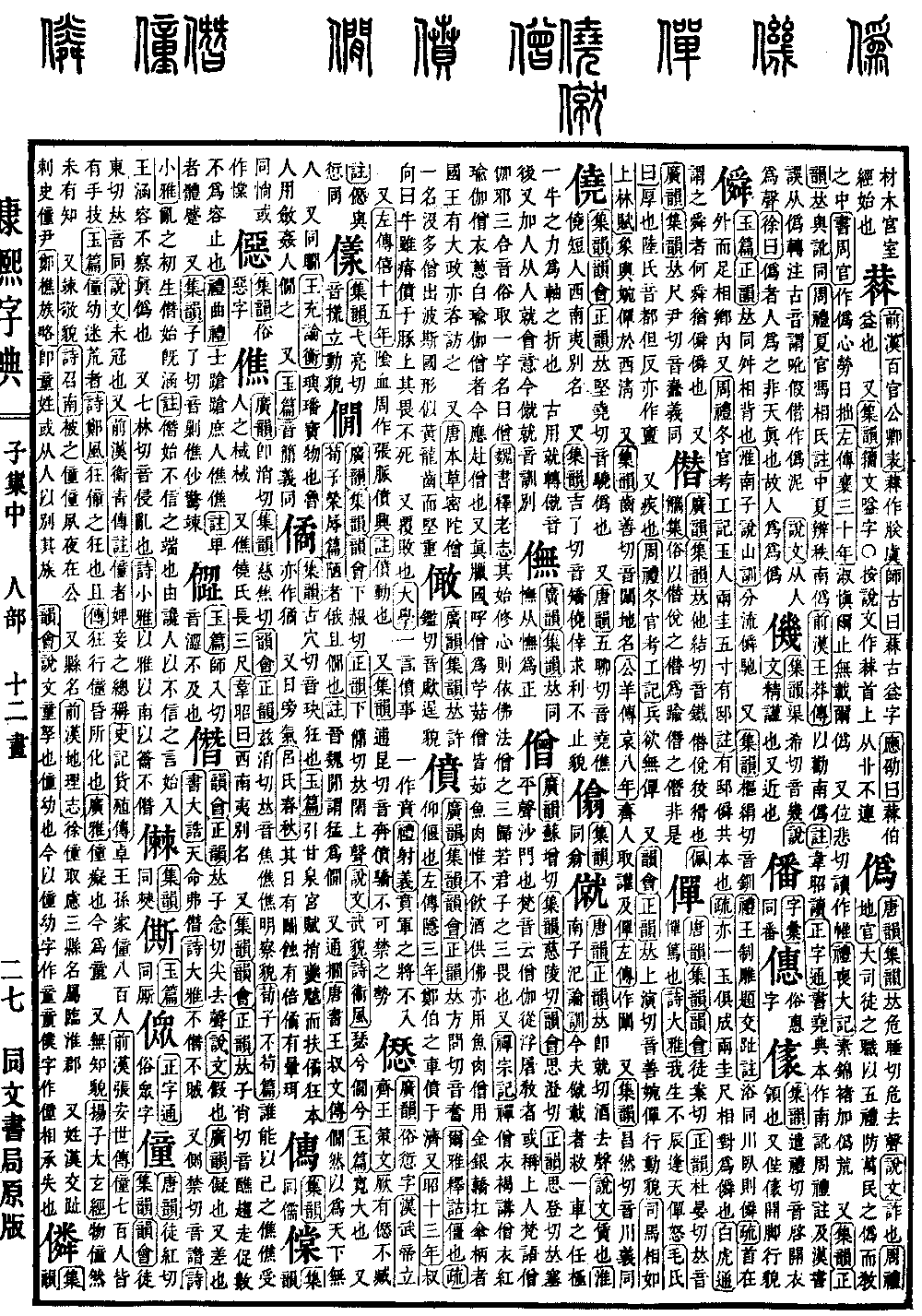
Zi Collection, Middle Volume
Radical: Person (rén)
僮
Kangxi Strokes: 14
Page 117, Entry 30
Pronounced tóng.
According to the Explaining Graphs and Analyzing Characters (Shuowen Jiezi), it refers to one who has not yet reached the age of capping.
Also, according to the commentary on the Biography of Wei Qing in the History of the Former Han Dynasty (Qian Hanshu), it is a collective term for male and female servants.
In the Biographies of Wealthy Merchants from the Records of the Grand Historian (Shiji), it is noted that the household of Zhuo Wangsun had eight hundred servants.
In the Biography of Zhang Anshi from the History of the Former Han Dynasty (Qian Hanshu), it states there were seven hundred servants, all of whom possessed manual skills.
According to the Jade Chapters (Yupian), it describes those who are young and bewildered.
In the Odes of Zheng from the Book of Odes (Shijing), it mentions the madness of the foolish youth. The commentary explains this as the foolish actions of one who is unenlightened.
According to the Broad Elegance (Guangya), it means foolish. Nowadays, it is written as the character for child. It also describes a state of ignorance.
In the Great Mystery (Taixuanjing) by Yangzi, it says: things are in an ignorant state, lacking knowledge.
It also describes a state of reverent awe. In the Odes of Shao South from the Book of Odes (Shijing), it states: wearing it with reverent dignity, morning and night in the public service.
It is also the name of a county. According to the Treatise on Geography in the History of the Former Han Dynasty (Qian Hanshu), Xu, Tong, and Qulü were three county names belonging to Linhuai Commandery.
It is also a surname. During the Han dynasty, there was Tong Yin, the Inspector of Jiaozhi.
According to the General Records of Clans (Zulüe) by Zheng Qiao, this is the same as the Tong surname. Some write it with the person radical to distinguish the clan.
According to the Collection of Rhymes (Yunhui), the Explaining Graphs and Analyzing Characters (Shuowen Jiezi) states that the character for child refers to a child of a servant. The character for servant (with the person radical) refers to the young. Nowadays, the character for child is used for the young, and the character for servant (with the person radical) is used for servant, which is an error handed down over time.