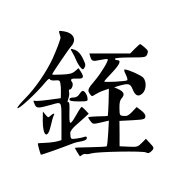
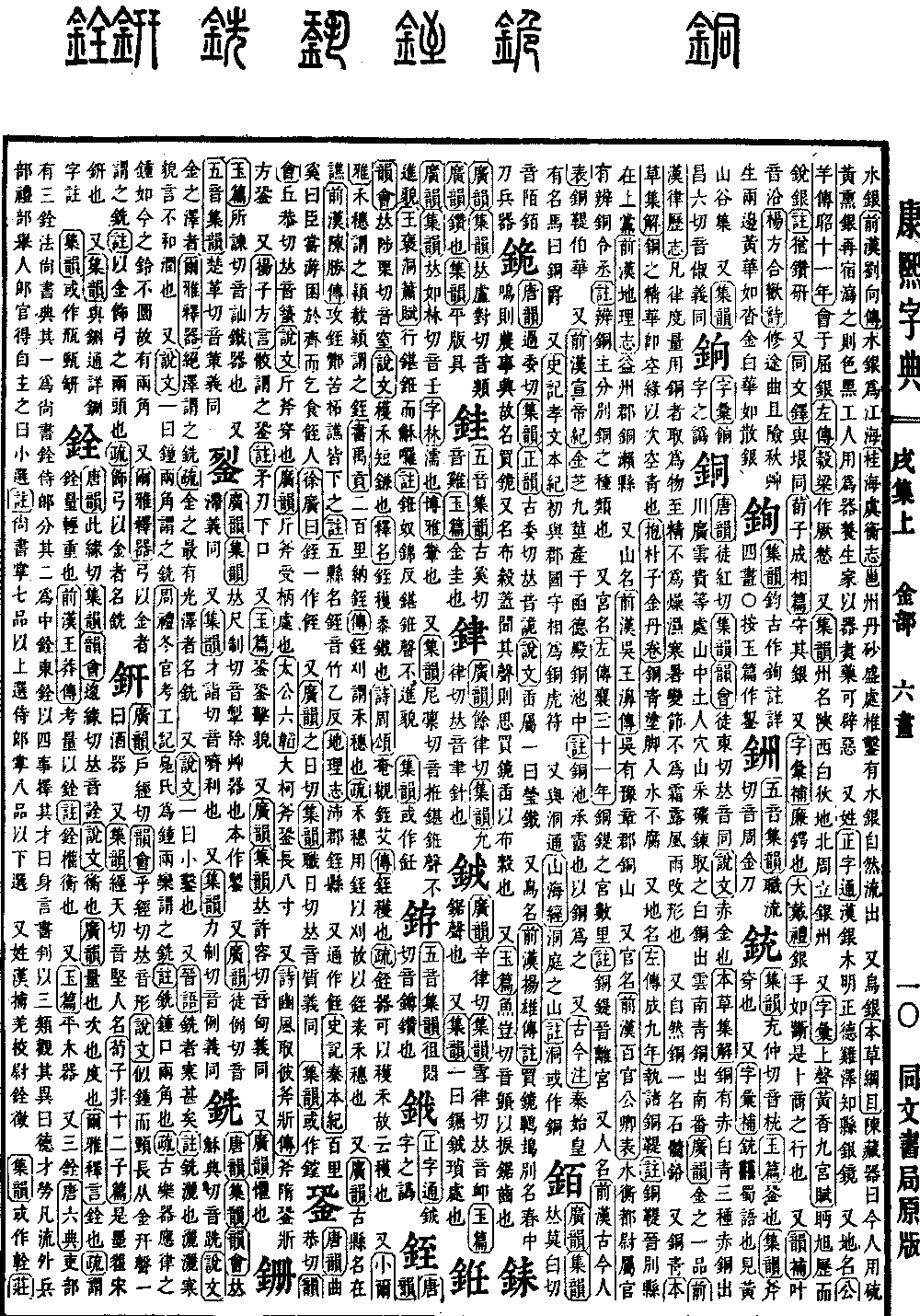
Xu Collection, Upper Volume
Radical: Metal (jīn)
Kangxi Strokes: 14
Page 1304, Entry 15
Tang Rhymes (Tangyun), Rhyme Collections (Yunhui): Pronounced zhi.
Shuowen Jiezi (Shuowen): A short sickle used for harvesting crops.
Explication of Names (Shiming): A zhi is an iron implement used for harvesting broomcorn millet.
Book of Odes (Shijing), Zhou Hymns (Zhou Song): All see the zhi and the ai.
Commentary (Zhuan): Zhi means to harvest.
Sub-commentary (Shu): This implement is used to harvest grain, hence it signifies the act of harvesting.
Little Er'ya (Xiao Er'ya): The ear of grain is called ying, and severing the ear is called zhi.
Book of Documents (Shangshu), Tribute of Yu (Yu Gong): Within a range of two hundred li, offer zhi as tribute.
Commentary (Zhuan): Zhi means to cut, referring to the ear of grain.
Sub-commentary (Shu): Because ears of grain are cut with a zhi, the term is used to represent the grain ear itself.
Guangyun: An ancient county name, located in the Qiao region.
History of the Former Han (Qian Hanshu), Biography of Sheng: Attacked Zhi, Zuan, Ku, Zhe, and Qiao, and captured them all.
Annotation: These are the names of five counties. Zhi is pronounced zhu yi.
Treatise on Geography (Dilizhi): Pei Commandery contains Zhi County.
Also used interchangeably with another form.
Records of the Grand Historian (Shiji), Annals of Qin (Qin Benji): Baili Xi said, I was once in dire straits while traveling through the state of Qi and had to beg for food.
Xu Guang says: There is a variant reading of zhi.
Guangyun, Jiyun: Pronounced zhi. The meaning is the same.
Jiyun: Sometimes written in a variant form.
Textual Research: Also used interchangeably with another form. In the Records of the Grand Historian, Annals of Qin, Baili Xi said, I was once in dire straits while traveling through the state of Qi and had to beg for food. Xu Guang says: Zhi, one theory is that it is a variant. Following the original text, the phrase zhi is written as has been corrected to one variant form is zhi.