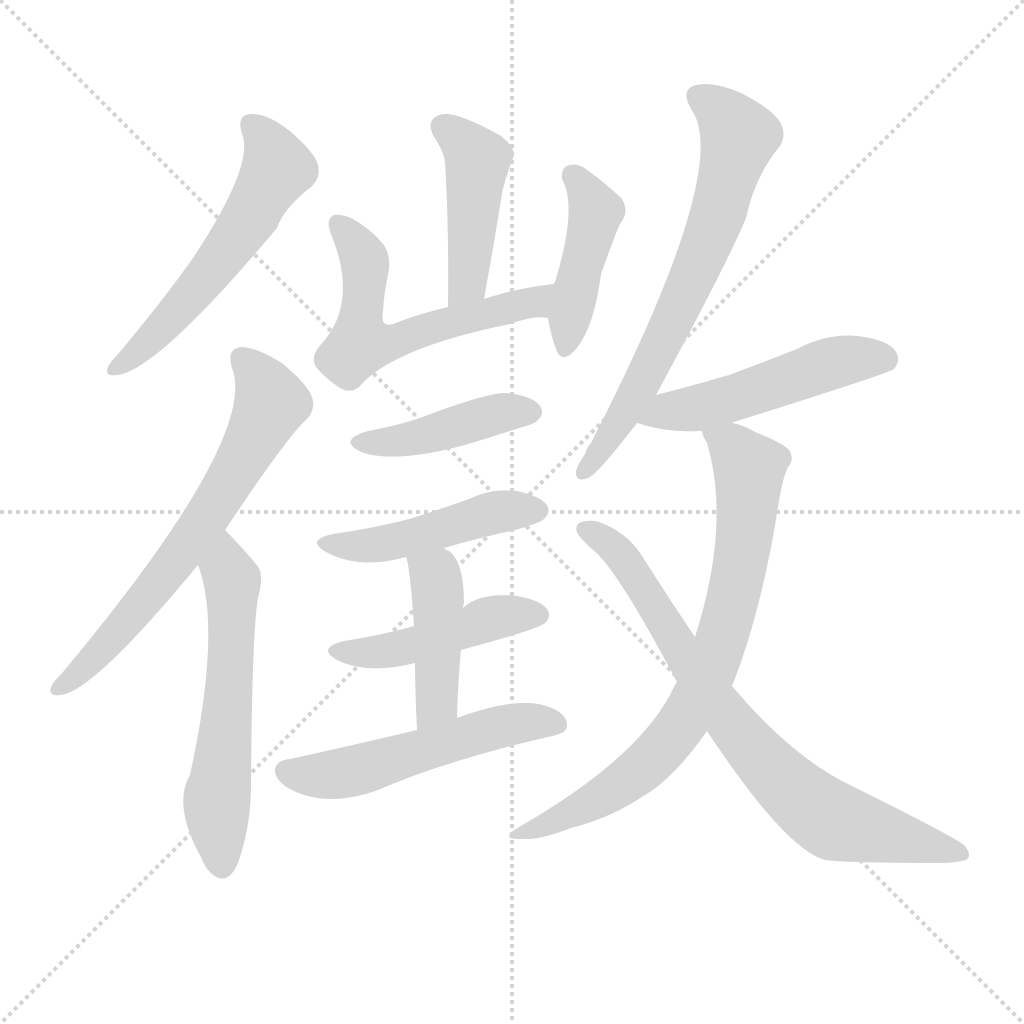
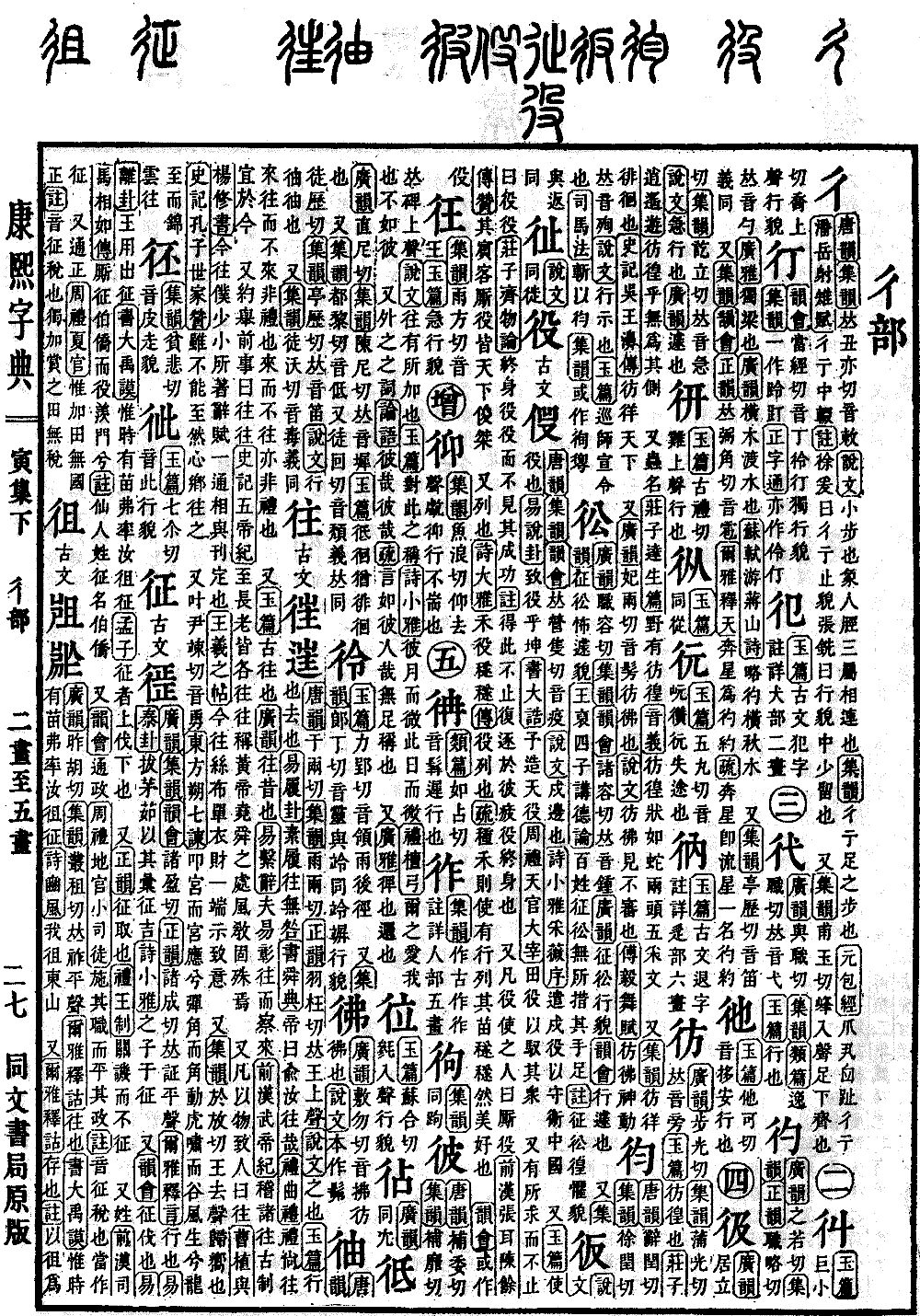
Yin Collection, Lower Volume
Radical: Step (chì)
Kangxi Strokes: 15
Page 365, Entry 02
Ancient script. Pronounced zheng (level tone).
Shuowen Jiezi (Shuowen): To summon. Derived from the abbreviated form of wei. It is written as zheng, representing that which proceeds from the subtle and becomes manifest; it is thus called zheng.
Rites of Zhou (Zhouli), Office of Heaven, Minister: In charge of the orders and summons of the hundred official bureaus. Commentary: To differentiate between various offices, and to prepare for the summons of the king.
Discourses of the States (Guoyu): Only the official is to be summoned.
Also, Guangyun: To testify, to clarify.
Book of Documents (Shangshu), Great Plan (Hongfan): To contemplate and apply the various signs.
Zuo Commentary (Zuo Zhuan), 30th Year of Duke Zhao: And to testify to faults. Commentary: Zheng means to clarify.
Also, Guangyun: To accomplish.
Book of Etiquette and Ceremonial (Yili), Marriage Rites of the Gentleman: To present the betrothal gifts. Commentary: Zheng means to accomplish. Sending an envoy to present gifts to complete the marriage ceremony.
Also, to inquire.
Zuo Commentary (Zuo Zhuan), 4th Year of Duke Xi: If the bundles of rushes are not presented, and the wine for the royal sacrifice is not provided, there is no way to filter the wine; it is this for which I am inquiring.
Also, to collect.
Rites of Zhou (Zhouli), Office of Earth: The village overseer collects the taxes according to the season. Commentary: The village overseer collects taxes and tributes within a hundred li.
Also, to seek.
Records of the Grand Historian (Shiji), Biographies of Merchants: Seeking the expensive where goods are cheap. Commentary: Zheng means to seek; it means that if goods are cheap here, one seeks to sell them where they are expensive.
Also, Erya, Explanation of Words: Zheng means void.
Also, a surname.
Guangyun: Zheng Chong from Henan, who held the position of Heir Apparent's Assistant Director in the Wu state.
Also, Jiyun: Pronounced cheng. The name of a county.
Zuo Commentary (Zuo Zhuan), 10th Year of Duke Wen: Taibo attacked Jin and took Beizheng. Pronunciation Guide: Now Zheng County.
Records of the Grand Historian (Shiji), Treatise on the Canals: Digging a canal, leading water from the Luo River from Zheng to beneath Shangyan.
Book of Former Han (Hanshu), Treatise on Geography: Zuofengyi has Zheng County. Commentary: It is what is now Chengcheng.
Also, Guangyun, Jiyun, Yunhui: Pronounced zhi (rising tone).
Yupian: The zhi note in the pentatonic scale.
Erya, Explanation of Music: The zhi note is called die.
Book of Music (Yueshu): The sound comes from the heart, the teeth close and the lips open, which is zhi. Zhi is fire; its nature is intense and it illuminates well. The five notes correspond to summer.
Book of Rites (Liji), Monthly Ordinances (Yueling): In the first month of summer, its note is zhi.
Also, Record of Music (Yueji): Zhi corresponds to affairs. Commentary: Zhi belongs to summer; summer is the season when all things grow and complete their physical forms. Affairs also have form, so zhi is matched with affairs.
Fengsu Tong: Zhi means blessings. It signifies that things are flourishing and abundant. In the five elements, it is fire; in the five constant virtues, it is propriety; in the five affairs, it is sight. All belong to affairs.
Also, interchangeable with cheng (to punish).
Xunzi, Correct Discourses: Regarding the essence of human beings, to forbid violence and hate evil, and to punish the source of their arrival.
Also, interchangeable with zheng (to campaign).
Records of the Grand Historian (Shiji), Genealogy of the Three Kings: If one is not a scholar, one may not follow the campaign.
Also, rhyming with zhong.
Ban Gu, Lingtai Poem: Thus constructing the spiritual terrace, the spiritual terrace is already grand. The Emperor diligently ascends at the right time, thereupon examining the auspicious signs.