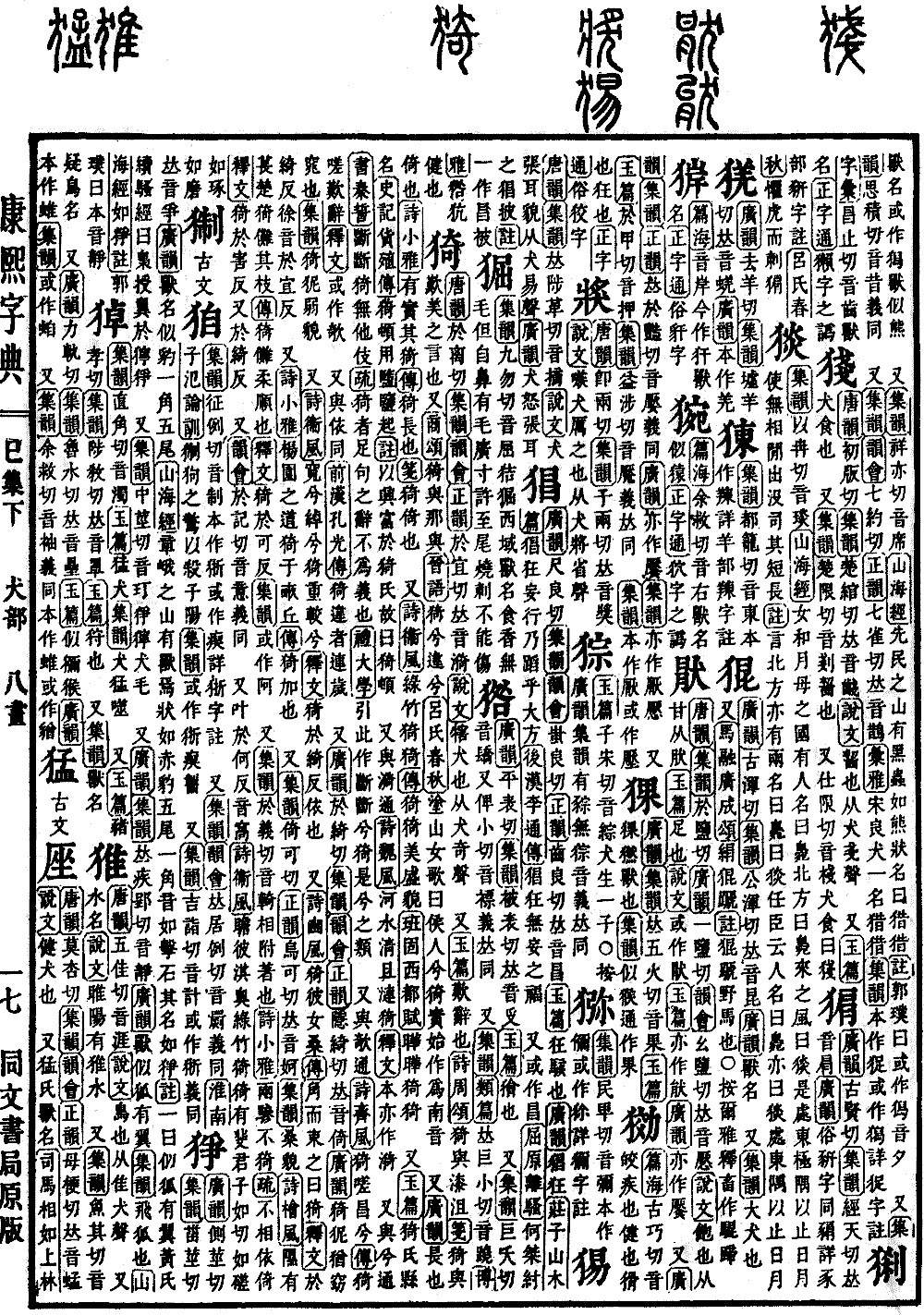
Si Collection, Lower Volume
Radical: Dog (quǎn)
Kangxi Strokes: 12
Page 713, Entry 20
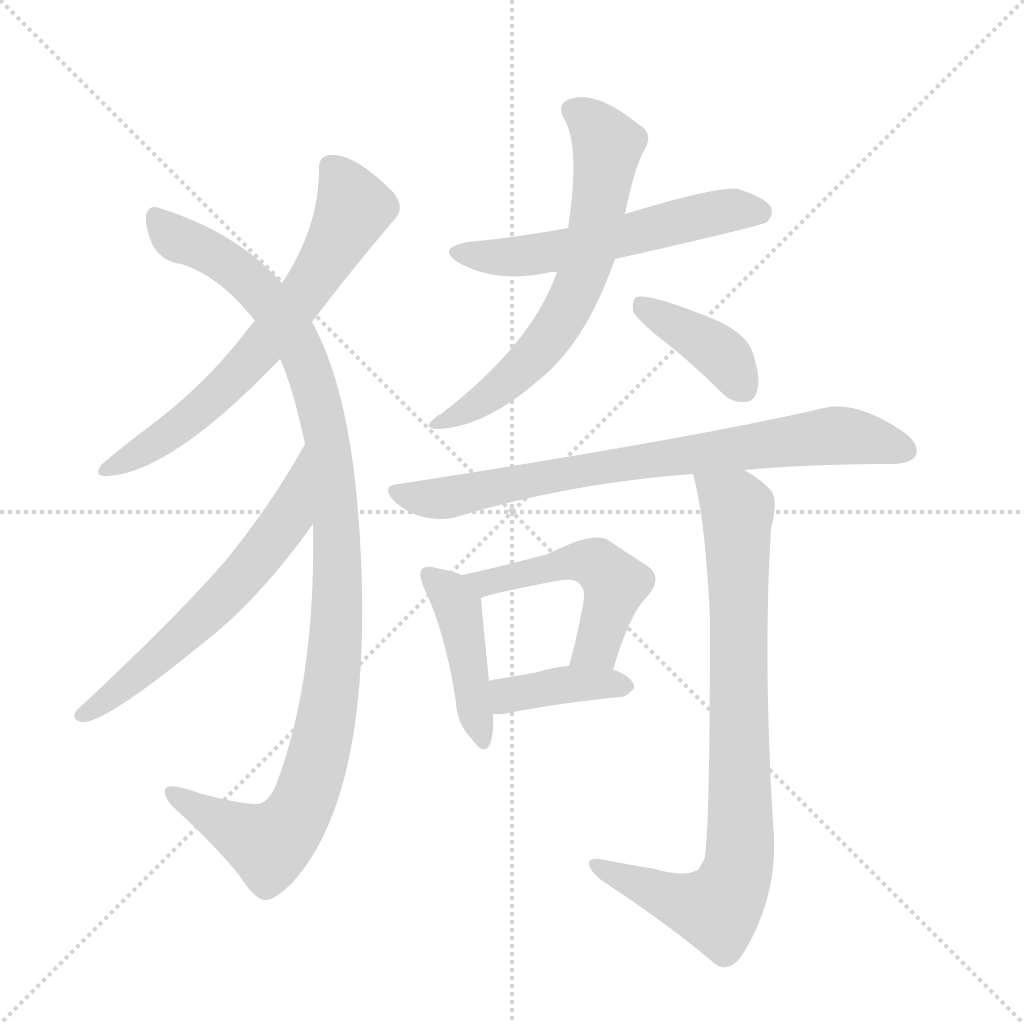
Pronounced yi. Pronounced the same as the character yi.
In the Explanation of Simple and Compound Characters (Shuowen Jiezi), it is defined as a castrated dog. The character is composed of the Dog radical with qi acting as the phonetic component.
Furthermore, in the Jade Chapter (Yupian), it is defined as an exclamation.
In the Book of Odes (Shijing), Zhou Eulogies (Zhou Song), there is the line: With an exclamation of wonder at the Qi and Ju rivers. The commentaries note that this exclamation is a phrase used to praise beauty.
Also in the Shang Eulogies (Shang Song): With an exclamation of wonder and grace. In Discourses of the States (Guoyu), Jin Discourses: Ah, oh, departing! The Spring and Autumn Annals of Master Lu (Lu Shi Chunqiu) records that the woman of Mount Tushan sang: Oh, the lord of men! This is considered the beginning of southern music.
Additionally, in the Broad Rhymes (Guangyun), it carries the meanings of long and to lean upon.
In the Book of Odes (Shijing), Lesser Odes (Xiao Ya): It has long fruits. The commentary interprets it as long, while the sub-commentary interprets it as to lean upon.
Also in the Book of Odes (Shijing), Odes of Wei (Wei Feng): The green bamboo is beautiful and luxuriant. The commentary says this describes a beautiful and flourishing appearance. Ban Gu’s Western Capital Rhapsody (Xidu Fu) also contains the phrase flourishing and luxuriant.
Additionally, the Jade Chapter (Yupian) refers to Yishi, a county name.
The Records of the Grand Historian (Shiji), Biographies of the Money-makers, records that Yi Dun built his fortune using salt from the salt marshes. The commentary notes that he was called Yi Dun because he gained his wealth in Yishi County.
It is also used interchangeably with yi.
In the Book of Odes (Shijing), Odes of Wei (Wei Feng): The Yellow River is clear with ripples. The sub-commentary states that some versions are also written as yi.
It is also used interchangeably with xi.
In the Book of Documents (Shangshu), Oath of Qin: Firmly and resolutely, without other tricks. The sub-commentary states that it is a particle used to complete the sentence, carrying no actual meaning. When the Book of Rites (Liji), Great Learning, quotes this, it is written as xi, demonstrating that the two are synonymous.
It is also used interchangeably with qi.
In the Book of Odes (Shijing), Odes of Qi (Qi Feng): Alas, how flourishing! The commentary states that this is an exclamation. The sub-commentary states that some versions use qi.
It is also used interchangeably with yi.
In the History of the Han (Hanshu), Biography of Kong Guang: Those who lean or deviate have done so for years.
Pronounced yi. Pronounced the same as the character yi.
In the Broad Rhymes (Guangyun), yini means graceful and slender.
In the Collection of Rhymes (Jiyun), yini describes a weak and delicate appearance.
Also in the Book of Odes (Shijing), Odes of Wei (Wei Feng): Generous and elegant, leaning against the heavy carriage. The sub-commentary notes it is pronounced yi and means to lean against.
Also in the Book of Odes (Shijing), Odes of Bin (Bin Feng): Pulling down the mulberry branches. The commentary says that pulling branches down to tie them is called yi. The sub-commentary provides the pronunciation, as does Xu Miao.
Also in the Book of Odes (Shijing), Lesser Odes (Xiao Ya): The path to the poplar garden, leaning against the mound in the field. The commentary interprets this as to add onto.
In the Collection of Rhymes (Jiyun), pronounced e. Pronounced the same as the character e.
In the Collection of Rhymes (Jiyun), it describes a soft and beautiful appearance.
In the Book of Odes (Shijing), Odes of Hui (Hui Feng): In the marshlands grow the hardy kiwi vines, their branches soft and compliant. The commentary states that this describes a soft and compliant appearance. The sub-commentary notes the pronunciation, and the Collection of Rhymes (Jiyun) states that some versions are written as e.
Additionally, in the Collection of Rhymes (Jiyun), pronounced yi. Pronounced the same as the character yi. It means to lean on or depend upon one another.
In the Book of Odes (Shijing), Lesser Odes (Xiao Ya): The two outer horses do not lean against each other. The sub-commentary interprets this as not depending on one another. The sub-commentary provides both yi and yi pronunciations.
Also, in the Rhyme Treasury (Yunhui), it is pronounced yi. Pronounced the same as the character yi, with the same meaning.
It is also pronounced as a rhyming word, pronounced wo.
In the Book of Odes (Shijing), Odes of Wei (Wei Feng): Behold the bend in the Qi River, where the green bamboo is lush and luxuriant. The noble man, elegant and refined, is like bone and ivory that has been cut and filed, like jade that has been carved and polished.