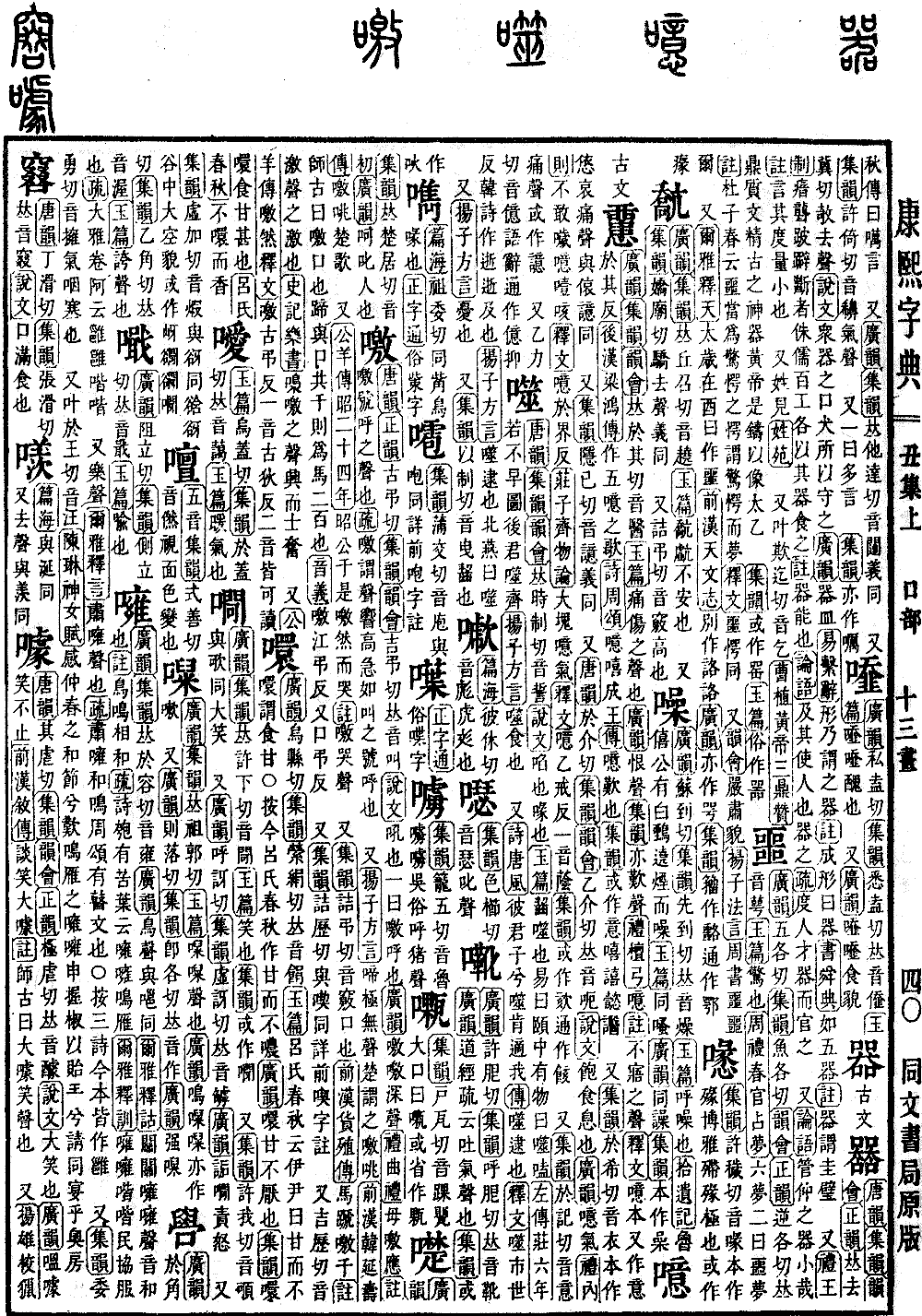
Chou Collection, Upper Volume
Radical: Mouth (kǒu)
16 Kangxi strokes
Page 210, Entry 08
Ancient form. According to Guangyun (Broad Rhymes) and Jiyun (Collected Rhymes), and Yunhui (Collection of Rhymes), pronounced yi.
According to Yupian (Jade Chapters), the sound of pain and injury. According to Guangyun, a sound of regret. According to Jiyun, also a sound of sighing.
In Book of Rites (Liji), record of Tan Gong, it is written: I. The commentary states: a sound of not awakening. The textual explanation states: I, originally also written as yi (a variant form).
In Biography of Liang Hong in Book of the Later Han (Hou Hanshu), it is mentioned as the Song of Five I.
In Book of Odes (Shijing), Zhou Hymns, it is written: I xi King Cheng. The commentary states: I, a sigh. According to Jiyun, sometimes written as yi, xi, xi, yi.
Also, according to Jiyun, pronounced yi. Originally written as a variant form, the sound of mournful pain. Same as yi and yi.
Also, according to Jiyun, pronounced yi. Same meaning.
Also, according to Tangyun (Tang Rhymes), pronounced e. According to Jiyun and Yunhui, pronounced e. According to Shuowen (Explaining Characters), the breath of a full stomach. According to Guangyun, to belch.
In Book of Rites (Liji), section on Inner Rules, it states: do not dare to retch, belch, sneeze, or cough. The textual explanation states: I, pronounced jie.
In Zhuangzi, section on Discussion on Making All Things Equal, it states: The Great Clod belches forth breath. The textual explanation states: I, pronounced jie; another pronunciation is yin. According to Jiyun, sometimes written as kai. Commonly written as a variant form.
Also, according to Jiyun, pronounced yi. A sound of pain. Sometimes written as yi.
Also, pronounced yi. A sentence-final particle. Commonly written as yi or yi.
Verification: In Book of Rites (Liji), section on Inner Rules, the text reads do not dare to retch, belch, choke, or cough. I have corrected choke to sneeze in accordance with the original text.