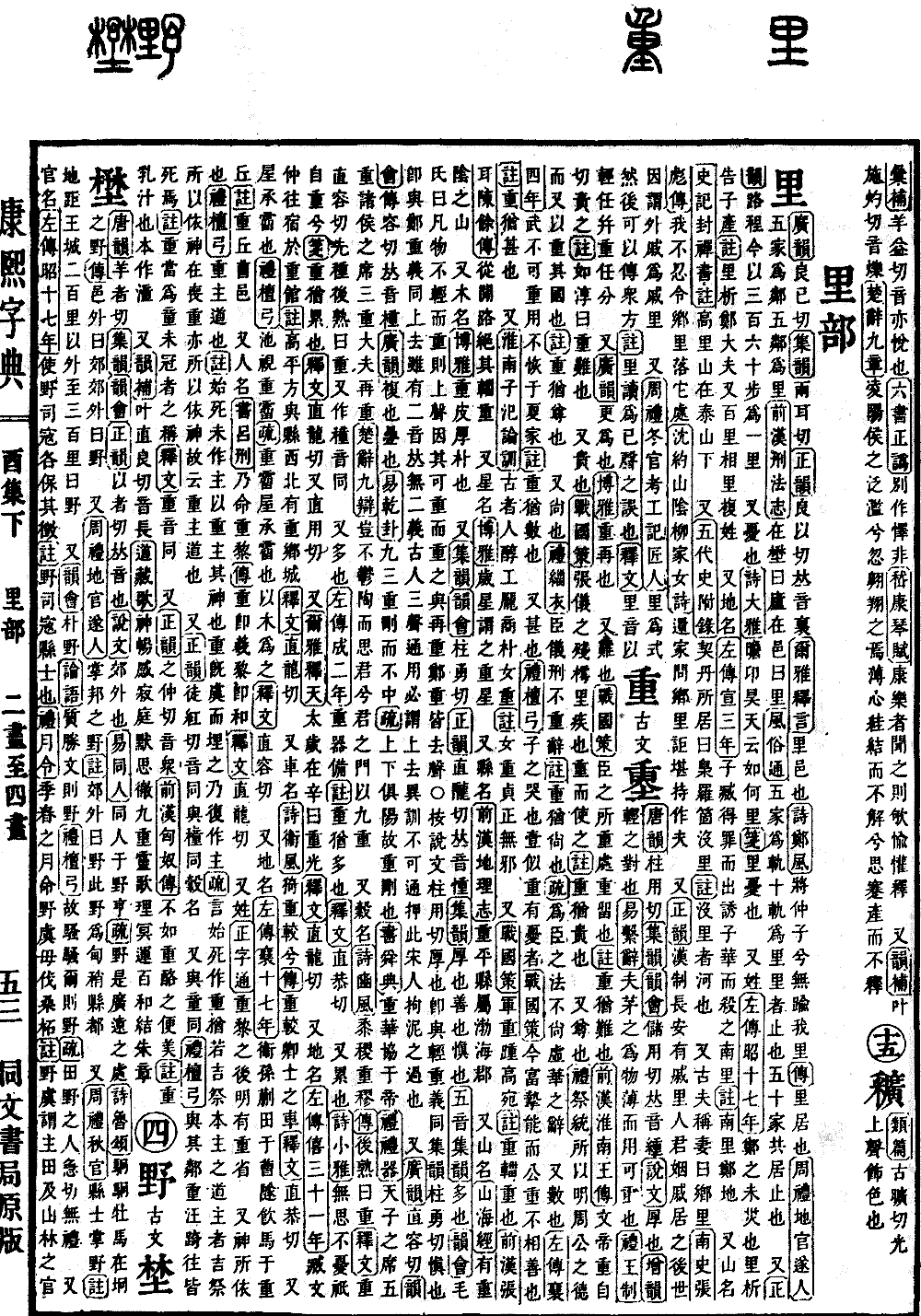
You Collection, Lower Volume
Radical: Village (lǐ)
Page 1291, Entry 05
The ancient form is written as ye.
Pronounced ye.
Pronounced ye.
Shuowen Jiezi (Explaining Graphs and Analyzing Characters) explains: Outside the suburbs.
Book of Changes (Yijing), Hexagram Tongren: Those who are in agreement in the wilds are successful.
Commentary explains: Wilds refers to vast, remote areas.
Book of Odes (Shijing), Lu Song: Fine, fine are the stallions, in the wilds of the state.
Commentary explains: Outside the city is called suburban; outside the suburban is called the wilds.
Also seen in Rites of Zhou (Zhouli), Ministry of Earth, Sui Ren: In charge of the state's wilds.
Annotation explains: Outside the suburbs is called the wilds; here it refers to the areas of dian, shao, xian, and du.
Also seen in Rites of Zhou (Zhouli), Ministry of Autumn: The district officer is in charge of the wilds.
Annotation explains: Areas from two hundred to three hundred miles outside the royal capital are called the wilds.
Also seen in Rhyme Compendium (Yunhui): Simple, rustic, and unrefined.
Analects (Lunyu): If simplicity exceeds cultural refinement, it appears rustic.
Book of Rites (Liji), Tan Gong: Therefore, an urgent manner appears rustic.
Commentary explains: People in the fields are hurried and lack etiquette.
Also refers to an official title.
Zuo Tradition (Zuozhuan), 18th Year of Duke Zhao: Let the wild officials each safeguard their assessments.
Annotation explains: Wild officials are the district officers.
Book of Rites (Liji), Monthly Ordinances: In the last month of spring, command the wild foresters not to cut down mulberry and lacquer trees.
Annotation explains: Wild foresters are officials in charge of fields, mountains, and forests.
Also refers to a place name.
Classic of History (Shangshu), Tribute of Yu: The plains and marshes were drained, extending to Zhuye.
Commentary explains: Zhuye is a place name.
Zuo Tradition (Zuozhuan), 17th Year of Duke Xuan: The Jin people captured Yan Ruo at Yewang.
Annotation explains: Yewang County now belongs to Henei Commandery.
Also, 25th Year of Duke Zhao: The Marquis of Qi offered condolences to the Duke at Ye-jing.
Annotation explains: East of Zhuo'a County in Jinan there is Ye-jing Pavilion.
There is also Juye, a county name, see History of the Former Han (Qian Hanshu), Treatise on Geography.
Also refers to a lake or marsh name.
Classic of History (Shangshu), Tribute of Yu: The great wilds were drained.
Rites of Zhou (Zhouli), Ministry of Summer, Offices of the Provinces: East of the river is called Yanzhou; its mountain is Mount Dai, and its marsh is the Great Wilds.
There is a compound surname, Dongye.
Master Lu's Spring and Autumn Annals (Lüshi Chunqiu): Dongye Ji met Duke Zhuang while driving a chariot.
See also Zhuangzi, Free and Easy Wandering: The wild horses, the dust, and the living creatures breathing upon each other.
Annotation explains: Wild horses refer to floating vapors.
See also Erya, Guangya: Wild fowl is the pheasant.
Also pronounced shu.
Also pronounced shu.
Same as the character for villa.
Jiyun (Collection of Rhymes) explains: A hut in the fields.
Zheng Yun (Correct Rhymes) states: This was originally the ancient character for villa, with the character for field under the character for earth; later people borrowed it for the word for wilderness, and thus added an extra earth radical.
Also pronounced yu.
Meaning: Outside the suburbs.
Also used for rhyming as shu.
Book of Odes (Shijing), Bei Feng: This young lady is going to her new home, sending her off far into the wilds. Rhymes with the preceding yu and the following yu.
Zuo Tradition (Zuozhuan), 25th Year of Duke Zhao, nursery rhyme: The feathers of the pheasant, the duke is away in the wilds, go and gift him a horse. The character for horse is pronounced lao.
Also used for rhyming as wo.
Song of Longdi in the History of the Later Han (Hou Hanshu): Thinking of what I desire, drifting in the vast wilds. Ascending high to look far away, tears falling down.
Also used for rhyming as shu.
Ban Gu, Western Capital Rhapsody (Xidu Fu): The hunting nets connected the ropes, covering the mountains and circling the wilds. The ranked soldiers stood all around, scattered like stars and spread like clouds.
Editorial note: Regarding Zuo Tradition (Zuozhuan), 17th Year of Duke Zhao, let the wild officials each safeguard their assessments, according to the original text, 17th Year has been changed to 18th Year.