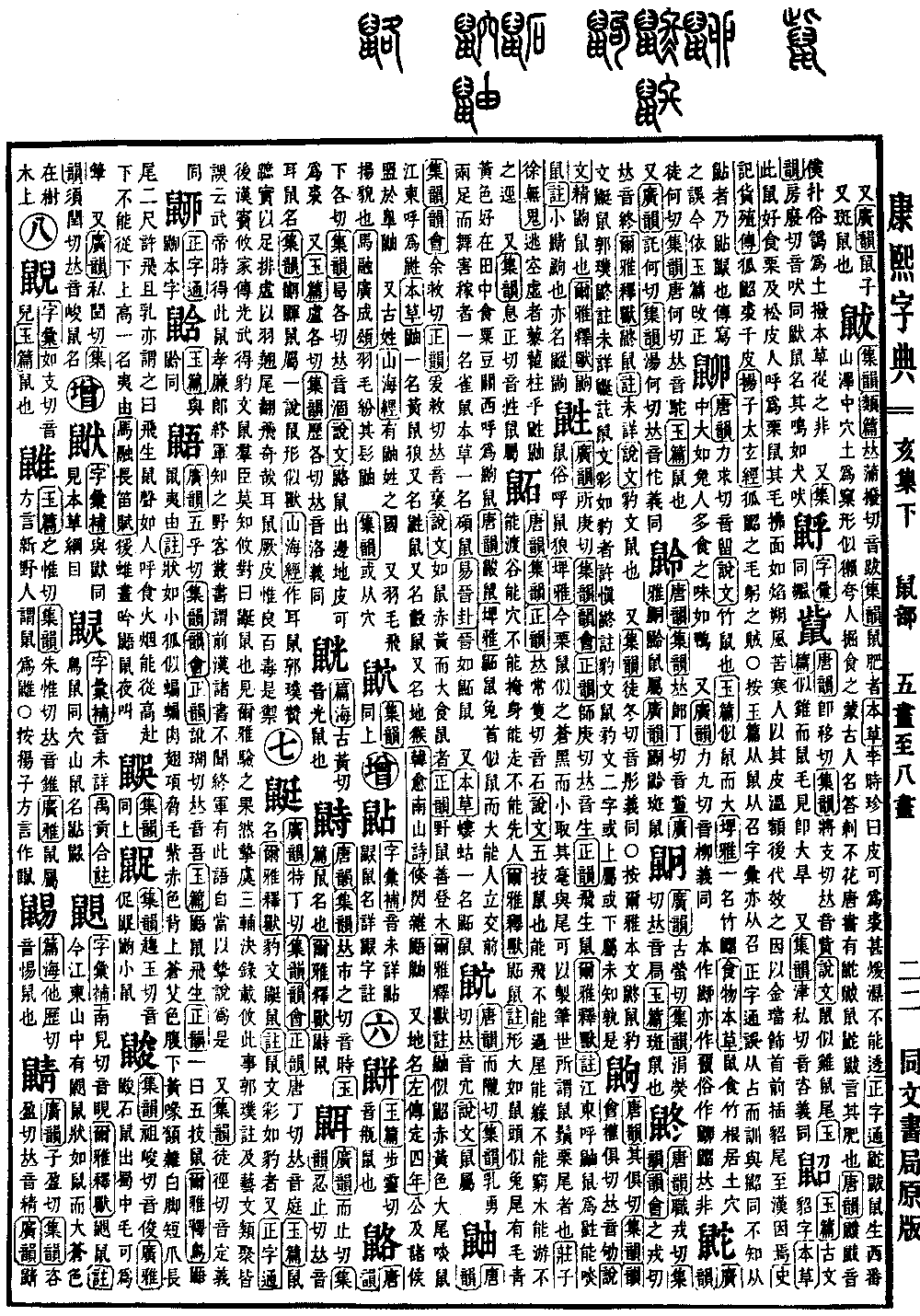
Hai Collection, Lower Volume
Radical: Mouse (shǔ)
Kangxi stroke count: 18
Page 1528, Entry 14
Pronounced yòu.
According to the Explaining Graphs and Analyzing Characters (Shuowen Jiezi), it is an animal like a mouse, reddish-yellow in color and large, which eats mice.
According to Correct Rhymes (Zhengyun), it is a wild mouse, skilled at climbing trees.
According to the commentary on the Er Ya, section on beasts, the weasel (yòu) resembles the sable, is reddish-yellow in color, has a large tail, and eats mice; in the region east of the Yangtze River, it is called the sheng.
According to the Materia Medica (Bencao), the weasel (yòu) is also known as the yellow mouse-wolf (huángshǔláng). It is also known as the sheng-mouse (shēngshǔ). It is also known as the mouse (lǜ). It is also known as the earth-monkey (dìhóu).
In the Poem of Southern Mountain (Nánshān Shī) by Han Yu: It moves swiftly, intermingled with flying squirrels and weasels.
It is also a place name. According to the Zuo Commentary (Zuozhuan), in the fourth year of Duke Ding, the Duke and the feudal lords made a covenant at Gaoyou.
It is also an ancient surname. According to the Classic of Mountains and Seas (Shanhaijing), there is a country of the You surname.
It also describes the appearance of feathers and hair flying about. According to the Ode to Guangcheng (Guǎngchéng Sòng) by Ma Rong: Feathers and hair are scattered and flying about.
In the Collected Rhymes (Jiyun), it is sometimes written with the hole radical.