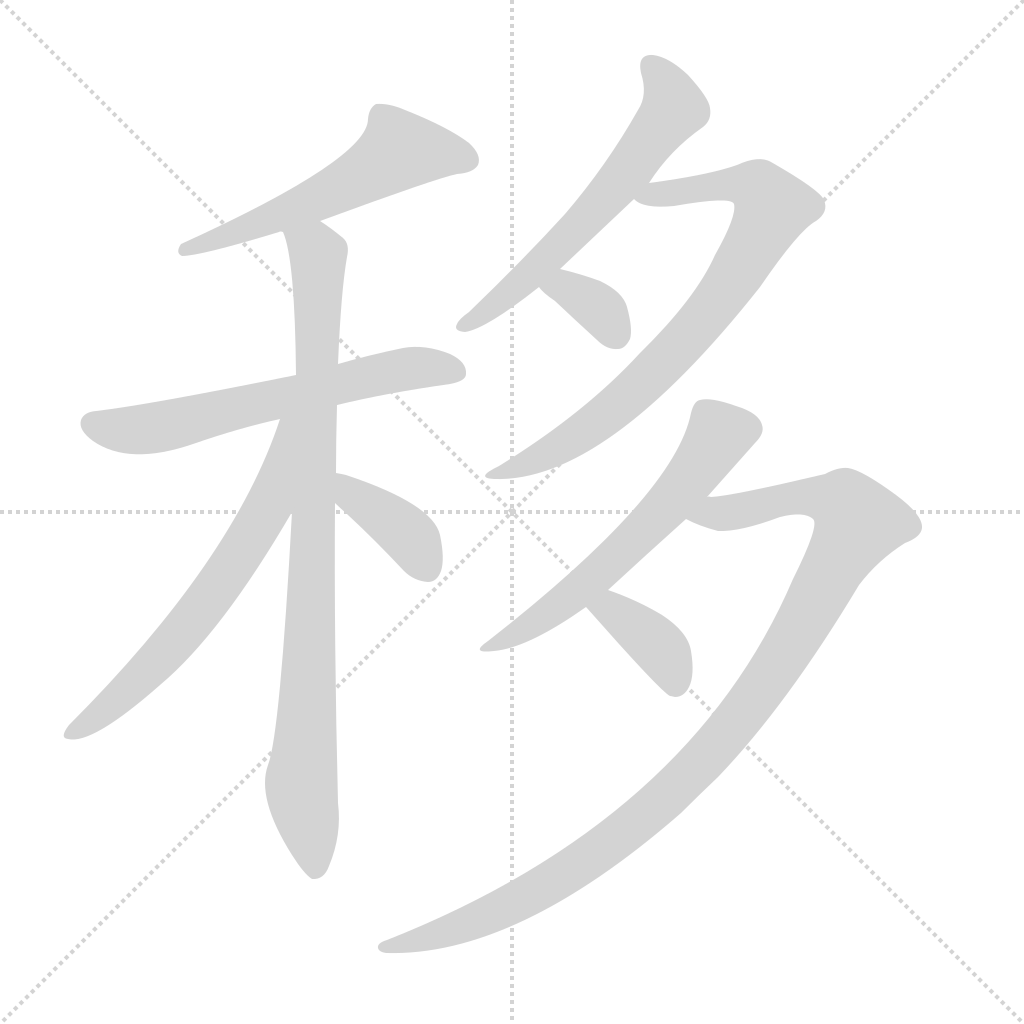
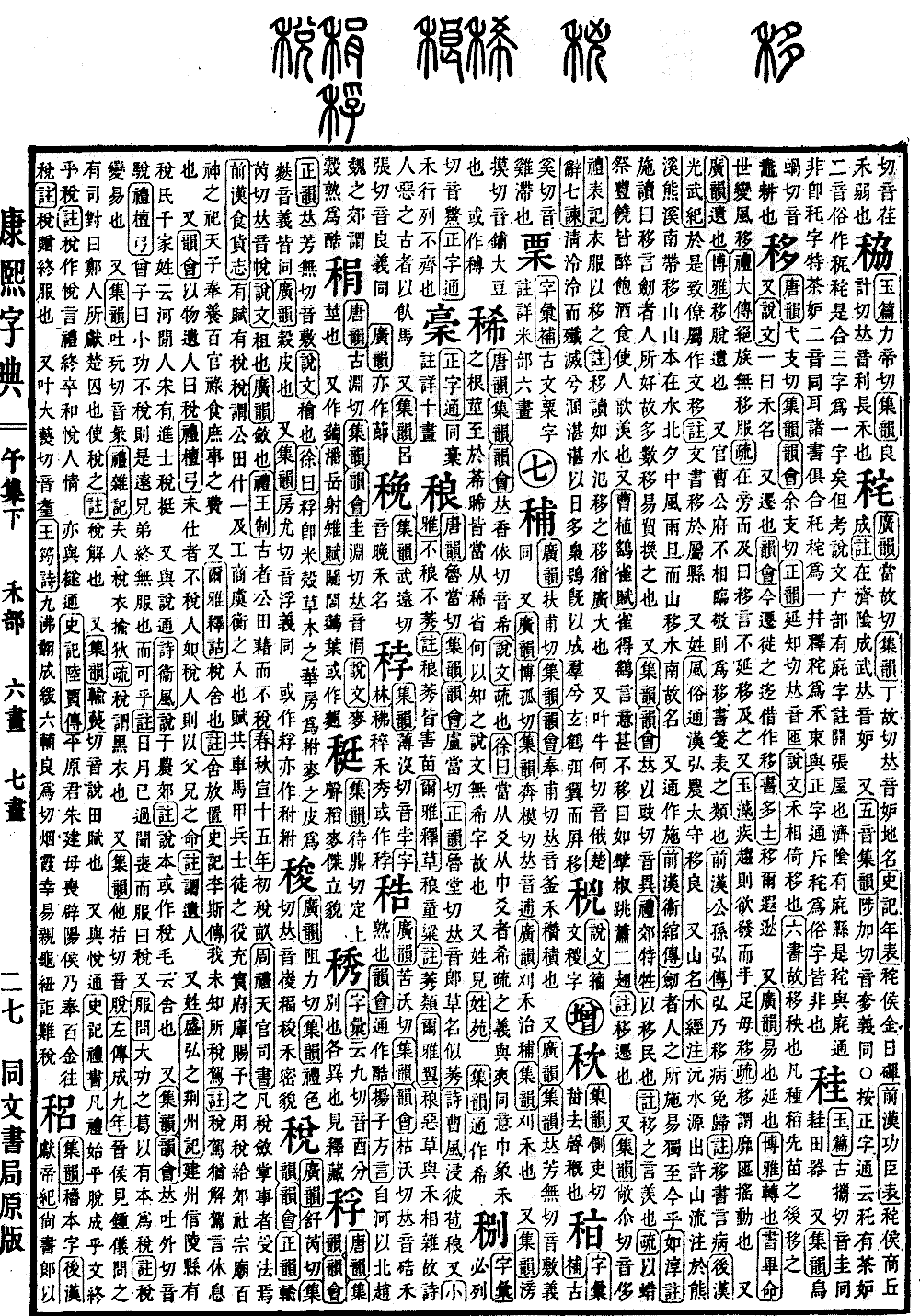
Wu Collection, Lower Volume
Radical: Grain (hé)
Kangxi Strokes: 11
Page 853, Entry 04
Pronounced yi (rising tone)
According to the Analytical Dictionary of Chinese Characters (Shuowen Jiezi), it describes the appearance of grain seedlings leaning against each other and moving.
According to the Explanation of the Six Writings (Liushugu), it refers to the transplanting of rice seedlings. In rice cultivation, seedlings are first sprouted and then transplanted.
Another definition in the Analytical Dictionary of Chinese Characters (Shuowen Jiezi) states it is the name of a type of grain.
Also refers to moving or migrating.
According to the Collection of Rhymes (Yunhui), the character for migration is now used interchangeably with this character.
From the Book of Documents (Shangshu), chapter "Multi-officers": "I will move you to a distant land."
Also, according to the Extensive Dictionary of Rhymes (Guangyun), it means to change or to prolong.
According to the Extensive Record (Boya), it means to transform.
From the Book of Documents (Shangshu), chapter "Bi's Command": "The ways of the world change, and customs are altered."
From the Book of Rites (Liji), chapter "Great Traditions": "When kinship is severed, there are no funeral rites for mourning attire to be transferred."
The commentary states: Being adjacent and involving others is called shifting. It means that which cannot be extended or transferred to involve another.
Also, from the Book of Rites (Liji), chapter "Jade Beads": "When walking quickly, one should look as if setting out, but the hands and feet should not sway or shake."
The commentary states: Shifting refers to swaying or shaking.
Also, according to the Extensive Dictionary of Rhymes (Guangyun), it means to drop or leave behind.
According to the Extensive Record (Boya), it means to fall off or be lost.
Also refers to official documents such as notifications or formal letters exchanged between government offices that are not under the same jurisdiction.
From the History of the Former Han (Qian Hanshu), biography of Gongsun Hong: "Gongsun Hong then submitted a written request to resign due to illness and return home."
The commentary states: Submitting a document to declare an illness.
From the History of the Later Han (Hou Hanshu), annals of Emperor Guangwu: "Consequently, he summoned subordinates to draft official documents and dispatch them to the various counties."
The commentary states: To send documents to subordinate counties.
Also a surname.
According to the Customs and Traditions (Fengsutong), there was a Governor of Hongnong named Yi Liang during the Han dynasty.
Also the name of a mountain.
According to the Commentary on the Classic of Waterways (Shuijingzhu), the Yuan River originates at Xu Mountain and flows into Xiong Creek. The south side of Xiong Creek encircles Yi Mountain. The mountain was originally north of the river, but after a night of wind and rain, it moved to the south side by morning, hence the name.
Also used interchangeably with the character for bestow (shi).
From the History of the Former Han (Qian Hanshu), biography of Wei Wan: "A sword is something people use to trade; how could it remain until now?"
The commentary by Ru Chun states: Read as yi. It means that since swords are objects people favor, they are often exchanged and change hands frequently.
Also, according to the Collection of Rhymes (Yunhui) and the Rhyme Dictionary of the Court (Yunhui), pronounced yi (falling tone).
From the Book of Rites (Liji), chapter "The Suburban Sacrificial Offering": "Used to make the people envy."
The commentary states: Yi means to envy.
The sub-commentary states: Because the food during the La sacrifice is plentiful and everyone is well-fed and satisfied, it arouses envy in others.
Also, from Cao Zhi's Rhapsody on the Sparrowhawk and the Sparrow: "The sparrow listened to the hawk's words; its expression remained completely unchanged, its eyes glared like split chili peppers, and it jumped up and flapped its two wings."
The commentary states: Yi means to change.
Also, according to the Collection of Rhymes (Jiyun), pronounced chi (rising tone).
From the Book of Rites (Liji), chapter "Record of Clothing": "Use clothing to expand one's influence."
The commentary states: Read as the yi in the rippling of water. It means to expand.
Also rhyming with e, pronounced e.
From the Verses of Chu (Chuci), chapter "Seven Admonitions": "Cold and clear, only to be extinguished; chaotic and disorderly, yet increasing day by day. Evil birds have already gathered in flocks, while the white crane tucks its wings and retreats into hiding."