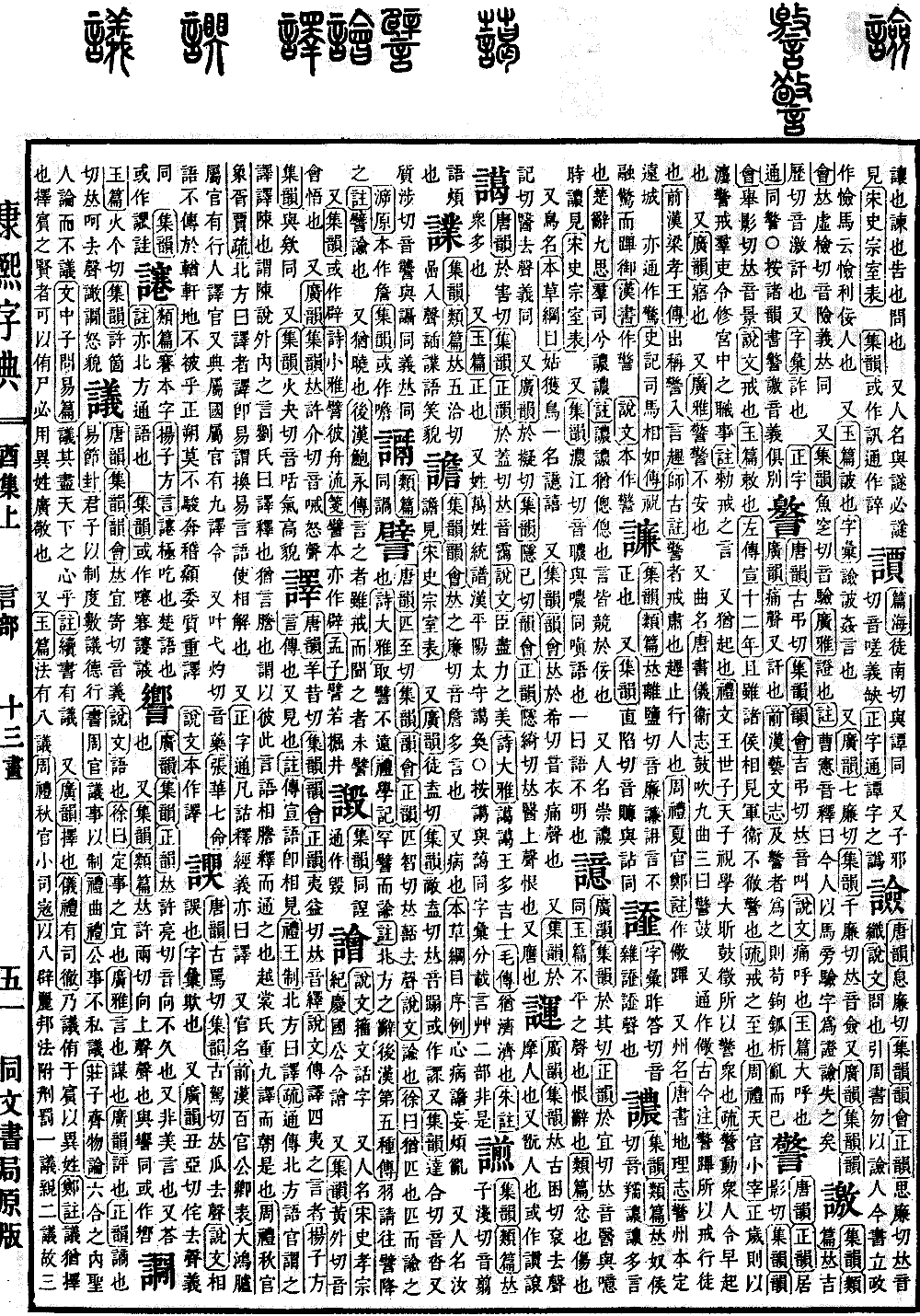
You Collection, Upper Volume
Radical: Speech (yán)
Translation: Yì
Kangxi Stroke Count: 20
Page 1183, Entry 19
Pronounced yì. According to the Shuowen Jiezi (Shuowen), it refers to those who translate the languages of the four barbarian tribes. According to the Fangyan (Regional Languages) by Yang Xiong, it also means to communicate or to meet. The commentary explains that to communicate or propagate speech is to meet. In the Book of Rites (Liji), specifically the Royal Regulations section, it states that those of the north are called interpreters. The sub-commentary states that the official who communicates the language of the north is called an interpreter. To interpret is to explain; it means to articulate the speech of those from outside and inside. Mr. Liu states: to interpret is to release, similar to transcribing, meaning to transcribe and release the speech of both sides to make them understood, such as the people of Yueshang who arrived at the court after nine interpretations. According to the commentary by Jia Gongyan on the Rites of Zhou (Zhouli), specifically the chapter on the Ministry of Autumn and the Xiangxu official, those of the north are called interpreters because interpretation means to change, that is, to exchange languages so that they may understand one another. Additionally, according to the Zhengzitong (Correction of Characters), the explanation of the meanings of classics is also called interpretation. It is also an official title. According to the Table of Officials and Ministers in the History of the Former Han (Qian Han Shu), the Ministry of Protocol had subordinates including heralds and interpreters, and the Ministry of Dependent States had an office for the nine interpreters. It is also pronounced yuè. In the Seven Exhortations (Qi Ming) by Zhang Hua, it is written: Languages are not transmitted by light carriages, and the lands are not covered by the orthodox calendar; yet none fail to gallop forward and strike their foreheads to the ground, offering their allegiances through repeated interpretations. In the original Shuowen Jiezi, the character was written in a variant form.