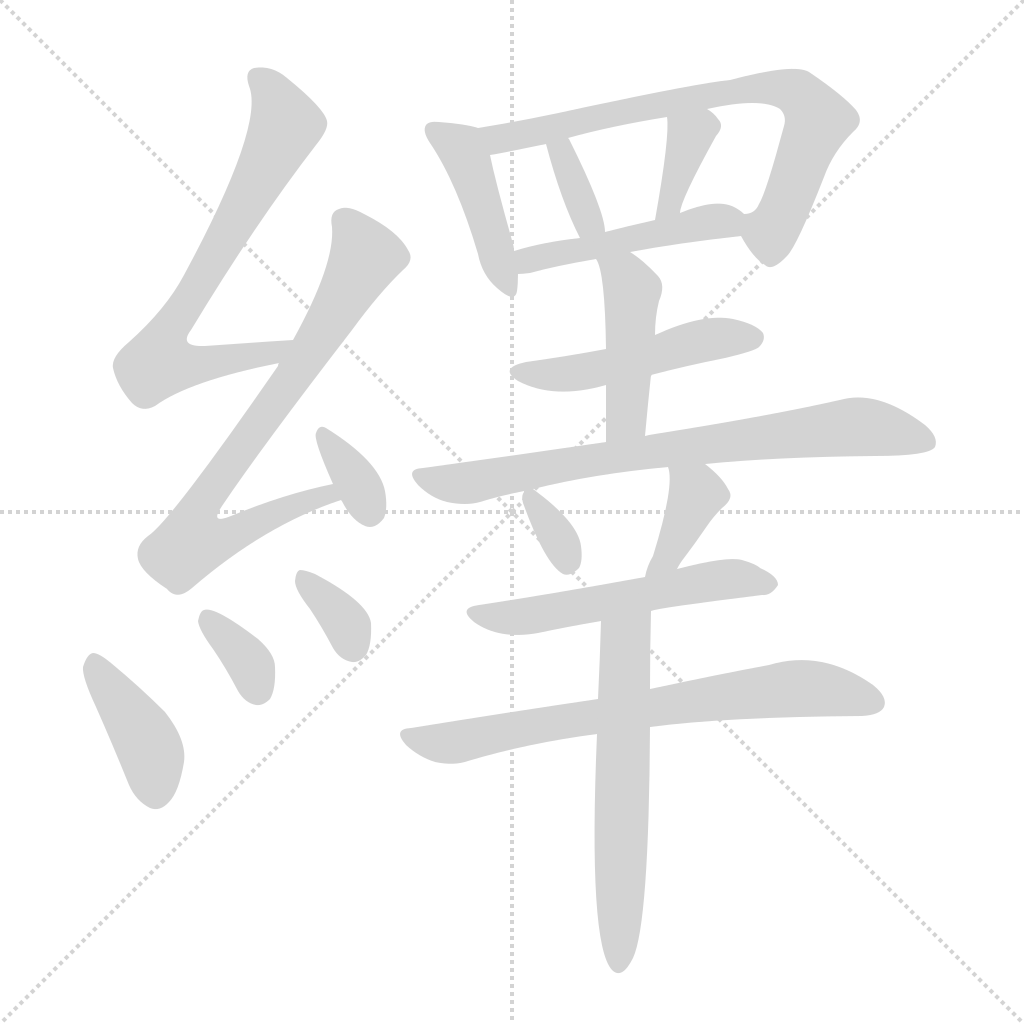
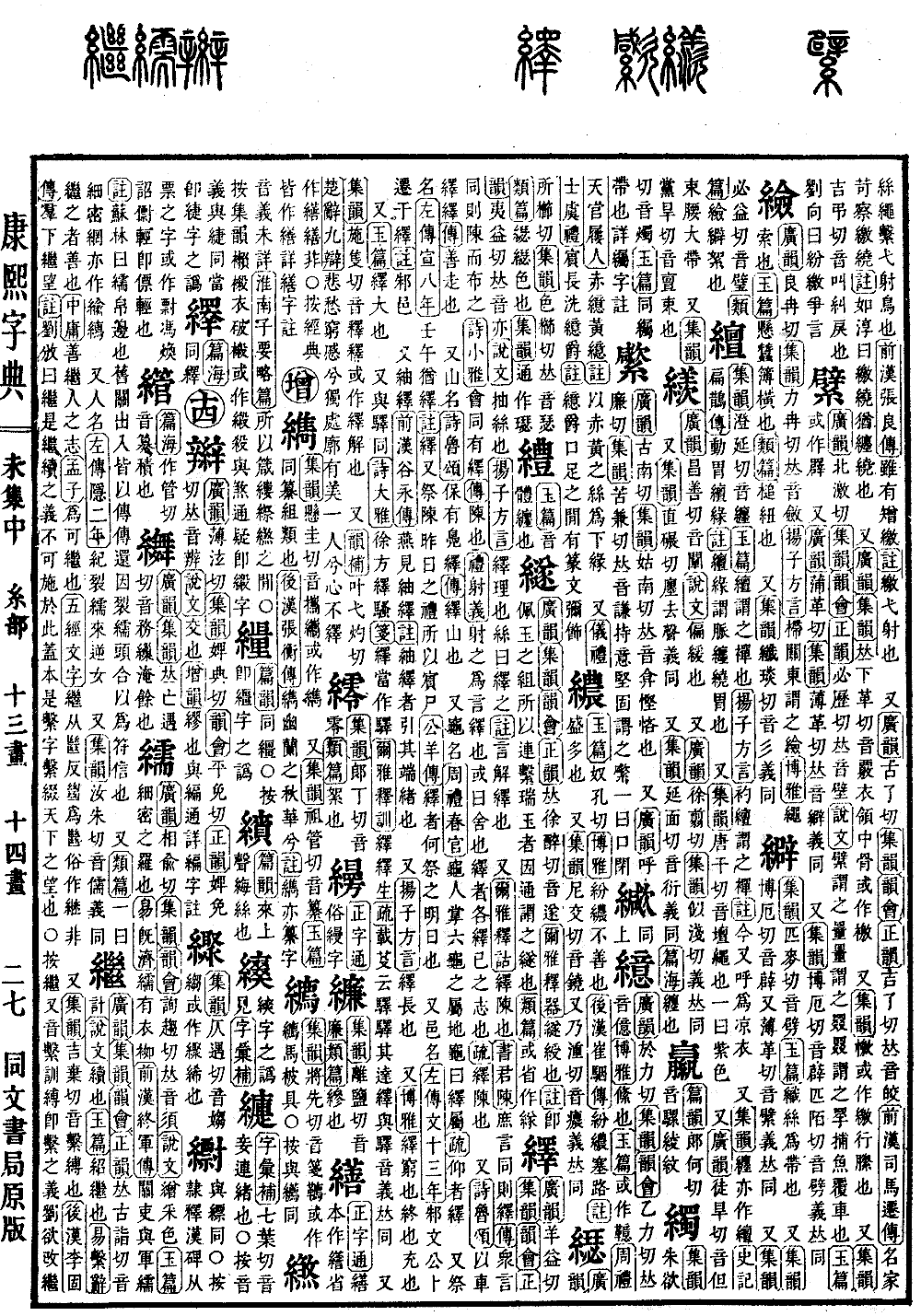
Wei Collection, Lower Volume
Radical: Silk (mì)
Kangxi Strokes: 19
Page 941, Entry 15
Guangyun (Dictionary of Rhymes) pronounces it yi (falling-rising tone). Jiyun (Compilation of Rhymes), Yunhui (Collection of Rhymes), and Zhengyun (Correct Rhymes) pronounce it yi (falling-rising tone). The pronunciation is identical to yi (falling-rising tone).
Shuowen Jiezi (Explaining Graphs and Analyzing Characters): To reel silk.
Yangzi Fangyan (Regional Dialects): Yi means to organize. Silk is referred to as the process of reeling it. Commentary: Refers to unraveling and organizing.
Erya Shigu (Approaching Elegance: Explaining Words): Yi means to display or arrange.
Book of Documents (Shujing): When the discourse of the masses is in accord, it is laid out (yi). Commentary: When the common discourse is in accord, it is displayed and made public.
Book of Odes (Shijing): The gathering and assembly have order (yi). Commentary: Means to display or arrange.
Book of Rites (Liji): Archery as a concept refers to order (yi). It may also mean to relinquish; yi means to each state one's own aspirations. Sub-commentary: Yi means to state or present.
Book of Odes (Shijing): With carriages moving in steady succession (yi yi). Commentary: Means good at traveling or running.
Also a mountain name. Book of Odes (Shijing): Preserving the Fu and Yi mountains. Commentary: Yi is the name of a mountain.
Also a type of tortoise. Rites of Zhou (Zhouli): The tortoise official manages the six categories of tortoises; the earth tortoise is called the Yi type. Sub-commentary: The one with an upward-facing shell is called Yi.
Also a sacrificial name. Zuo Commentary (Zuozhuan): On the renwu day, the Yi sacrifice was still performed. Commentary: Yi is a follow-up sacrifice, arranging the rituals of the previous day to respectfully attend to the personator of the deceased. Gongyang Commentary (Gongyang Zhuan): What is Yi? It is the second day of sacrifice.
Also an ancient city name. Zuo Commentary (Zuozhuan): Duke Wen of Zhu divined and relocated his capital to Yi. Commentary: A city of the State of Zhu.
Also chouyi (to unravel and explain). Book of Han (Hanshu): To meet in private and deliberate (chouyi). Commentary: Chouyi means to draw out the threads of a matter.
Yangzi Fangyan (Regional Dialects): Yi means long or extended.
Guangya (Broad Glossary): Yi means exhausted, finished, or filled.
Yupian (Jade Chapters): Yi means big or great.
Identical to yi (post-station). Book of Odes (Shijing): The Xu region is in turmoil (yisao). Commentary: Yi should be written as yi (post-station).
Erya Shixun (Approaching Elegance: Explaining Teachings): Yiyi means to grow. Sub-commentary: Zaisan states: vigorous is its growth. Yi and yi (post-station) are the same in pronunciation and meaning.
Jiyun (Compilation of Rhymes): Pronounced shi (falling-rising tone). Shi is sometimes written as Yi. It means to explain or interpret.
Yunbu (Supplementary Rhymes): Rhymes with zhuo (entering tone). Chu Ci (Songs of Chu): Sorrowful, poor, and grieving, I dwell alone in the vastness; there is a beautiful person, but my heart is not at ease (yi).
Textual verification: Erya Shixun, yiyi, growth. Added the character meaning as per the original text.