Chen Collection, Lower Volume
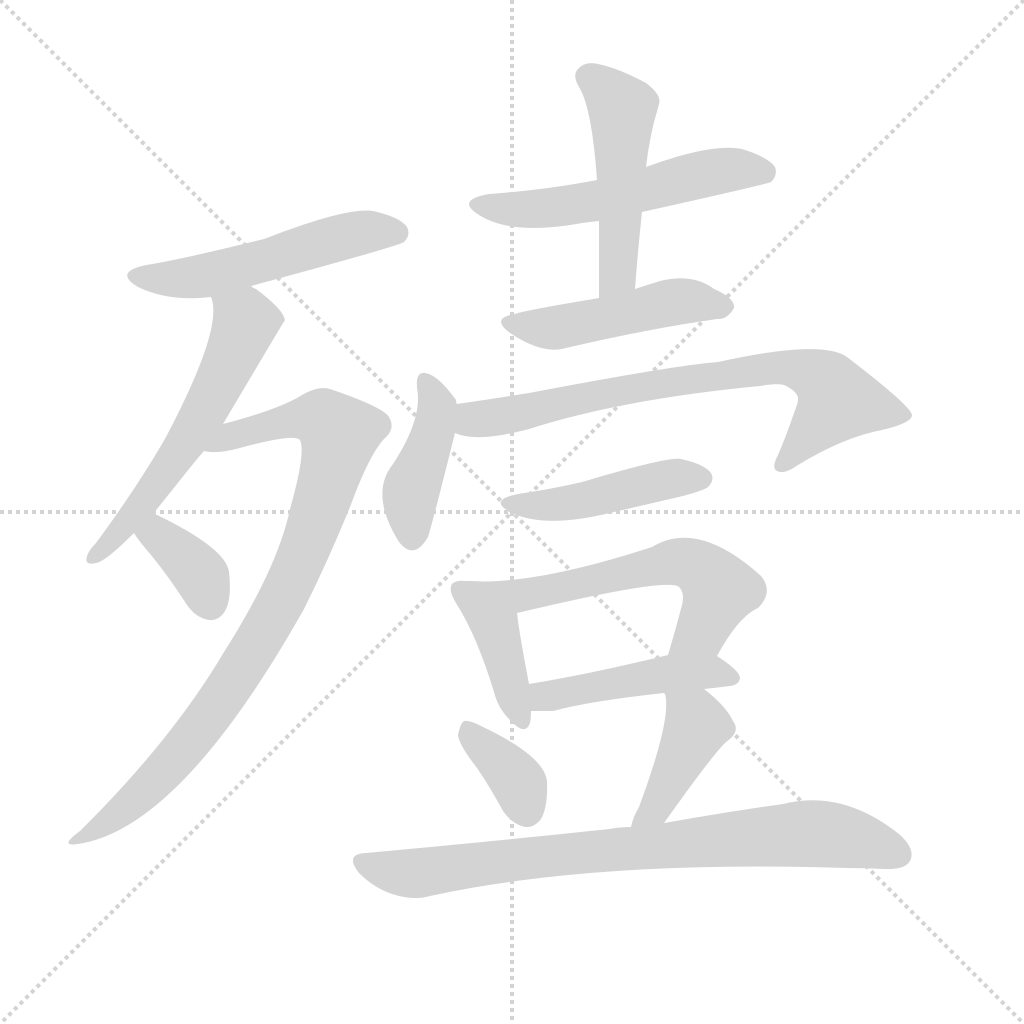
Radical: Evil (dǎi)
Kangxi Strokes: 16
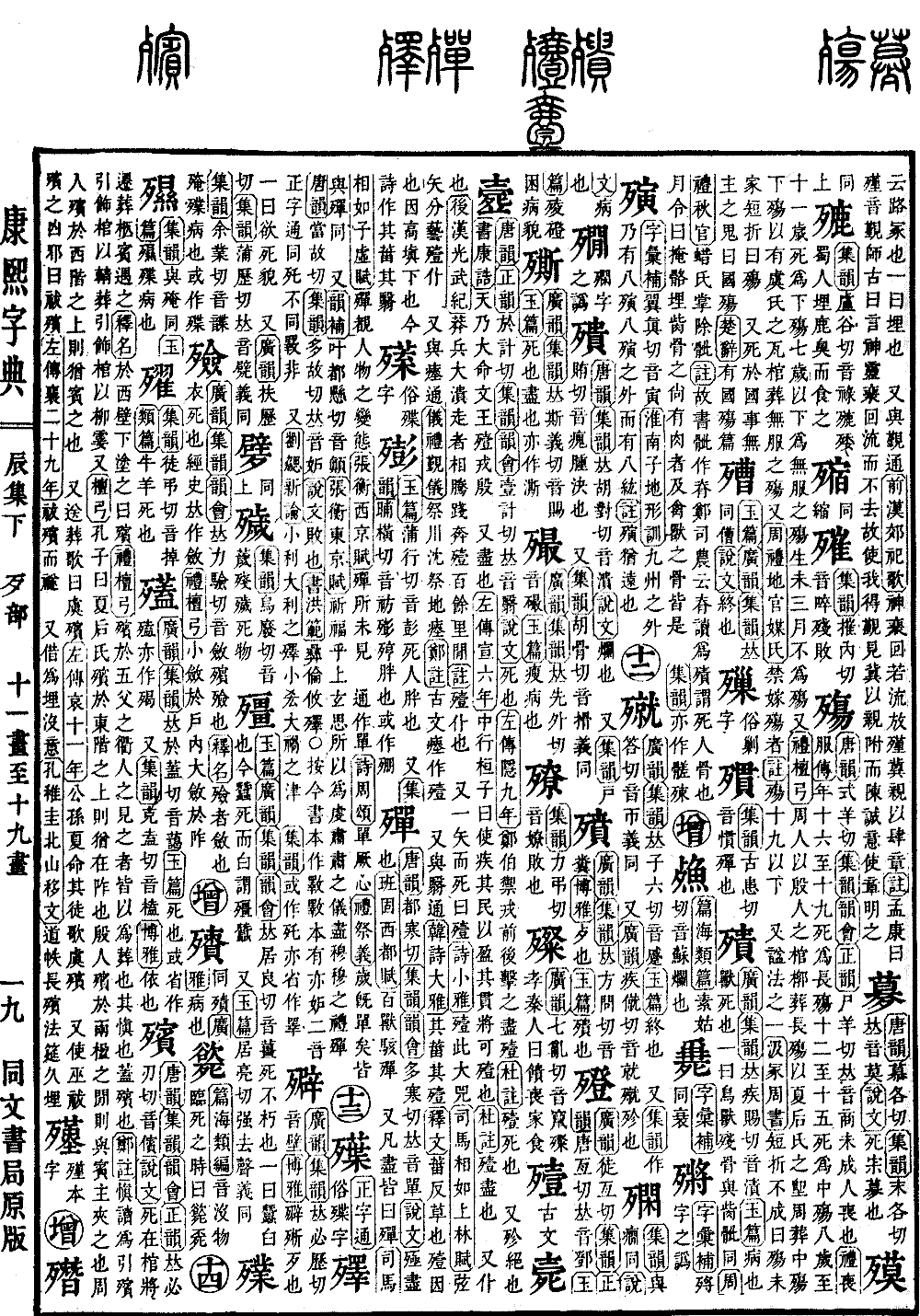
Page 583, Entry 25
According to Tang Rhymes (Tangyun) and Correct Rhymes (Zhengyun), the pronunciation is yi (falling tone). According to Collected Rhymes (Jiyun) and Rhyme Collection (Yunhui), the pronunciation is yi (falling tone). It is pronounced the same as yi (falling tone).
Shuowen Jiezi explains it as: death.
Commentary in Zuo Zhuan (Zuozhuan) on the ninth year of Duke Yin states: The Earl of Zheng defended against the Rong people, attacking from front and rear, and annihilated them all.
Du Yu comments: Yi means death.
It also refers to extermination.
Book of Documents (Shangshu), Kang Gao states: Heaven bestowed the great mandate upon King Wen, allowing him to exterminate the Shang dynasty.
It also means to exhaust or entirely.
Zuo Zhuan (Zuozhuan) on the sixth year of Duke Xuan states: Zhonghang Huanzi said: Let him harm his own people, and when his accumulated evils are full, he can be entirely destroyed.
Du Yu comments: Yi means to exhaust.
It also refers to falling or collapsing.
Book of the Later Han (Hou Hanshu), Annals of Emperor Guangwu states: Wang Mang’s army was routed and fled; the fleeing soldiers trampled each other, and corpses lay fallen for over a hundred miles.
The commentary states: Yi means to fall prostrate.
It also refers to killing with a single arrow, called yi.
Book of Odes (Shijing), Lesser Odes (Xiaoya) states: Shoot dead this great wild ox.
Sima Xiangru’s Rhapsody on the Shanglin Park (Shanglin Fu) states: Arrows flew thick, striking the targets, and the prey fell to the ground at the sound.
It is also used interchangeably with yi (to bury).
Book of Etiquette and Ceremonial (Yili), Court Audience Rites (Jinli) states: Sacrifices to rivers utilize deep immersion, while sacrifices to the land utilize burial.
Zheng Xuan comments: In ancient texts, yi (to bury) was written as yi.
It is also used interchangeably with yi (to shade or withered trees).
Han Commentary on the Book of Odes (Hanshi), Greater Odes (Daya) states: Those withered grasses and those fallen trees.
The explanation states: Zi refers to the overturning of grass roots. Yi refers to relying on the terrain, leveling the low with the high. Current versions of the Book of Odes (Shijing) write it as its withered plants and its shade.