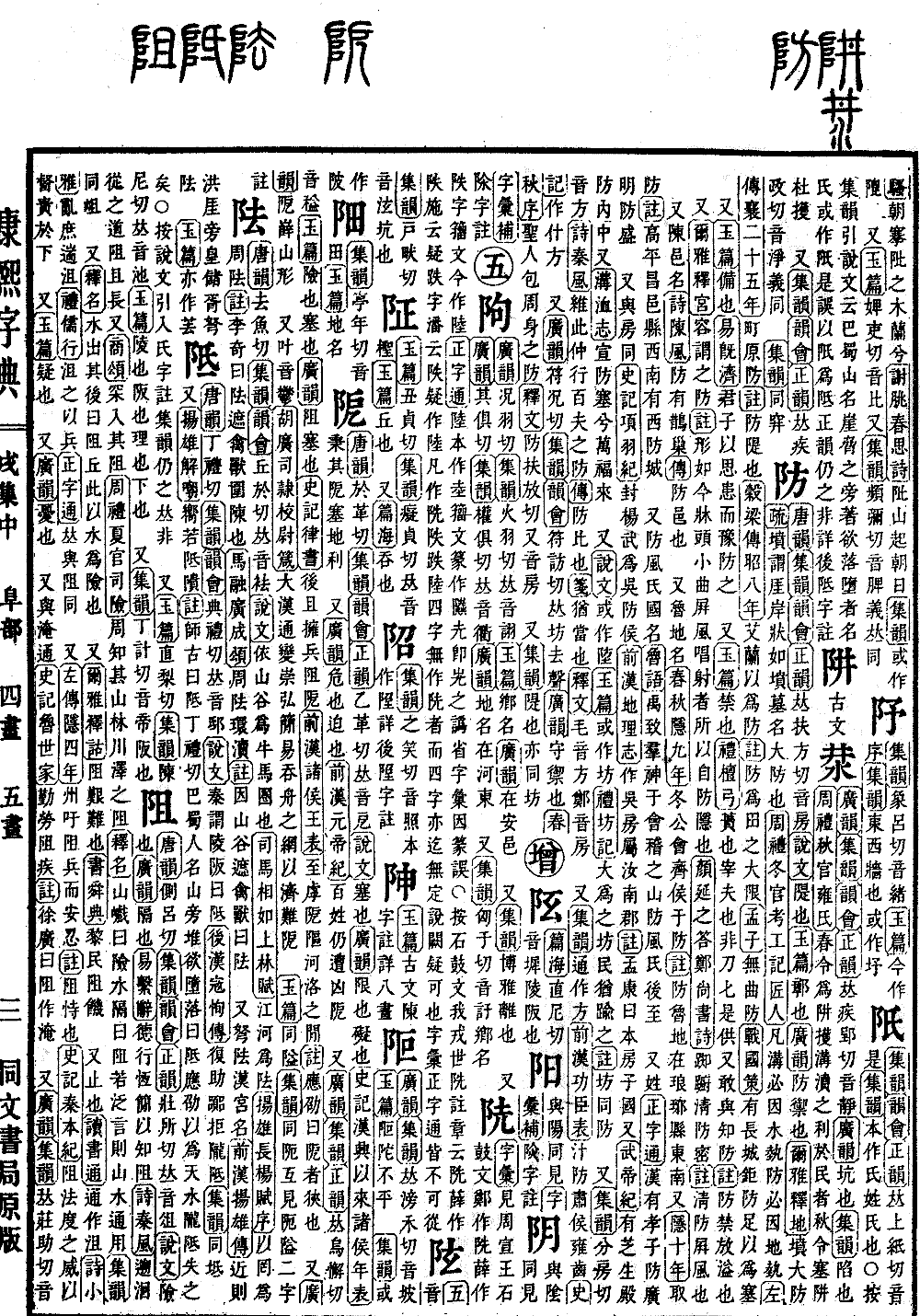
Xu Collection, Middle Volume
Radical: Mound (fù)
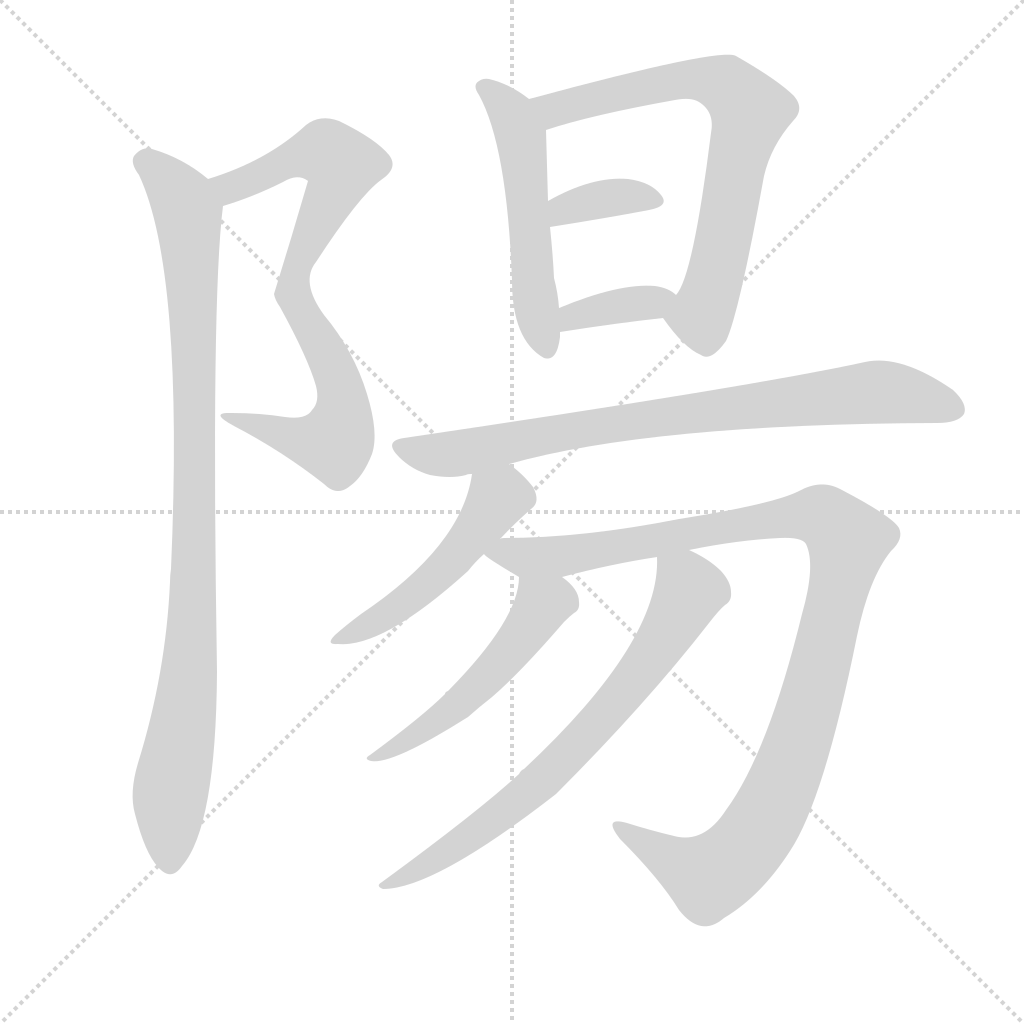
陽
Kangxi Strokes: 17
Page 1347
Archaic Form:
"With hair gathered in tufts like horns" — Book of Odes (Shijing)
[Tang Rhyme] Pronounced yáng in the cháng (tranquil, serene) tone.
[Collected Rhymes] [Rhyme Compendium] [Correct Rhyme] Pronounced yáng in the yáng (ocean, vast) tone.
[Jade Chapters] The work of Heaven, illuminating all things, is called yang.
[Analytical Dictionary of Characters] Brightness; height. Also, the sun.
"The dew is so heavy, it will not dry without the sun" — Book of Odes (Shijing), Lesser Odes (Xiaoya). Commentary: Yang refers to the sun.
"The Son of Heaven should face the yang (sun)" — Zuo Commentary (Zuozhuan), Duke Wen, 4th year.
"The Yin people sacrificed at their yang" — Book of Rites (Liji), Meaning of Sacrifices (Jiyi). Annotation: Yang refers to midday.
"Sun-dried by the autumn yang" — Mencius (Mengzi).
Also, "Gathered at the many yangs, entered the Emperor's palace" — Chu Lyrics (Chuci), Far Roaming (Yuan you). Annotation: Accumulated yang forms heaven; heaven has nine layers, hence "many yangs" (chóngyáng).
Also, [Jade Chapters] Double. Also, month's division.
[Erya], Explanation of Heaven: The tenth month is yang.
"The year is also in yang" — Book of Odes (Shijing), Lesser Odes (Xiaoya).
Also, [Erya], Explanation of Heaven: Spring is green yang (qīngyáng). Annotation: The qi is clear and warm yang.
Also, [Erya], Explanation of Heaven: When the Grand Year is in guǐ, it is called zhāoyáng.
Also, the fifth day of the fifth month is called duānyáng, and the ninth day of the ninth month is called chóngyáng, as seen in [Expanded Meaning of Monthly Ordinances].
Also, [Erya], Explanation of Mountains: West of a mountain is xìyáng (sunset), east of a mountain is zhāoyáng (sunrise).
"Crossing its xìyáng" — Book of Odes (Shijing), Greater Odes (Daya).
"The phoenix tree grows there, towards the zhāoyáng" — Book of Odes (Shijing), Greater Odes (Daya).
Also, north of water.
"On the north bank of the Qia River" — Book of Odes (Shijing), Greater Odes (Daya).
[Guliang Commentary], Duke Xi, 28th year: North of water is yang.
Also, [Explanation of Names] A high mound is called a yángqiū, because its elevation is close to yang.
Also, "My vermilion is very yang" — Book of Odes (Shijing), Odes of Bin (Binfeng). Commentary: Yang means bright.
Also, [Jade Chapters] Clear.
Also, "Dragon banners, yangyang" — Book of Odes (Shijing), Odes of Zhou (Zhousong). Commentary: Yangyang means having patterns or designs.
Also, "The gentleman, yangyang" — Book of Odes (Shijing), Odes of Wang (Wangfeng). Commentary: Yangyang means having no particular concerns in his heart.
Also, [Rites of Zhou (Zhouli)], Officials of Earth (Diguan), Grand Minister of Education (Dasitu): "Teaching humility with yang rituals, the people will not contend." Annotation: Yang rituals refer to the rites of village archery and drinking.
Also, a state name.
[Spring and Autumn Annals (Chunqiu)], Duke Min, 2nd year: "The Qi people relocated Yang." Annotation: Yang is a state name.
[Strategies of the Warring States (Zhanguoce)]: "Stopping a leaking boat and making light of the waves of Yanghou." Annotation: [Records of Many Things] states that the Marquis of Jinyang drowned and became the god of the great sea.
Also, [Spring and Autumn Annals (Chunqiu)], Duke Zhao, 12th year: "Qi's Gao Yan led an army to reinstate the Earl of Northern Yan in Yang." Annotation: Yang is Tang, a separate city of Yan; Zhongshan has a Tang county.
Also, a county name.
[Records of the Grand Historian (Shiji)], Annals of Emperor Gaozu: "West past Gaoyang." Annotation: Belonging to Liu.
Also, a pass name.
[History of the Former Han (Qian Han)], Western Regions (Xiyu) Treatise: "7802 li from Yang Pass."
Also, [Zuo Commentary (Zuozhuan)], Duke Zhao, 24th year: "Gongsun Yu of Qi, encamped at Yangzhou."
Also, Yangcheng, a mountain name. During the Han dynasty, it was a county, belonging to Yingchuan Commandery.
Also, an ancient emperor's title.
[Records of the Grand Historian (Shiji)], Annals of the Five Emperors: Emperor Zhuanxu Gaoyang.
Also, [Explanation of Names] The character for standing person (lì rén) resembles a person standing. Or, it is called yangmen (yang gate), because the front is yang, and the two sides resemble a gate.
Also, [Jade Chapters] Injury.
Also, [Zhuangzi], Mastering Life (Dasheng) chapter: "Among those in the northwest, yíyáng resides there." Annotation: Yíyáng is a ghost's name.
Also, [Baopuzi], Ascending and Traversing (Dengshe) chapter: "When trees in the mountains can speak human words, it is not the tree itself that can speak, but its essence doing so, named cúnyáng."
Also, chāngyáng, another name for sweet flag.
[Han Yu], Treatise on Advancing in Learning (Jinxuejie): "Chāngyáng extends one's years."
Also, a surname.
[Records of the Grand Historian (Shiji)], Sima Xiangru's "Rhapsody on the Master of Nothing" (Zixu Fu): "Yangzi was his outrider." Annotation: The ancient immortal Yangling.
[Guangyun]: King Jing of Zhou enfeoffed his youngest son in Yangfan; his descendants adopted the fief name as their surname.
Also, during the Han dynasty, there were twenty-two compound surnames: Ouyang, Gaoyang, Qingyang, Sunyang, Ziyang, Zhouyang, Jingyang, Biyang, Gengyang, Xiyang, Guiyang, Yeyang, Lingyang, Xianyang, Liyang, Puyang, Taiyang, Laoyang, Anyang, Chengyang, Zhuyang, Suoyang.
Also, commonly written as yáng.
[Book of Rites (Liji)], Jade Ornament (Yuzhao): "Full of qi, truly yáng and xiū." Annotation: Diān is read as tián. Yáng is read as yáng. Filling the body with qi, making one's breath full, like the yang qi embodies things.
[Explanation of Names] Yang is yáng (to spread), the qi spreading outward.
Also, synonymous with yáng (to pretend).
[Book of Rites (Liji)], Tan Gong (Tangong): "Pretending to be good at it."
[History of the Former Han (Qian Han)], Annals of Emperor Gao: "Pretended to honor King Huai as the Righteous Emperor, but in fact did not follow his commands."
Also, pronounced cháng.
[Erya], Explanation of Ancient Words: "Yang, to give." Annotation: The Lu version of the Book of Odes (Lushi) says: "How can yang be like this?" Today, people in Ba and Pu call themselves āyáng. Commentary: The [History of the Han Dynasty (Hanshu)], Treatise on Arts and Literature (Yiwenzhi) states that Shen Gong of Lu taught the Book of Odes, hence it is the Lu version. Its classic text says: "How can yang be like this?" Shen Gong took yang to mean "to give," so he cited it. [Explanation of Texts]: Yang is pronounced cháng.
[Collected Rhymes of Five Tones] Vulgar form is.
[Character Dictionary] Also vulgarly written as diàn.
[Character Dictionary Supplement] Also written as yángyáng.