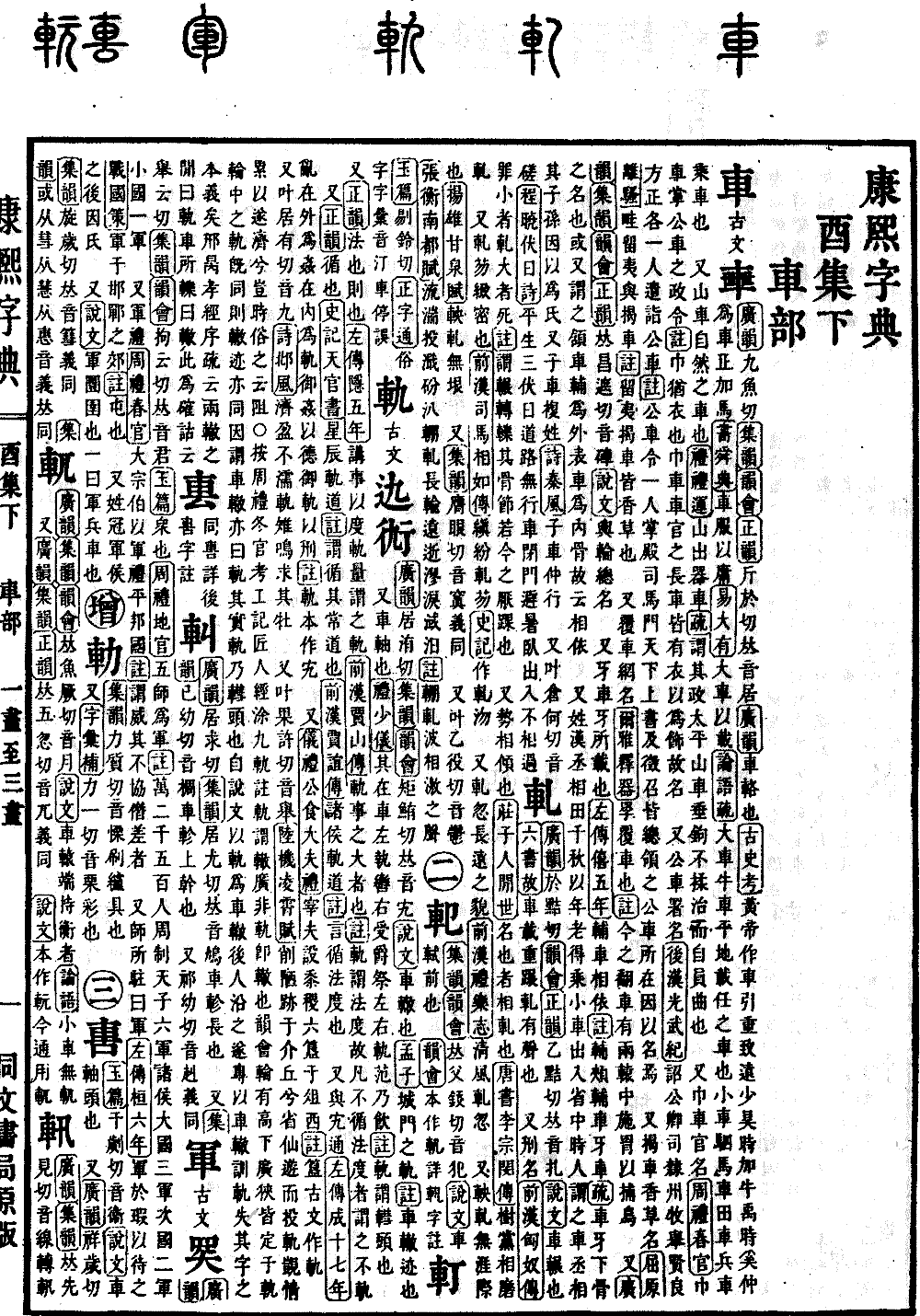
You Collection, Lower Volume
Radical: Carriage (chē)
Ya (yá); Kangxi stroke count: 8; Page 1239
Pronounced zha
According to the Analytical Dictionary of Chinese Characters (Shuowen Jiezi), it refers to the crushing motion of a carriage. According to the Detailed Explanation of the Six Writings (Liushuguxu), it describes the sound made by a carriage bearing a heavy load as it crushes and rolls.
Also refers to a type of punishment. According to the History of the Former Han Dynasty (Qianhan Shu), records on the Xiongnu state that those with minor crimes are crushed, and those with major crimes are put to death. The commentary explains this as the crushing and grinding of bones and joints, similar to modern foot-crushing punishments.
Also refers to mutual conflict or rivalry. According to the Zhuangzi, reputation is that which causes people to struggle against one another. According to the History of the Tang Dynasty (Tang Shu), biographies of Li Zongmin, it refers to forming factions and mutually grinding against one another.
Also refers to dense or tight, as in the phrase zha-wu. According to the History of the Former Han Dynasty (Qianhan Shu), biography of Sima Xiangru, it describes a fine, dense texture. The Records of the Grand Historian (Shiji) records this as zha-wu.
Also refers to a long or distant appearance, as in zha-hu. According to the History of the Former Han Dynasty (Qianhan Shu), Treatises on Rites and Music, it describes a clear wind stretching far and wide.
Also refers to boundless or vast, as in the phrase yang-zha. According to Yang Xiong's Rhapsody on Sweet Springs (Ganquan Fu), it describes an infinite expanse.
Pronounced ya. Same meaning as above.
Also rhymes with yu. According to Zhang Heng's Rhapsody on the Southern Capital (Nandu Fu), referring to the rushing rapids and the clashing sounds of the waves. The long current flows far away, turbulent and deep. The commentary explains this as the sound of waves crashing against each other.