Xu Collection, Upper Volume
Radical: Metal (jīn)
Yue
Kangxi stroke count: 13
Page 1302, Entry 02
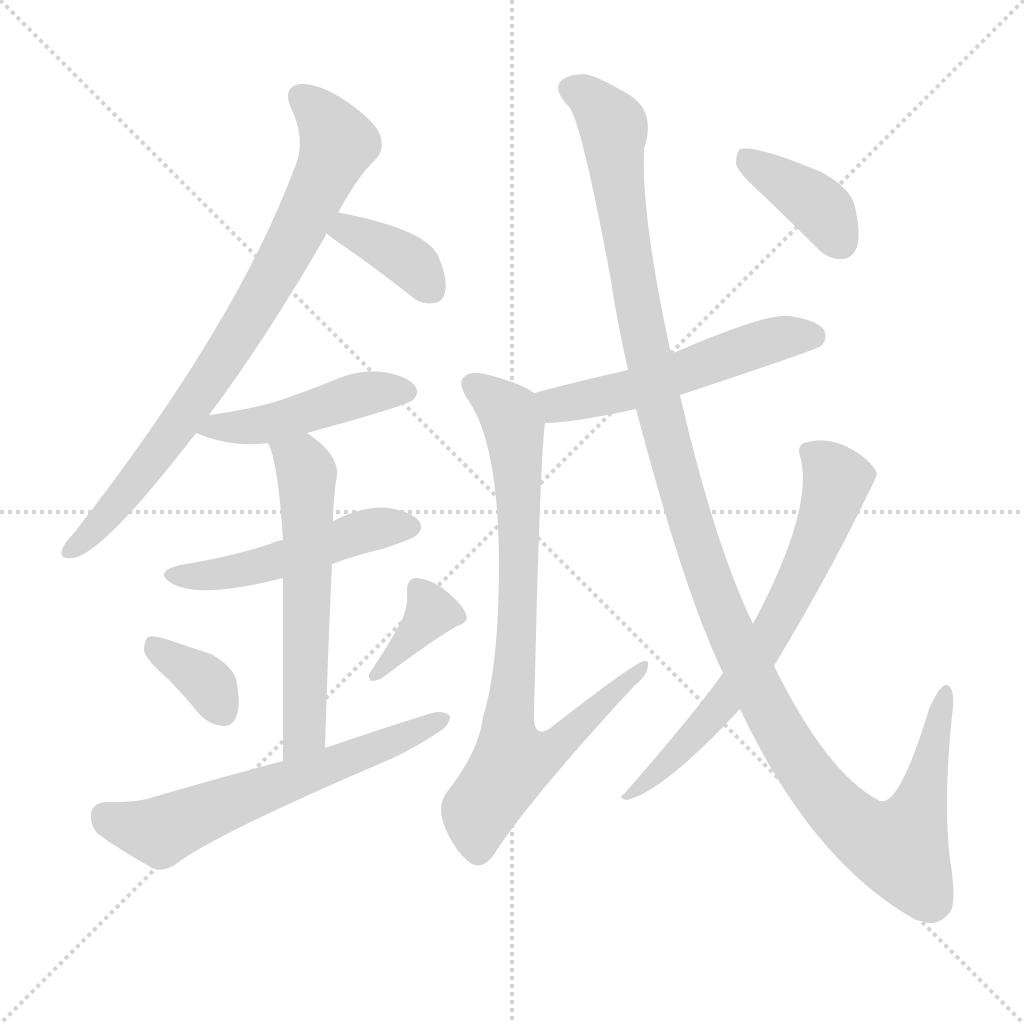
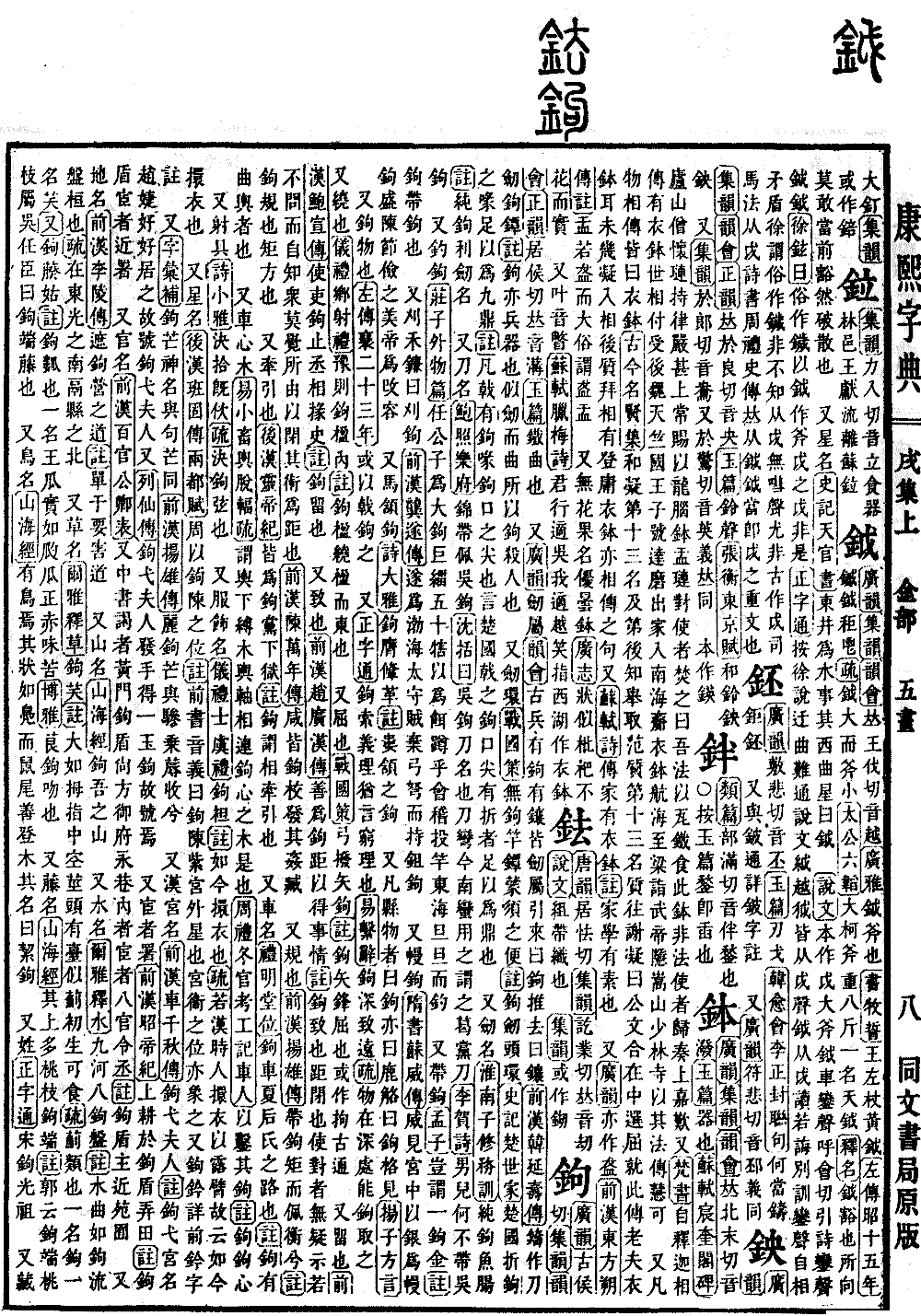
According to Guangyun (Rhyme Dictionary), Jiyun (Collected Rhymes), and Yunhui (Collection of Rhymes), the pronunciation is yue. According to Guangya (Expanded Er Ya), a yue is an axe. In the Book of Documents (Shujing), specifically the Muye Oath, it is stated that the king held a yellow yue in his left hand. In the Zuo Tradition (Zuo Zhuan), in the fifteenth year of Duke Zhao, it is mentioned alongside shields and sacrificial spirits. The commentary notes that a yue is large, while an axe is small. In the Six Secret Teachings (Liutao) of Taigong, it is said that a great handle axe weighs eight catties, and it is also known as the celestial yue. According to Shiming (Explanation of Names), yue means to clear away; whatever it is directed toward cannot stand before it, and thus it is cleared and scattered. It is also the name of a star. In the Records of the Grand Historian (Shiji), specifically the Treatise on the Celestial Offices, it is stated that the eastern well represents water affairs, and the curved stars to its west are called Yue.
According to the Shuowen Jiezi (Explaining Graphs and Analyzing Characters), the original form was yue. Regarding the sound of the carriage bells, it is pronounced hui (falling-rising tone), citing the Book of Odes (Shijing): the sound of the bells is yue yue. Xu Xuan says the common form is written as cuo, and to use yue to represent the axe is incorrect. Zhengzitong (Correction of Character Errors) notes that Xu's explanation is circuitous and difficult to understand. The Shuowen Jiezi states that yue and yue all follow the phonetic yue; yue follows yue and is read like hui, yet provides a separate definition for the sound of bells, which is self-contradictory. Xu's claim that the common form cuo is incorrect is also flawed, as he did not realize that following yue does not provide the sound hui, which is even more incorrect. In ancient times, it was written as yue. The Methods of the Sima (Sima Fa) uses yue. The Book of Odes (Shijing), the Book of Documents (Shujing), the Rites of Zhou (Zhouli), and historical traditions use yue. Yue is simply the redundant form of yue.