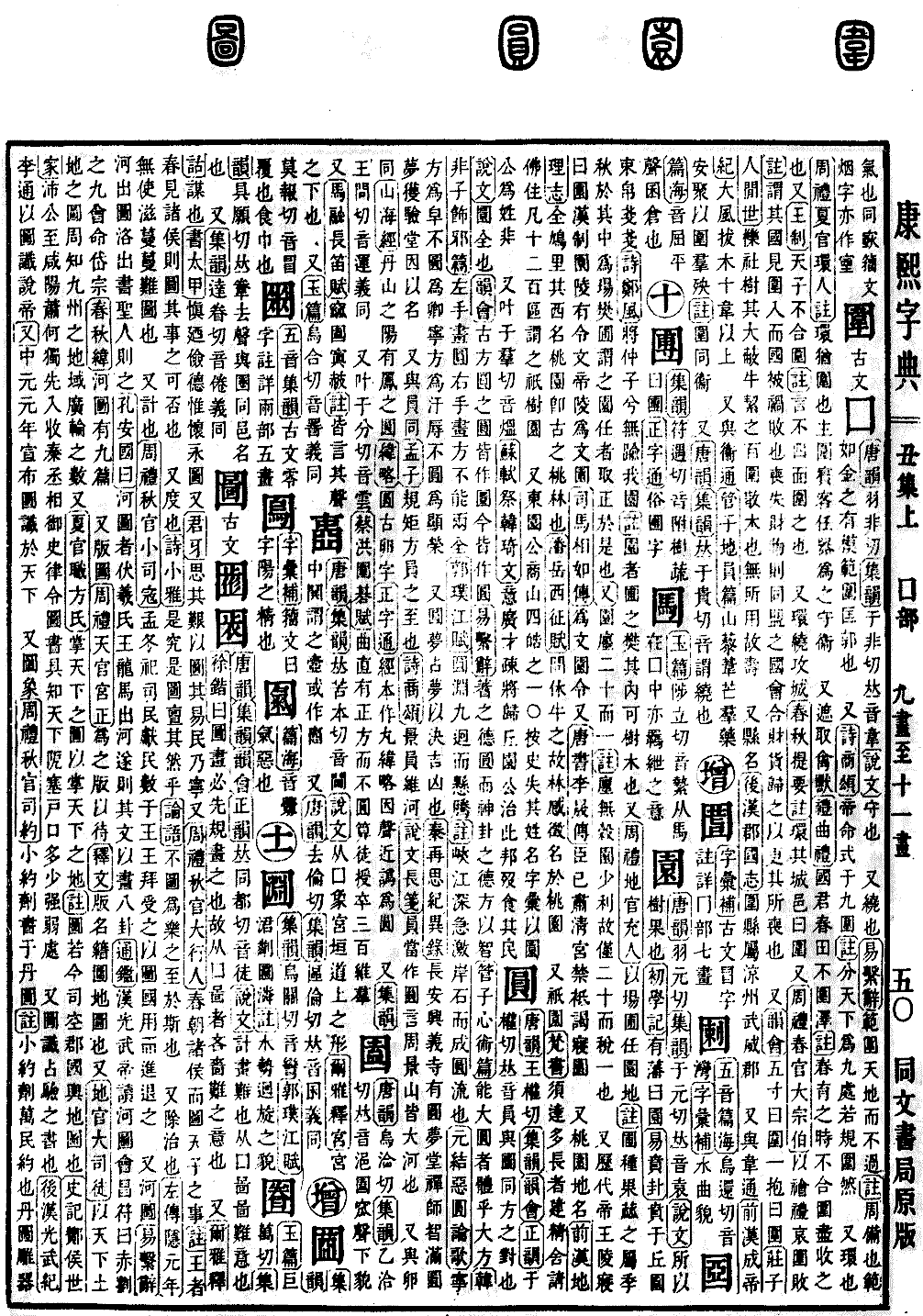
Chou Collection, Upper Volume
Radical: Enclosure (wéi)
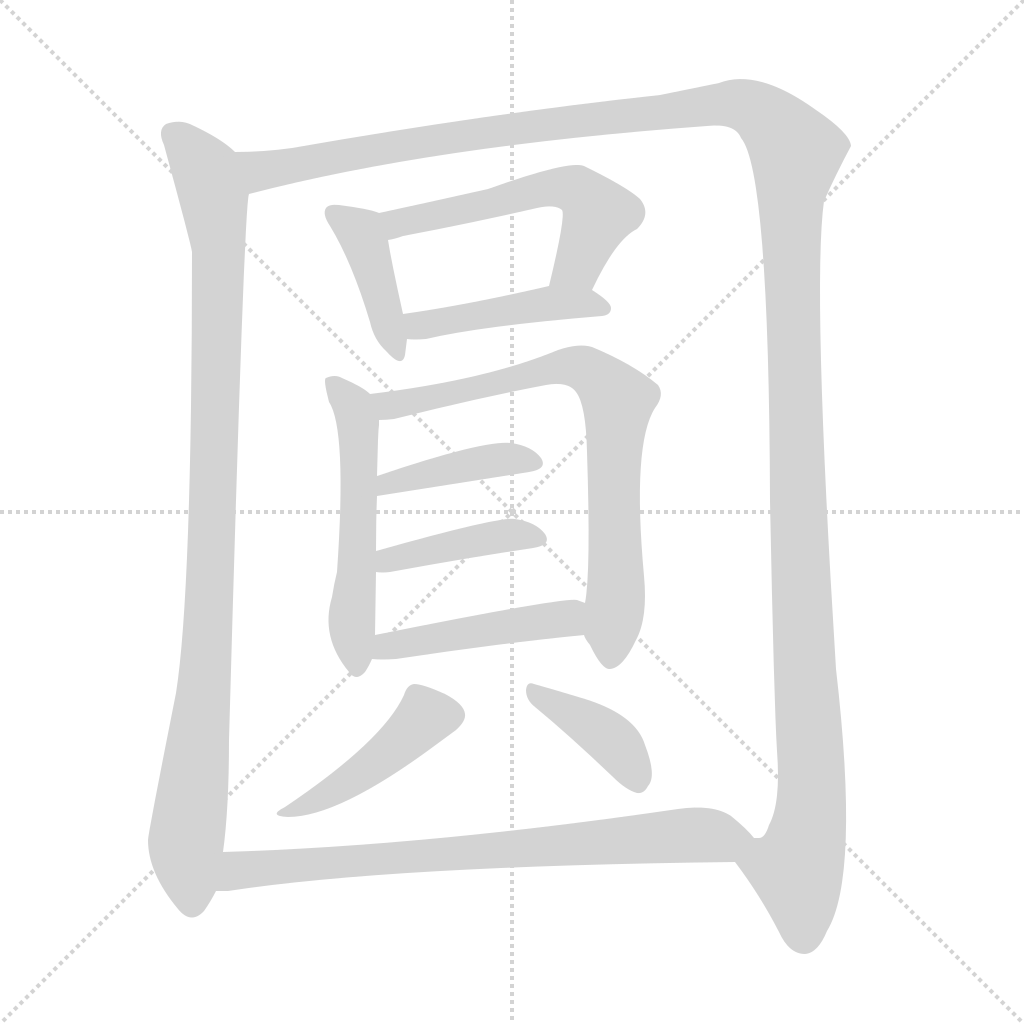
Circle. Kangxi strokes: 13. Page 220, Entry 09.
Pronounced yuan. Same as the character for circle (huán). The opposite of square.
Shuowen Jiezi: Circle, meaning complete.
Yunhui: In ancient times, both square and round were written as circle (huán); now both are written as circle (yuán).
Book of Changes (Yijing), Commentary on the Appended Phrases: The nature of yarrow stalks is flexible and miraculous, while the nature of the hexagrams is righteous and wise.
Guanzi, Heart Technique: Those who can achieve great harmony must conform their bodies to the Great Dao.
Han Feizi, Ornamentation of Evil: Drawing a circle with the left hand and a square with the right hand, one cannot perfect both simultaneously.
Guo Pu, River Rhapsody: The circular deep abyss swirls through nine bends, with water currents surging in mid-air.
Commentary: The gorge river flow is deep and rapid, striking the shore rocks to form circular whirlpools.
Yuan Jie, Song on the Theory of Loathing Slickness: I would rather be square and serve as a humble clerk than be slick and serve as a high minister. I would rather be square and endure humiliation than be slick and achieve glory.
Also refers to interpreting dreams, determining fortune by explaining dreams.
Qin Zaisi, Records of Anomalies: In Chang'an at Xingyi Temple, there is a Hall of Interpreting Dreams. The Chan master Zhiman was efficacious at interpreting dreams, and the hall was named accordingly.
Also identical to the character for member (yuán).
Mencius: Compasses and squares are the highest standards for squares and circles.
Book of Odes (Shijing), Eulogies of Shang: The surrounding borders all encircle the Yellow River.
Shuowen Changjian: The character for member (yuán) should be written as circle (yuán), meaning the surrounding Jingshan mountains all encircle the great river.
Also identical to the character for egg (luǎn).
Classic of Mountains and Seas (Shanhaijing): South of Mount Dan, there are phoenix eggs.
Weilue: Circle (yuán) is the ancient character for egg (luǎn).
Zhengzitong: The original text of the classics was written as ball (wán); the Weilue miswrote it as circle (yuán) because the pronunciations are similar.
Also, according to Jiyun, pronounced yun. The meaning is the same.
Also, following the rhyme scheme, pronounced yun.
Cai Hong, Rhapsody on Weiqi: The paths of the board each have their own regulations, square and not slick. Calculating the deployment of pieces, three hundred pieces form a group.
Yen, same as circle.