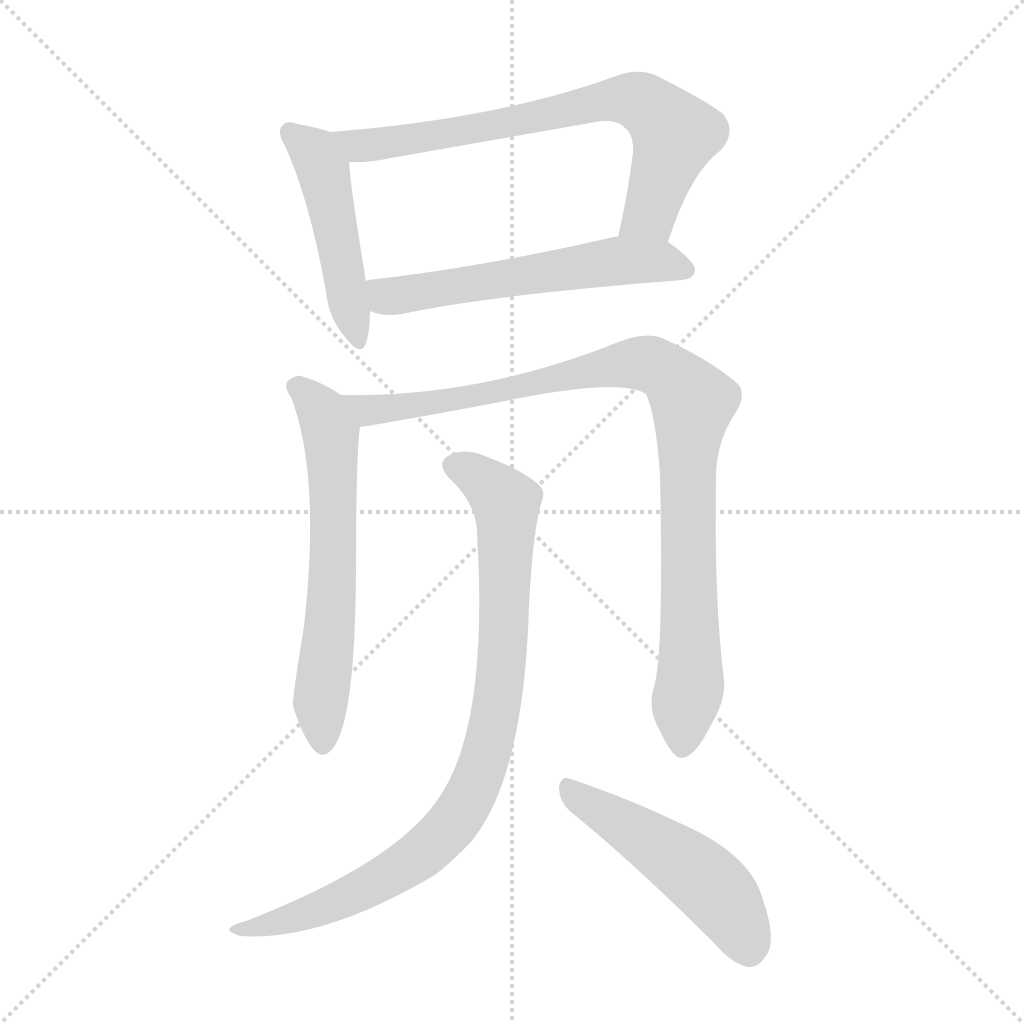
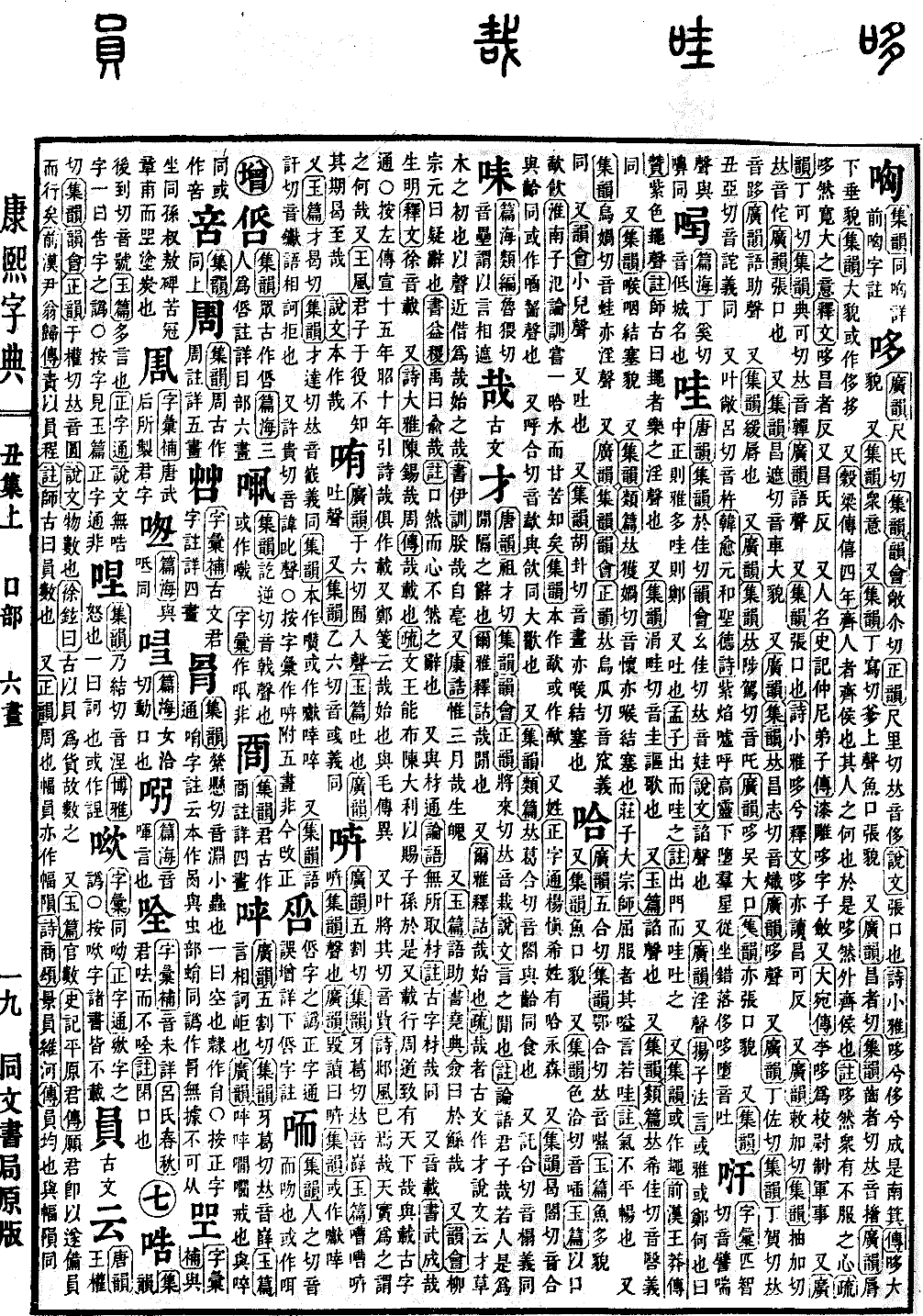
Chou Collection, Upper Volume
Radical: Mouth (kǒu)
Kangxi Strokes: 10
Page 189, Entry 01
According to ancient texts, in Tang Rhymes (Tangyun), pronounced yuan. In Collected Rhymes (Jiyun), Rhyme Meetings (Yunhui), and Orthodox Rhymes (Zhengyun), pronounced yuan. According to the Explaining Graphs and Analyzing Characters (Shuowen), it refers to the counting of objects. Xu Xuan says: In ancient times, cowrie shells were used as currency, hence the term for counting them.
Also, according to the Jade Chapters (Yupian), it refers to the number of officials. In the Biographies of Lord Pingyuan in the Records of the Grand Historian (Shiji), it is written: I wish for you to immediately prepare the count of the members and depart. In the Biography of Yin Wengui in the History of the Former Han (Qianhan), it is written: They were pressed to meet the quota. The commentary by Yan Shigu says: Yuan means number.
Also, according to Orthodox Rhymes (Zhengyun), it means circumference. The term fuyuan (extent of territory) is also written as fuyun. In the Hymns of Shang in the Book of Odes (Shijing), it is written: The extent is as the Yellow River. The commentary says: Yuan means even or uniform. It is the same as the character for fuyun.
Also, according to the Expanded Rhymes (Guangyun) and Collected Rhymes (Jiyun), pronounced yun. According to Expanded Rhymes, it means to increase. In the Minor Odes of the Kingdom in the Book of Odes (Shijing), it is written: Do not abandon your spokes, add them to your fufu. The commentary says: Yuan means to increase.
Also, a place name. In the Biographies of the Xiongnu in the History of the Former Han (Qianhan), it is written: The forward general went beyond the frontier over one thousand two hundred miles, reaching Wuyuan.
Also, used interchangeably with Yun. In the Table of Ancient and Modern People in the History of the Former Han (Qianhan), there is Yuan Gongxin. The commentary by Yan Shigu says: Yuan is read as Yun. It is also interchangeable with Yun. In the Odes of Zheng in the Book of Odes (Shijing), it is written: I shall delight in my cloud-like one. The Explanation of Text (Shiewen) says: Yuan was originally written as Yun. In the Hymns of Shang, it is written: The extent is as the Yellow River. The commentary by Zheng Xuan says: In ancient texts, Yuan was written as Yun. The Explanation of Text (Shiewen) says: Yuan, in Mao's version is pronounced yuan, and in Zheng's version is pronounced yun; both pronunciations are acceptable.
Also, according to Collected Rhymes (Jiyun) and Rhyme Meetings (Yunhui), pronounced yun. According to Collected Rhymes, it is a personal name. In the twenty-sixth year of Duke Xiang in the Zuo Commentary (Zuozhuan), it mentions Xingren Ziyuan.
Also, according to Expanded Rhymes (Guangyun), Collected Rhymes (Jiyun), and Rhyme Meetings (Yunhui), pronounced yun. According to Expanded Rhymes, it is a surname. The Records of Former Liang mention Yuan Chang of Jincheng; the Tang Dynasty had a Prefect of Dizhou named Yuan Banqian. Rhyme Meetings (Yunhui) notes Wu Yuan, a personal name, which later became a surname as people admired him. According to the twentieth year of Duke Zhao in the Zuo Commentary (Zuozhuan), regarding Wu Yuan, the Explanation of Text (Shiewen) records the original pronunciation as yun. Yang Shen said: In the poem by Lu Guimeng, it says that thanks to Wu Yuan the melancholy thoughts were few, he misread it as the level tone. This argument is incorrect. The character Yuan can be read in both the level and departing tones. The Jade Chapters (Yupian) and Expanded Rhymes (Guangyun) write it as the character with the shell radical.
Textual Research: In the Minor Odes of the Kingdom in the Book of Odes, the phrase Do not abandon your spokes, add them to your fufu, has been corrected from the original text to reflect the character for spoke. In the Hymns of Shang, the phrase The extent is as the Yellow River, with the commentary by Zheng Xuan noting the character was anciently written as Yun, has been corrected to follow the original text.