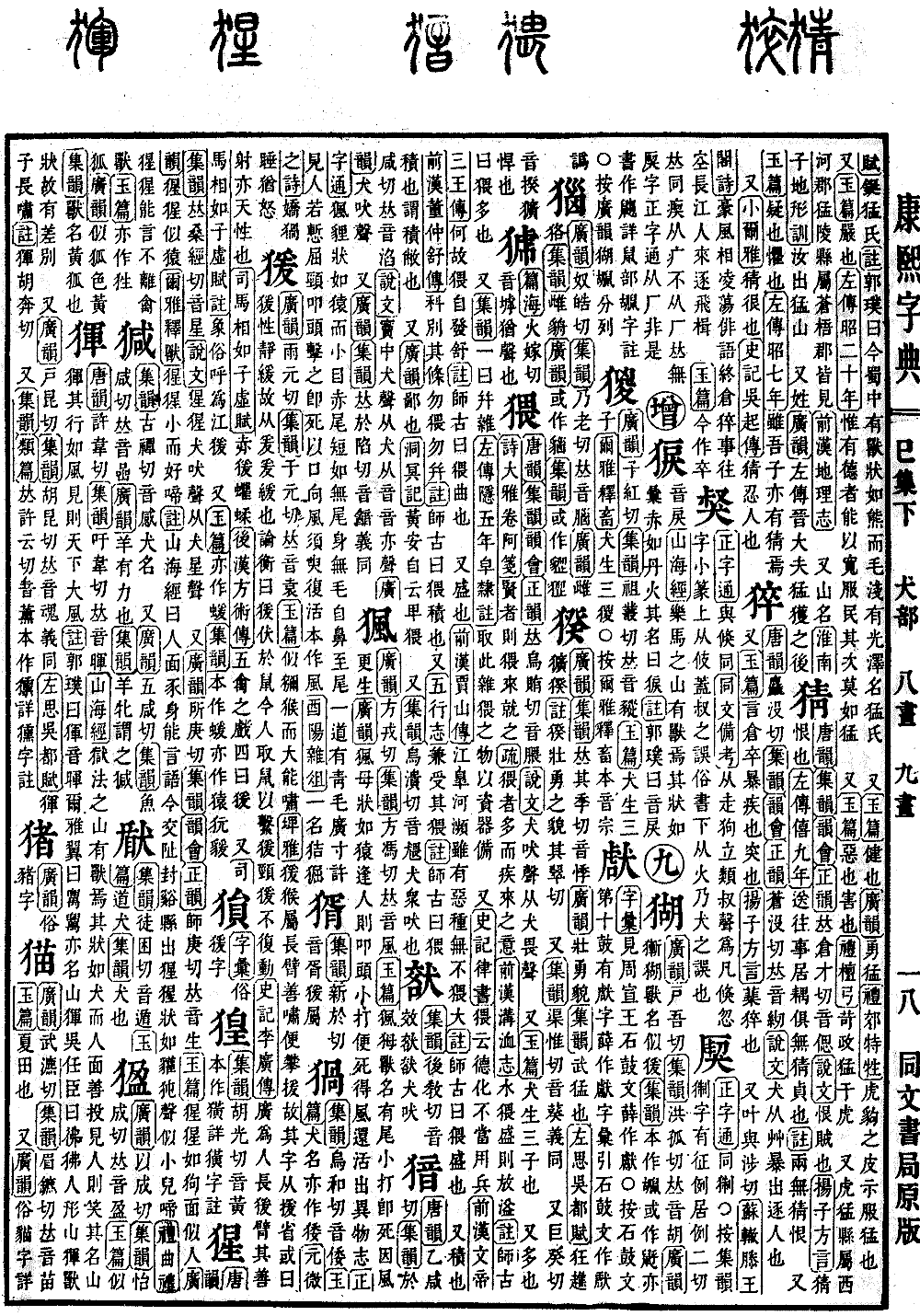
Si Collection, Lower Volume
Radical: Dog (quǎn)
Entry: yuan
Kangxi strokes: 13
Page 714, Entry 18
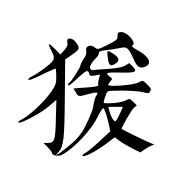
Pronounced yuan.
Jade Chapters (Yupian): Resembles a macaque but with a larger body, capable of emitting a long cry.
埤雅 (Piya): The yuan belongs to the monkey family. Its arms are long, it excels at long cries, and is skilled at climbing, which is why this character is derived from a shortened form of the character for pull/aid. Some also say the nature of the yuan is quiet and slow, which is why it is derived from the yuan component. Yuan signifies slowness.
Discourses Weighed in the Balance (Lunheng): The yuan can be subdued by a rat. Nowadays, people capture a rat and tie it to the neck of a yuan, causing the yuan to become motionless.
Records of the Grand Historian (Shiji), Biography of Li Guang: Li Guang had a large stature and arms as long as a yuan, and his skill in archery was innate.
Sima Xiangru, Rhapsody on the Masters of Void (Zixu Fu): Red yuan and mountain apes.
Book of the Later Han (Hou Hanshu), Biography of Arts and Techniques: In the Five Animal Frolics, the fourth method mimics the movements of a yuan.
Also, Commentary to Sima Xiangru's Rhapsody on the Masters of Void (Zixu Fu): The elephant is commonly called the river yuan.
Jade Chapters (Yupian): Also written in the variant form yuan.
Collected Rhymes (Jiyun): Originally written in the variant form yuan. Also written in the variant form yuan.