Mao Collection, Upper Volume
Radical: Heart (xīn)
Kangxi stroke count: 17
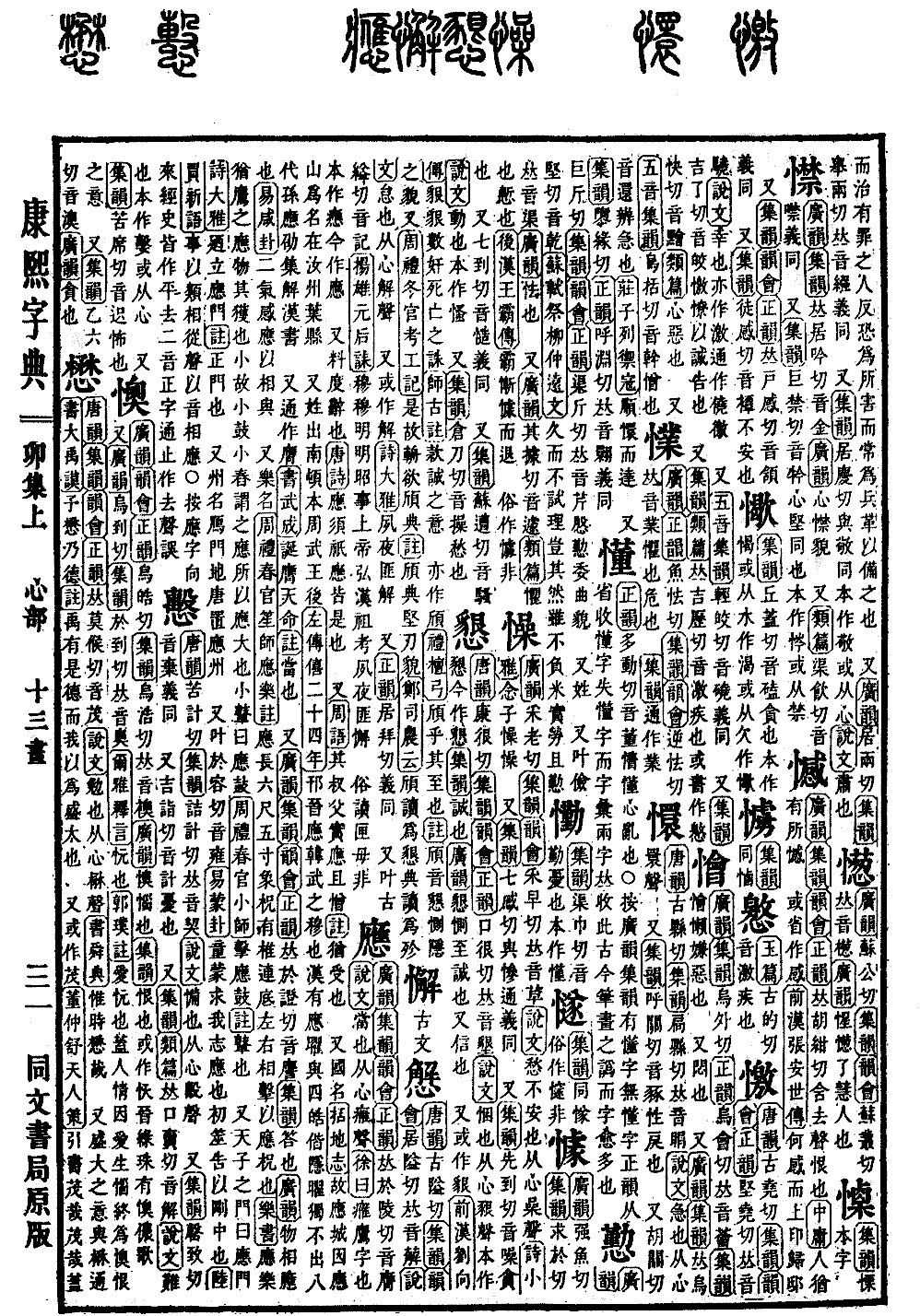
Page 405, Entry 14
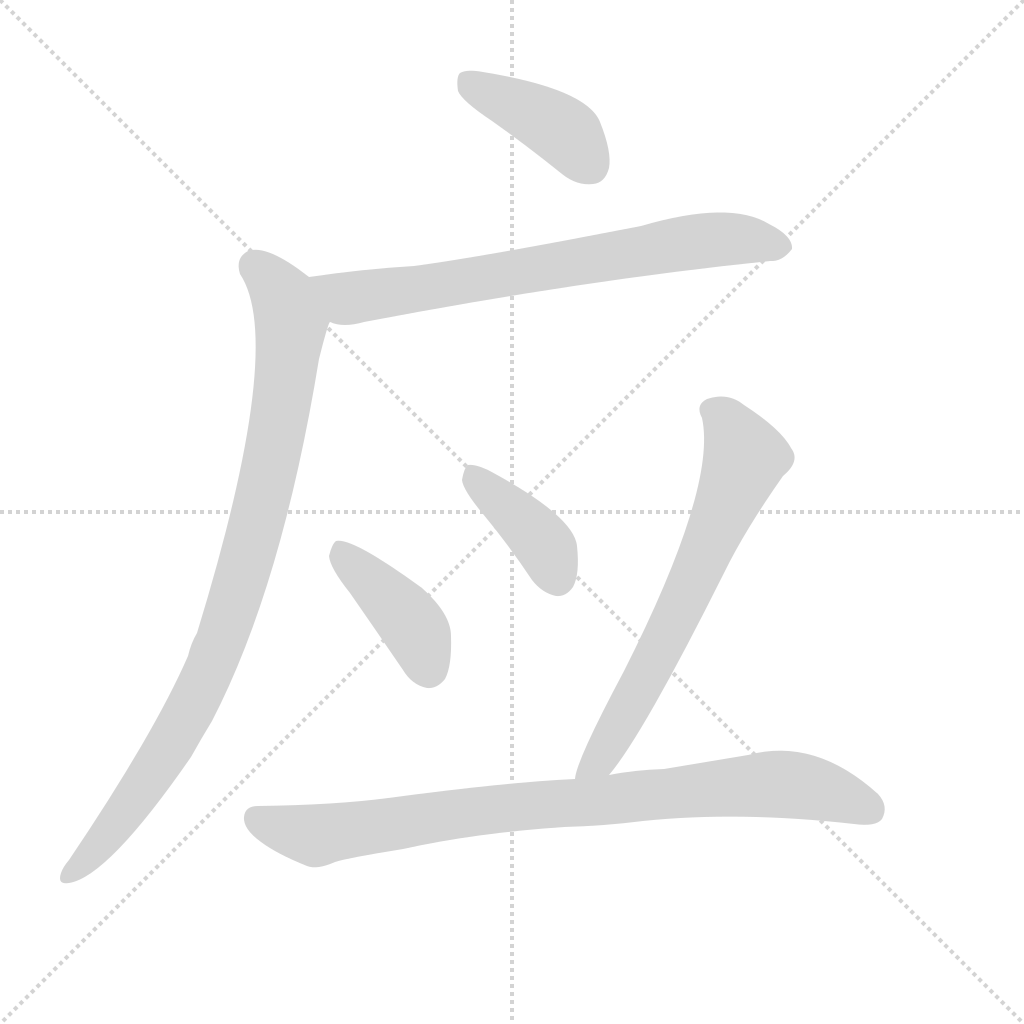
According to Broad Rimes (Guangyun), Collected Rimes (Jiyun), Rime Assemblies (Yunhui), and Correct Rimes (Zhengyun), the pronunciation is ying. According to Explaining Graphs and Analyzing Characters (Shuowen), it means to act as or to correspond. It is formed from the heart radical with a phonetic component. Xu says it is the character for hawk. It was originally written as a different form, but now it is written as this character. It also serves as a term for calculation or surmise; for example, in Tang poetry, the phrases expressing necessity or expectation are examples of this usage.
In Discourses of the States (Zhouyu), it is written: his uncle truly accepts and dislikes. The commentary states this is equivalent to receive.
It is also the name of a state. According to Comprehensive Geography (Kuodizhi), the former Ying City took its name from Ying Mountain and was located in Ye County of Ru Prefecture.
It is also a surname originating from Nandun, originally descended from King Wu of Zhou. In Zuo Commentary (Zuozhuan), year 24 of Duke Xi, it mentions the states of Han, Jin, Ying, and Han as descendants of King Wu. During the Han dynasty, there was Ying Yao, who went into seclusion with the Four White-Haired Elders, but Yao alone did not emerge. His eighth-generation descendant was Ying Shao, who compiled the Collected Explanations of the Book of Han (Hanshu).
It is also used interchangeably with the character for chest. In Book of Documents (Shu), chapter on the completion of the war, it is written: truly accepting the mandate of heaven. The commentary states this means to act as.
According to Broad Rimes (Guangyun), Collected Rimes (Jiyun), Rime Assemblies (Yunhui), and Correct Rimes (Zhengyun), the pronunciation is ying. According to Collected Rimes (Jiyun), it means to answer. According to Broad Rimes (Guangyun), it means for things to correspond to one another. In Book of Changes (Yijing), hexagram Xian: the two qi forces interact and respond to one another.
It is also the name of a musical instrument. According to the Rites of Zhou (Zhouli), department of spring officials, commentary on the master of the reed pipes and the musical instrument Ying: the Ying is six feet and five inches long, shaped like a wooden percussion box, with a mallet attached to the base, struck on the left and right to accompany the wooden percussion box. According to Book of Music (Yueshu), the Ying instrument is like a hawk responding to things; its capture is small, thus small drums and small mortars are called Ying, used to respond to the great ones. Small drums are called Ying drums. In Rites of Zhou (Zhouli), department of spring officials, small master: strike the Ying drum. The commentary states this refers to a small drum.
It is also the name of the gate of the Son of Heaven, called the Ying Gate. In Book of Odes (Shijing), Great Odes: he then established the Ying Gate. The commentary states this is the main gate.
It is also the name of a prefecture, located in the Yanmen region; the Tang dynasty established Ying Prefecture.
It is also rhymed with the pronunciation yong. In Book of Changes (Yijing), hexagram Meng: the ignorant youth seeks me, the will responds. The first divination informs, because of the firmness in the middle. In Lu Jia's New Discourses (Xinyu): affairs follow according to their kind, and sounds respond according to their tone. Note that regarding the character Ying, traditionally in the classics and historical records, it has been used with both level and departing tones. The Correct Dictionary (Zhengzitong) states it only has a departing tone, which is an error.