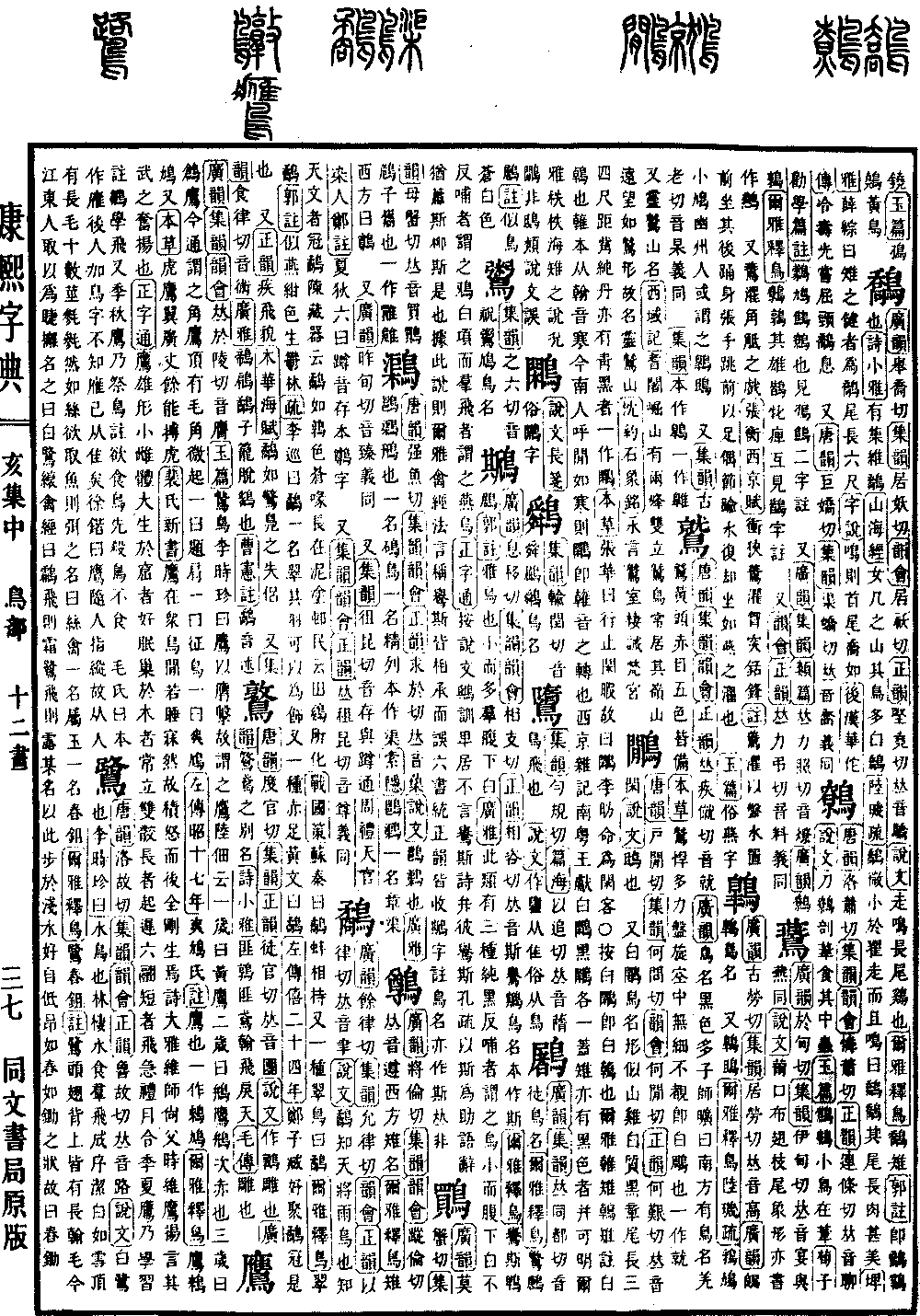
Hai Collection, Lower Volume
Radical: Bird (niǎo)
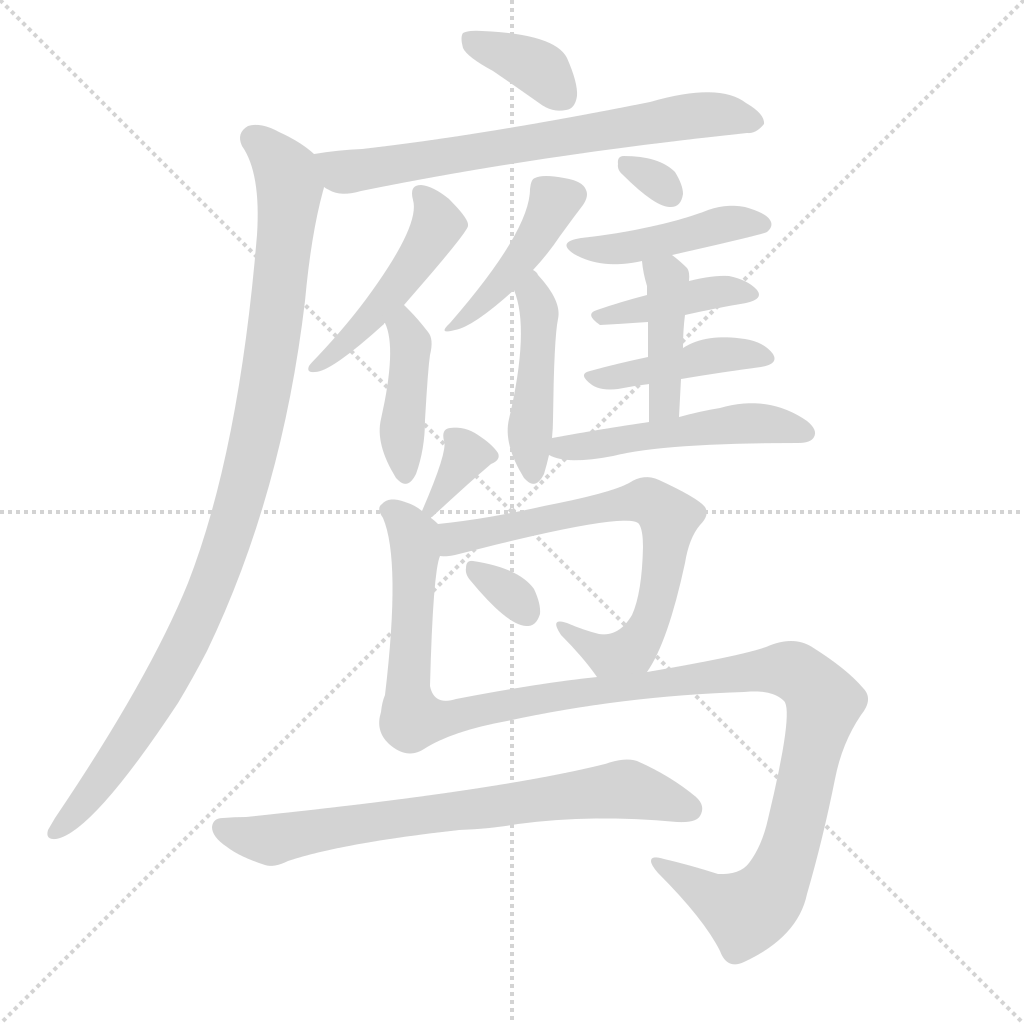
Eagle
Kangxi stroke count: 23
Page 1501, Entry 06
Pronounced ying.
According to the Guangyun (Broad Rhymes), Jiyun (Collected Rhymes), and Yunhui (Compilation of Rhymes): a raptorial bird. Li Shizhen says: The eagle strikes with its breast, which is why it is called ying (breast). Lu Dian says: A one-year-old is called a yellow eagle, a two-year-old is called a tiao eagle, where tiao means gradually approaching a red color. A three-year-old is called a cang eagle; it is now generally called the horned eagle, as the top of its head has slightly protruding tufts of feathers. It is also called tijiān, zheng bird, and shuangjiu. In the Zuo Tradition (Zuo Zhuan), Year 17 of Duke Zhao: The shuangjiu clan. The commentary notes: This is the eagle; it is also written as the variant form (laijiu). In the Erya (Approaching Elegance), section on birds: Eagle is laijiu. Also, in the Materia Medica (Bencao): The tiger eagle has a wingspan of over ten feet and is capable of attacking tigers. In Pei's New Writings (Pei shi xin shu): The eagle appears to be sleeping among other birds, thus it gathers its rage before its ferocity is fully unleashed. The Book of Odes (Shijing), Great Odes: Truly Master Shangfu was like an eagle taking flight. This refers to the soaring nature of his martial courage.
Zhengzitong (Comprehensive Guide to Characters) states: The male eagle is smaller in size than the female. Those that live in caves prefer to sleep, while those that nest in trees often stand. Those with long shanks rise slowly, and those with short primary feathers fly swiftly. The Book of Rites (Liji), Monthly Ordinances, records: In the final month of summer, the eagle begins to learn to fly. Note: This refers to young birds learning to fly. It also records: In the final month of autumn, the eagle performs bird sacrifices. Note: When it intends to eat a bird, it first kills it without consuming it. Master Mao says: It was originally written without the bird radical, and later generations added it, not realizing it was already derived from the character for bird (zhui). Xu Kai says: The eagle follows human command when released, which is why the character includes the element for person (ren).