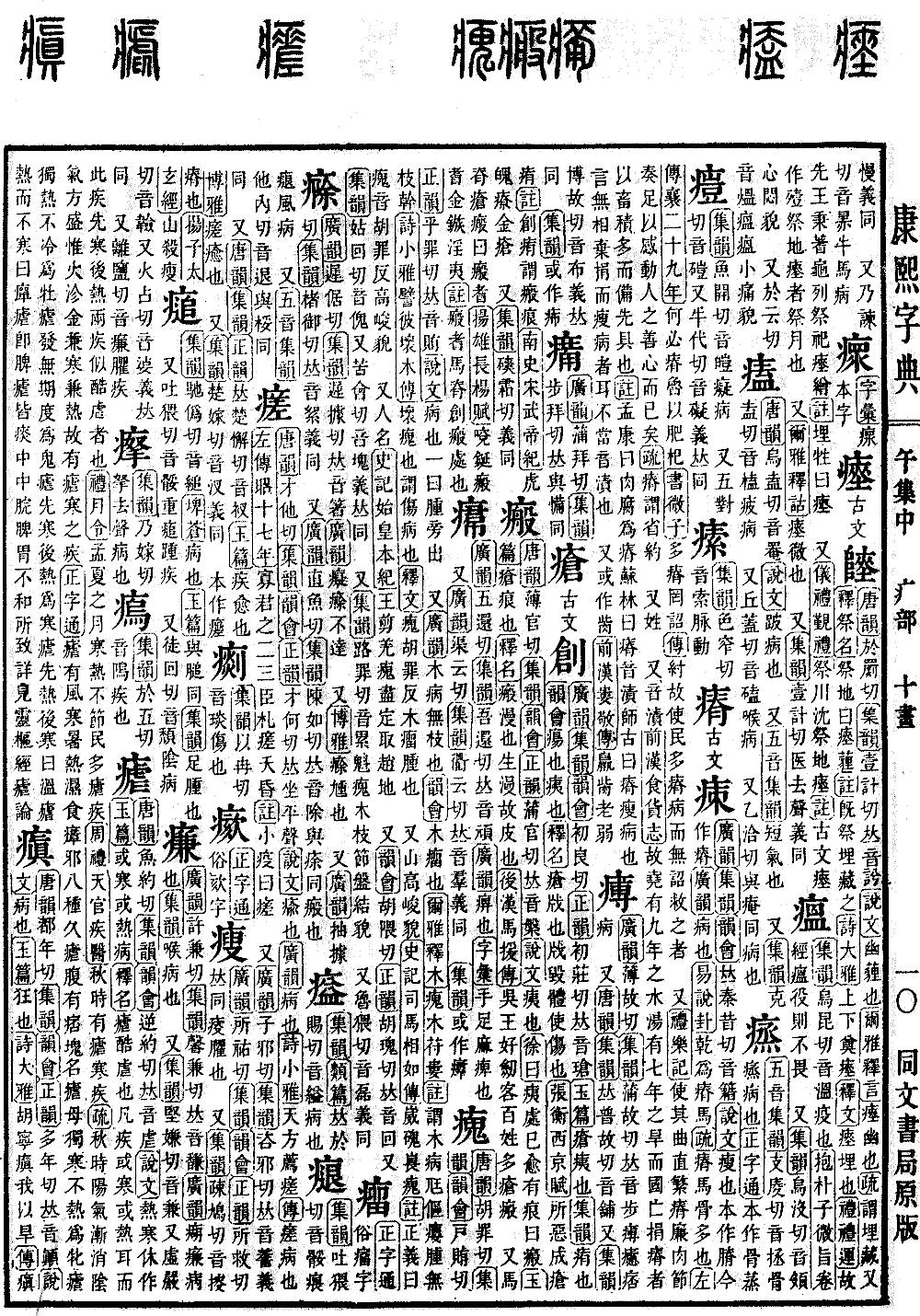
Wu Collection, Middle Volume
Radical: Sickness (bìng)
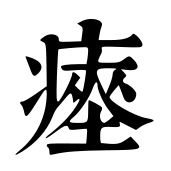
Yi
Kangxi Stroke Count: 15
Page 778, Entry 02
Ancient form.
Pronounced yi (falling tone).
Pronounced yi (falling tone).
According to the Explaining Graphs and Analyzing Characters (Shuowen Jiezi), it means to bury or conceal.
According to the Erhya (Erhya), specifically the section on Explaining Words (Shiyan), yi means to conceal.
The commentary states this refers to burying or interring.
Also, in the section on Explaining Sacrificial Names (Shiji), burying objects for the earth is called yimai.
The commentary states this is to bury the offerings after a sacrifice.
In the Book of Odes (Shijing), specifically the Greater Odes (Daya), it is written that offerings above and below were set and buried.
The Explaining Text (Shiwen) states that yi means to bury.
In the Book of Rites (Liji), specifically the Rites Evolution (Liyun), it is written that the former kings held the divining stalks and tortoise shells, arranged sacrifices, and buried the silks.
The commentary states that burying the sacrificial animals is called yi.
Also, in the Ceremonial Rites (Yili), specifically the Audience Rites (Jinli), it is written that for river sacrifices one submerges the offerings, and for earth sacrifices one buries them.
The commentary notes that the ancient form of yi is written as yi.
The earth sacrifice known as yi refers to the sacrifice to the moon.
Also, according to the Erhya (Erhya), specifically the section on Explaining Ancient Words (Shigu), yi means to be small or obscure.
Also, in the Collected Rhymes (Jiyun), it is pronounced yi (falling tone). The meaning is the same.