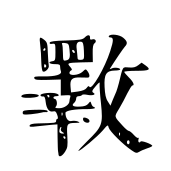
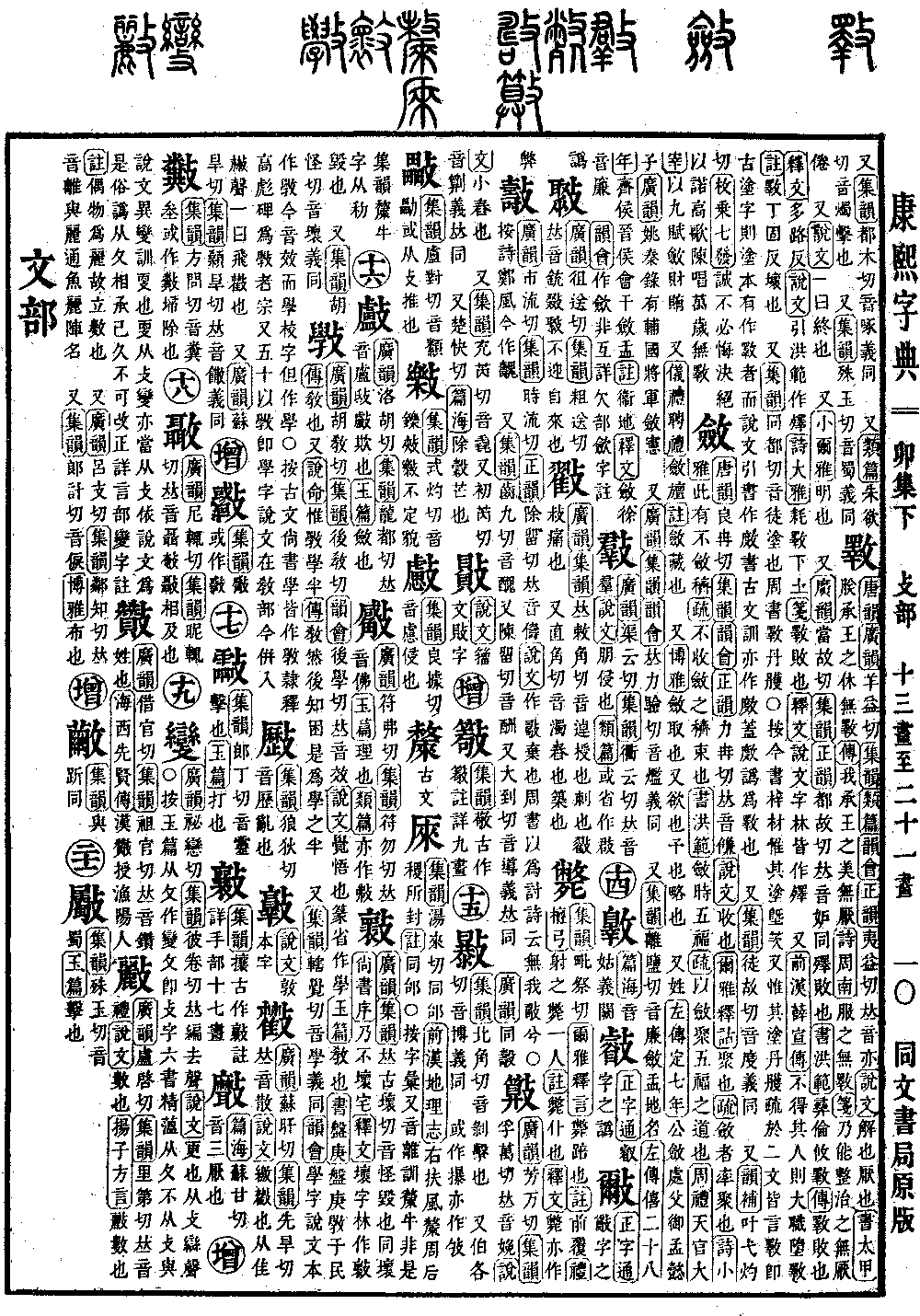
Mao Collection, Lower Volume
Radical: Tapping (pū)
Kangxi Strokes: 17
Page 476, Entry 01
Pronounced yi.
According to the Shuo Wen Jie Zi (Explaining Graphs and Analyzing Characters), it means to untie or to be satiated.
In the Book of Documents (Shangshu), it states, "I maintain the king's goodness without being satiated." The commentary explains, "I maintain the king's beauty without being weary."
In the Book of Odes (Shijing), it states, "Wear it without being satiated." The commentary explains, "Able to maintain it properly without weariness or fatigue."
Also, according to the Shuo Wen Jie Zi, it means to finish.
Also, according to the Xiao Erya (Small Approaches to Erya), it means to be bright.
Pronounced du.
Also written in a variant form (zhuàn), meaning to ruin.
In the Book of Documents (Shangshu), it states, "The constant social order is thereby ruined." The commentary explains, "Ruined." The explanation of characters notes the sound as duo. The Shuo Wen Jie Zi cites the Book of Documents using the character variant.
In the Book of Odes (Shijing), it states, "Consuming and ruining the lower earth." The commentary explains, "Ruined." The explanation of characters notes that both the Shuo Wen Jie Zi and the Zilin (Forest of Characters) use the variant character.
Also, in the Biography of Xue Xuan in the History of the Former Han (Hanshu), it states, "If one does not obtain the right person, the great duties will be neglected and ruined." The commentary explains, "Ruined."
Pronounced tu.
Means to plaster. In the Book of Zhou (Zhoushu), it mentions plastering with cinnabar pigment. Note: In the current version of the Zicai (Timber for Building), it is written as "only plastering, plastering walls, and roofing, and also only plastering with cinnabar pigment." The commentary to these two texts states that the character is the ancient form for plaster. Thus, plaster originally had a form written this way, but the Shuo Wen Jie Zi citation of the Book of Documents uses a different character. The ancient script interpretation of the Book of Documents also uses that form. It is likely that the character was corrupted into the current form.
Pronounced du.
The meaning is the same.
Also, for the purpose of rhyme, pronounced zhuo.
In the Qifa (Seven Stimuli) by Mei Cheng, it states, "Truly, there is no need to regret; resolutely promise with a word. Loudly singing the song, wishing for ten thousand years without end."