Wei Collection, Middle Volume
Radical: Silk (mì)
Kangxi Strokes: 17
Page 937, Entry 09
Broad Rhymes (Guangyun), Collected Rhymes (Jiyun), Dictionary of Rhymes (Yunhui), and Correct Rhymes (Zhengyun) state: pronounced yao.
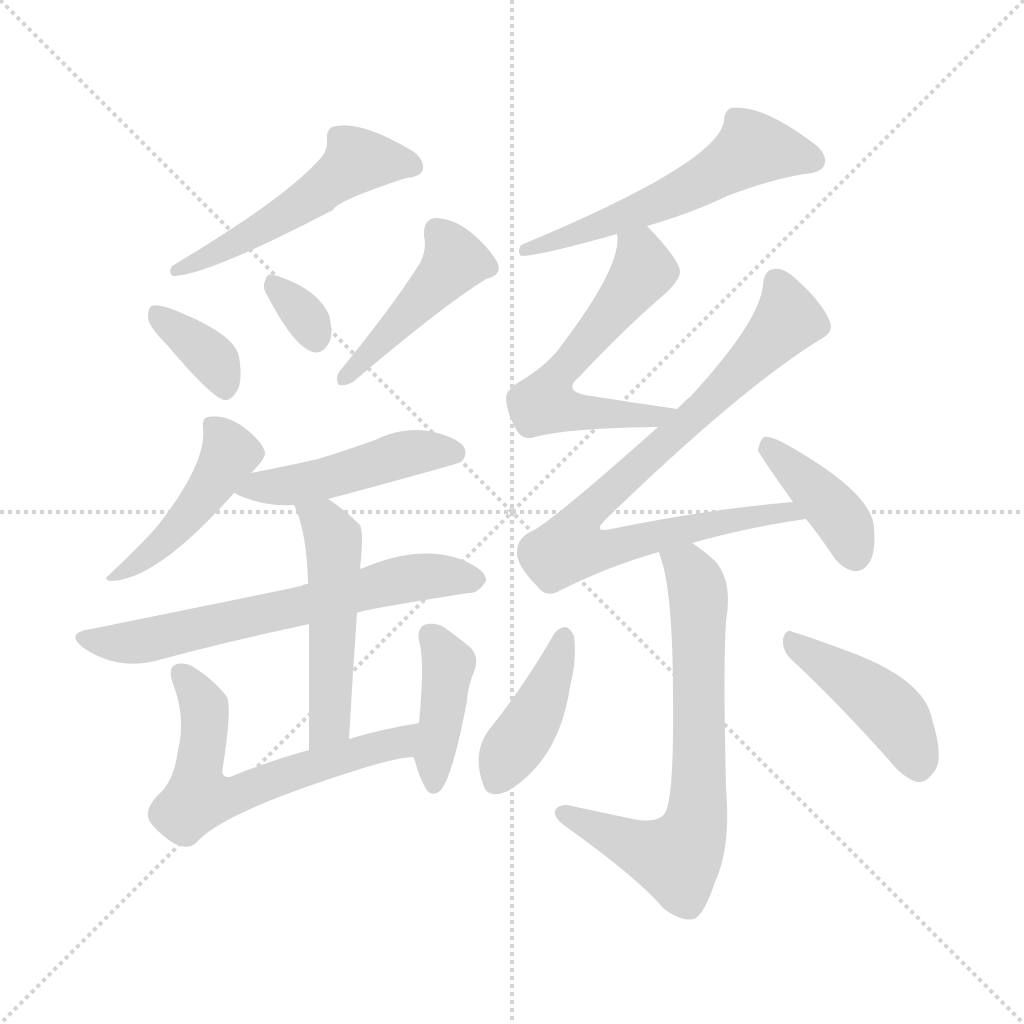
Explaining Graphs and Analyzing Characters (Shuowen) writes it as the form with the radical for silk, meaning to follow or accompany.
Xu Xuan says: Today, the common form uses the radical for silk.
Also, in the Book of Documents (Shangshu), chapter Tribute of Yu (Yu Gong): Their grasses are therefore lush.
Commentary: Means lush.
Explanation of Characters (Shiwen): Means to pull out.
Also, same as the character for corvée labor (yao).
In the Book of Odes (Shijing), Great Odes (Daya), People are also labored (Min yi lao zhi), annotation: Corvée labor is frequent and numerous.
Explanation of Characters (Shiwen): The original text for yao is also written as the character for corvée labor.
In the Records of the Grand Historian (Shiji), Annals of Emperor Gao (Gaozu Benji): Emperor Gao was often engaged in corvée labor at Xianyang.
Annotation: Ying Shao says: Yao means service or labor.
In the Former Han History (Qianhan), Annals of High Emperor (Gaodi Ji) annotation, Yan Shigu says: Pronounced the same as the character for corvée labor. In ancient times, they were used interchangeably.
Also, in the Annals of Emperor Wen (Wendi Ji): Reduce corvée labor expenses to benefit the people.
Also, same as the character for pottery (tao).
In the Former Han History (Qianhan), Table of Ancient and Modern People (Gujin Renbiao): Gao Yao is the same as Gao Tao.
Also, same as the character for ballad (yao).
In the Former Han History (Qianhan), Biography of Li Xun (Li Xun Zhuan): The people follow the customs.
Also, a surname.
In the Later Han History (Houhanshu), Biography of Zhi Yun (Zhi Yun Zhuan): Western Capital Supervisor of Posts Yao Yan.
Annotation: The surname Yao is a descendant of Gao Yao.
Also, according to Broad Rhymes (Guangyun), pronounced you; according to Collected Rhymes (Jiyun) and Dictionary of Rhymes (Yunhui), pronounced you. Same as the character for by/through/from (you).
In the Book of Changes (Yijing), Kun Hexagram: The reason from which it comes becomes gradual.
In the Zuo Tradition (Zuo Zhuan), Year 26 of Duke Zhao: The yoke was removed, and the blade entered three inches.
Annotation: Yao means to pass or exceed.
In the Former Han History (Qianhan), Annals of Emperor Wen (Wendi Ji): The vassal lords also have no means to teach and discipline their people.
Annotation: Yan Shigu says: Pronounced the same as the character for by/through/from (you).
Also, same as the character for plan/way (you).
In the Erya, Explaining Ancient Terms (Shigu): Yao means the way.
Sub-commentary: Small Odes (Xiaoya), chapter Skillful Words (Qiaoyan) states: The great way is orderly. The sound and meaning of this character and the character for plan (you) are the same.
Also, same as the character for still/as if (you).
In the Erya, Explaining Ancient Terms (Shigu): Yao means joy.
Annotation: The Book of Rites (Liji) states: When a person is happy, they chant; chanting, they sing; singing, they are satisfied. This character for satisfied is the same as the character for yao; they are just ancient and modern forms of the same word.
Also, same as the character for leisurely/far-reaching (you).
In the Former Han History (Qianhan), Biography of Wei Xian (Wei Xian Zhuan): The dogs and horses are leisurely.
Annotation: Yan Shigu says: This character is the same as the character for leisurely (you). Leisurely describes the appearance of walking.
Also, same as the character for wander/travel (you).
In the Former Han History (Qianhan), Narratives of Ban Gu (Ban Gu Xuzhuan): Master Lu is excellent and free-wandering. Note: In the Anthology of Literature (Wenxuan), it is written as excellent and free-wandering (youyou).
Also, according to Collected Rhymes (Jiyun), pronounced zhou.
In the Book of Changes (Yijing), Commentary on the Appended Remarks (Xici Zhu): The statements of the hexagram lines are the means by which to clarify success and failure.
Explanation of Characters (Shiwen): Fu Qian says: It means to extract, to extract good and bad fortune. Wei Zhao says: It means the basis, that from which good and bad fortune are produced.
In the Zuo Tradition (Zuo Zhuan), Year 2 of Duke Min: Cheng Feng heard the prognostications of Cheng Ji.
Annotation: Yao refers to the prognostic statements of divination hexagrams.
In the Erya, Explaining Ancient Terms (Shigu): Yao means at/in/to.
Annotation: Prognostication statements.
Sub-commentary: The words of divination hexagrams.
In the Standardizing Graphs (Ganlu Zishu): This character is the character for Gao Yao. The character for divination is the prognostication statement, pronounced zhou.
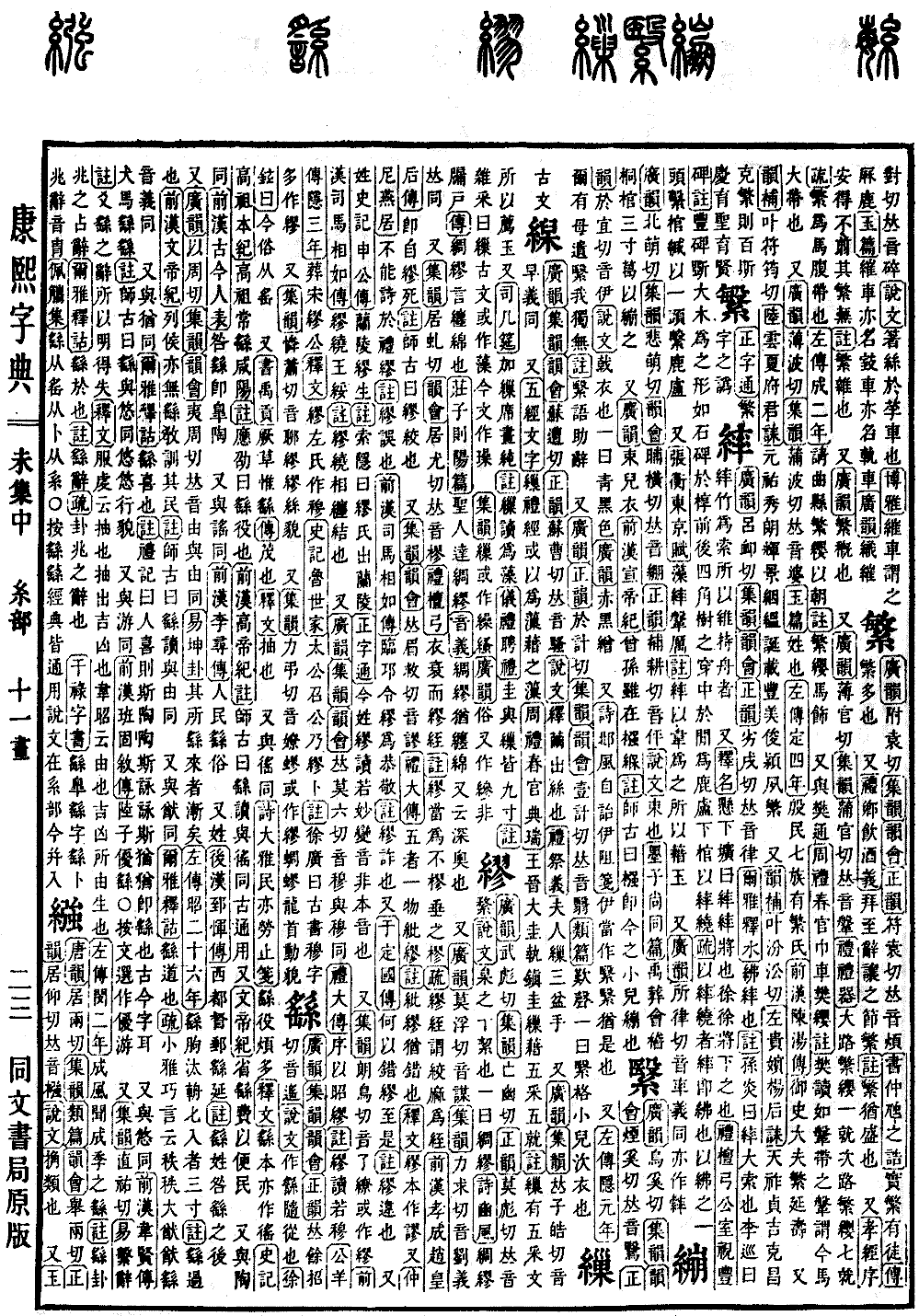
In the Pei Collection (Peiji): This character is composed of the radical for silk, the radical for follow, and the radical for divination. Note: In the classics, the forms are all used interchangeably. The Shuowen places it under the silk radical, and now they are all grouped here.