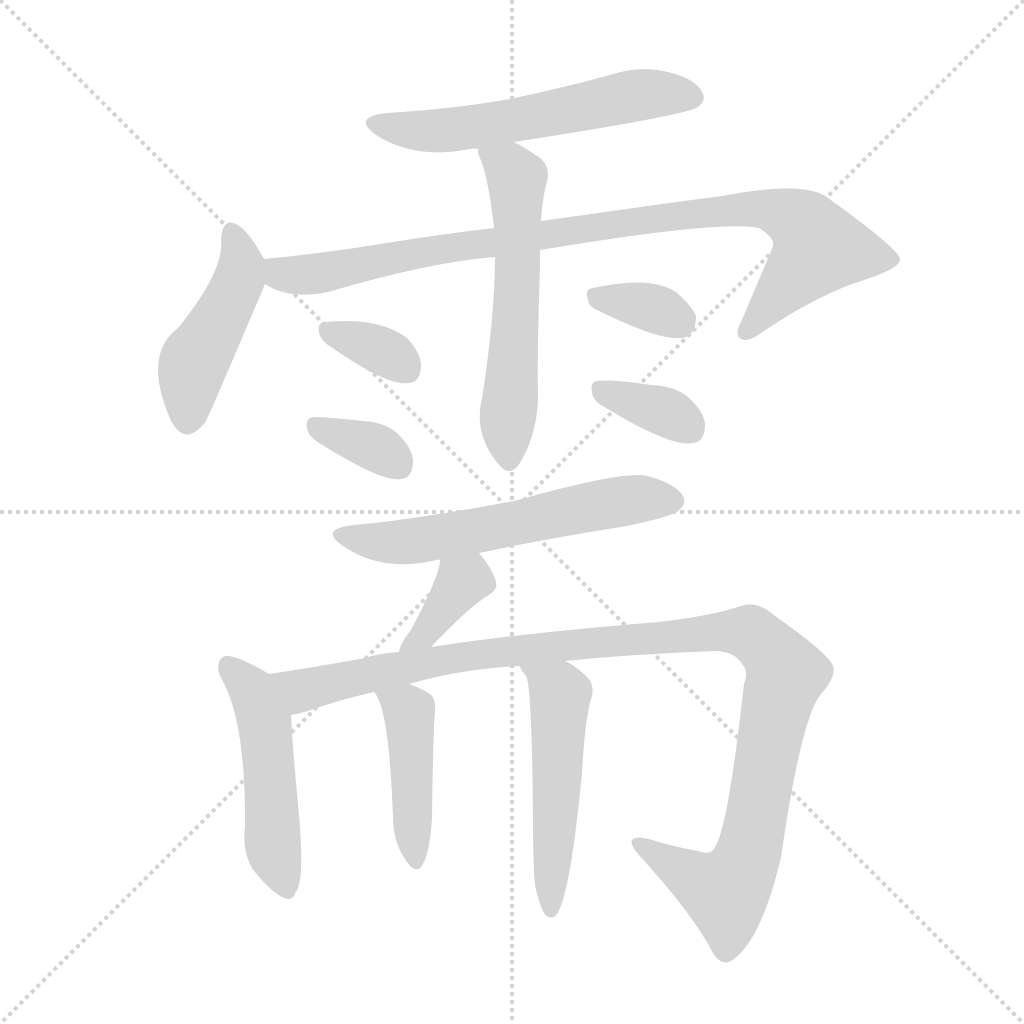
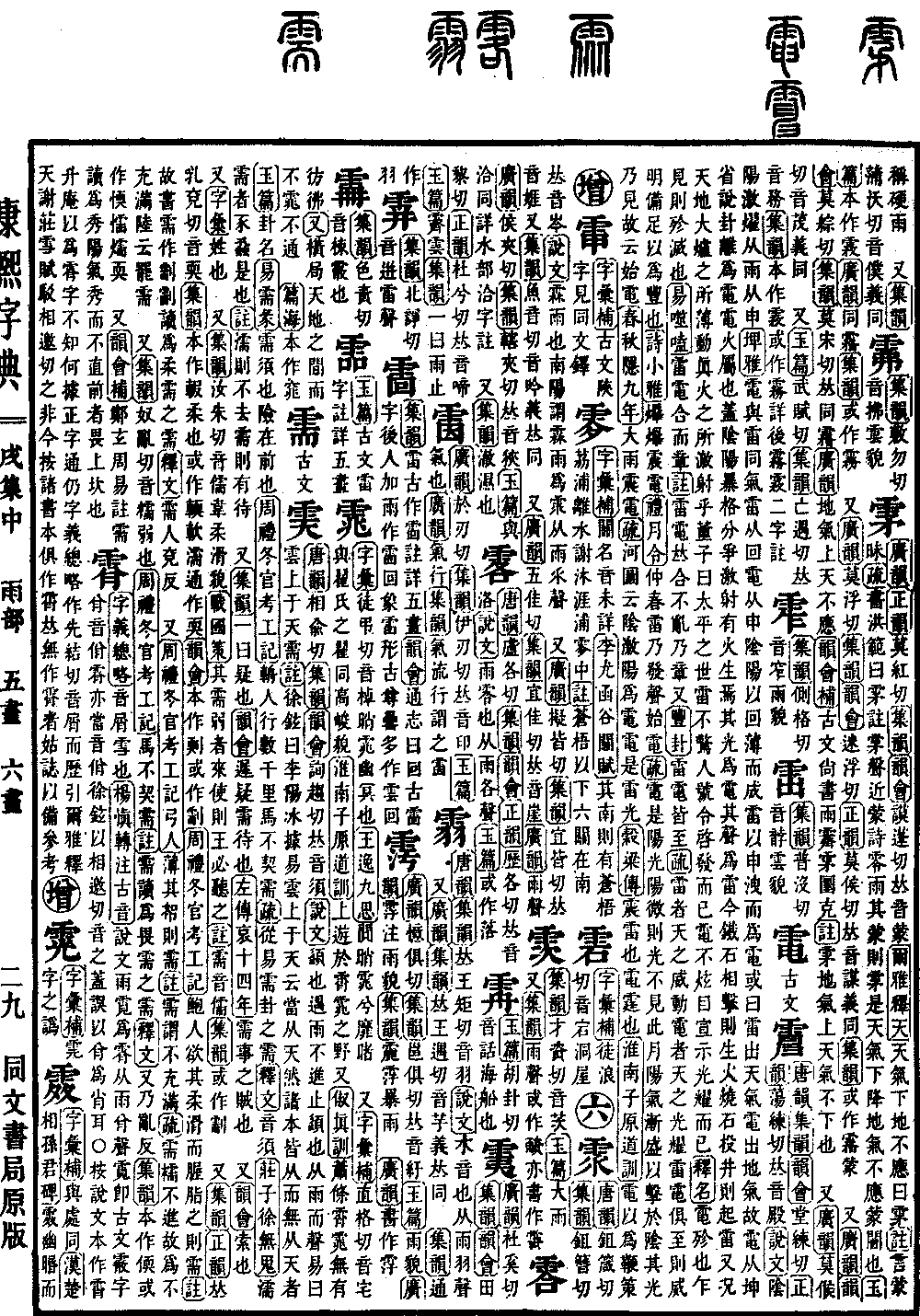
Xu Collection, Middle Volume
Radical: Rain (yǔ)
Xu (14 strokes)
Page 1373, Entry 24
Tang Rhymes (Tangyun): Pronounced xu. Collected Rhymes (Jiyun) and Rhyme Collection (Yunhui): Pronounced xu. The pronunciation is the same as the character for must (xū). Explaining Characters and Writing (Shuowen Jiezi) defines it as waiting. It means that when one encounters rain, one does not advance but stops. The character is composed of rain and the phonetic indicator which also acts as the sound. Book of Changes (Yijing) states: Clouds ascend to heaven, wait (xū). Commentary: Xu Xuan says that Li Yangbing, based on the Clouds ascend to heaven passage in the Book of Changes, believed the character should be written with the component for heaven at the top, yet all versions use the standard form, not the one with heaven. Jade Chapters (Yupian) says it is the name of a hexagram. Book of Changes, Commentary on the Judgement (Tuanzhuan) of the Waiting (Xu) hexagram: Waiting means to pause, because there is danger ahead. Rites of Zhou (Zhouli), Winter Officials, Artificers' Record (Kaogongji): A craftsman making a carriage pole, the carriage travels thousands of miles, and the horse does not halt due to worn hooves. Commentary: The waiting (xū) here follows the usage of the Waiting hexagram in the Book of Changes. Interpretation of Texts (Shiwen): Pronounced xu. Zhuangzi, Xu Wugui: Those who cling and wait, refers to lice on a pig. Commentary: Dampened and not leaving, waiting for an opportunity. Also, Collected Rhymes (Jiyun): Another definition is to express doubt. Rhyme Collection (Yunhui): Hesitation and waiting. Zuo Commentary (Zuozhuan), 14th Year of Duke Ai: Waiting is the calamity of success. Also, Rhyme Collection (Yunhui): It carries the meaning of demand. Also, Comprehensive Collection of Characters (Zihui): It is a surname. Also, Collected Rhymes (Jiyun): Pronounced ru. It describes the appearance of leather as soft and smooth. Strategies of the Warring States (Zhanguoce): Those weak individuals who come as envoys, the Great King will surely listen to them. Commentary: This instance of the character is pronounced ru. Collected Rhymes (Jiyun): Sometimes written in a variant form. Also, Collected Rhymes (Jiyun) and Orthography Rhymes (Zhengyun): Pronounced ruan. Collected Rhymes (Jiyun): The original character is a variant, meaning soft. Also written as the character for soft (ruǎn). Soft and supple is usually written with the character for soft (nuǎn). Rhyme Collection (Yunhui): The original character is a variant. Also written in other forms. Rites of Zhou, Winter Officials, Artificers' Record: A leather craftsman, wanting leather to be soft and smooth, applies thick fat, and it becomes soft. Commentary: Old editions write the character in a variant form, pronounced as the second element in the phrase for soft-waiting (xū). Interpretation of Texts (Shiwen): Pronounced ruan. Also, Rites of Zhou, Winter Officials, Artificers' Record, Bow Makers: The backing wood of a bow is too thin, so the bow is weak and lacks strength. Commentary: This usage means it is not full. Commentary: This implies slow and not advancing, so it is interpreted as not full. Lu Deming says: Weak and tired. Also, Collected Rhymes (Jiyun): Pronounced nuo. It means weak. Rites of Zhou, Winter Officials, Artificers' Record: The horse does not halt due to worn hooves. Commentary: Pronounced as the second element in a specific compound. Interpretation of Texts (Shiwen): Also pronounced nuo. Collected Rhymes (Jiyun): The original character is a variant for weak or cowardly (nuò). Also written as other variants. Also, Supplement to Rhyme Collection (Yunhui Bu): Zheng Xuan's commentary on the Book of Changes: The character is pronounced xiu. It means the yang energy is elegant but does not directly advance because it fears the water hexagram above.