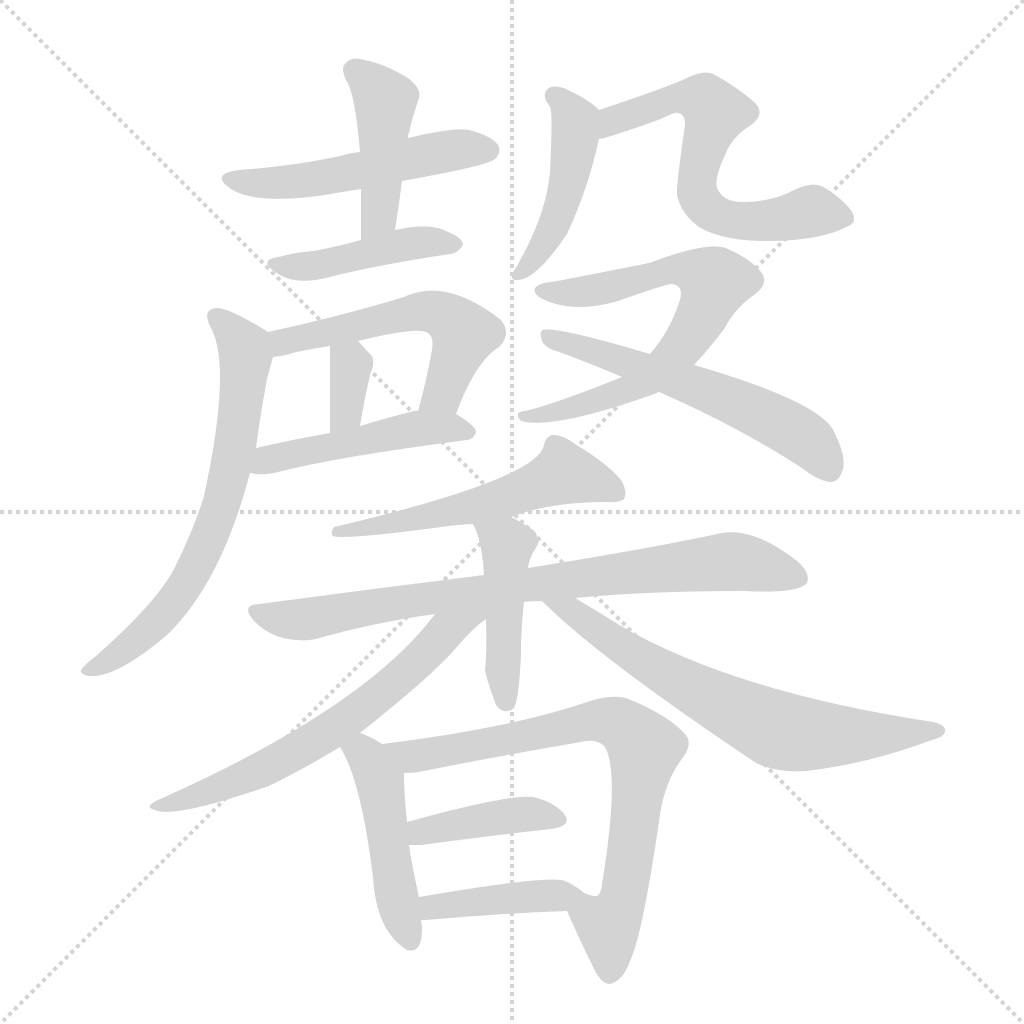
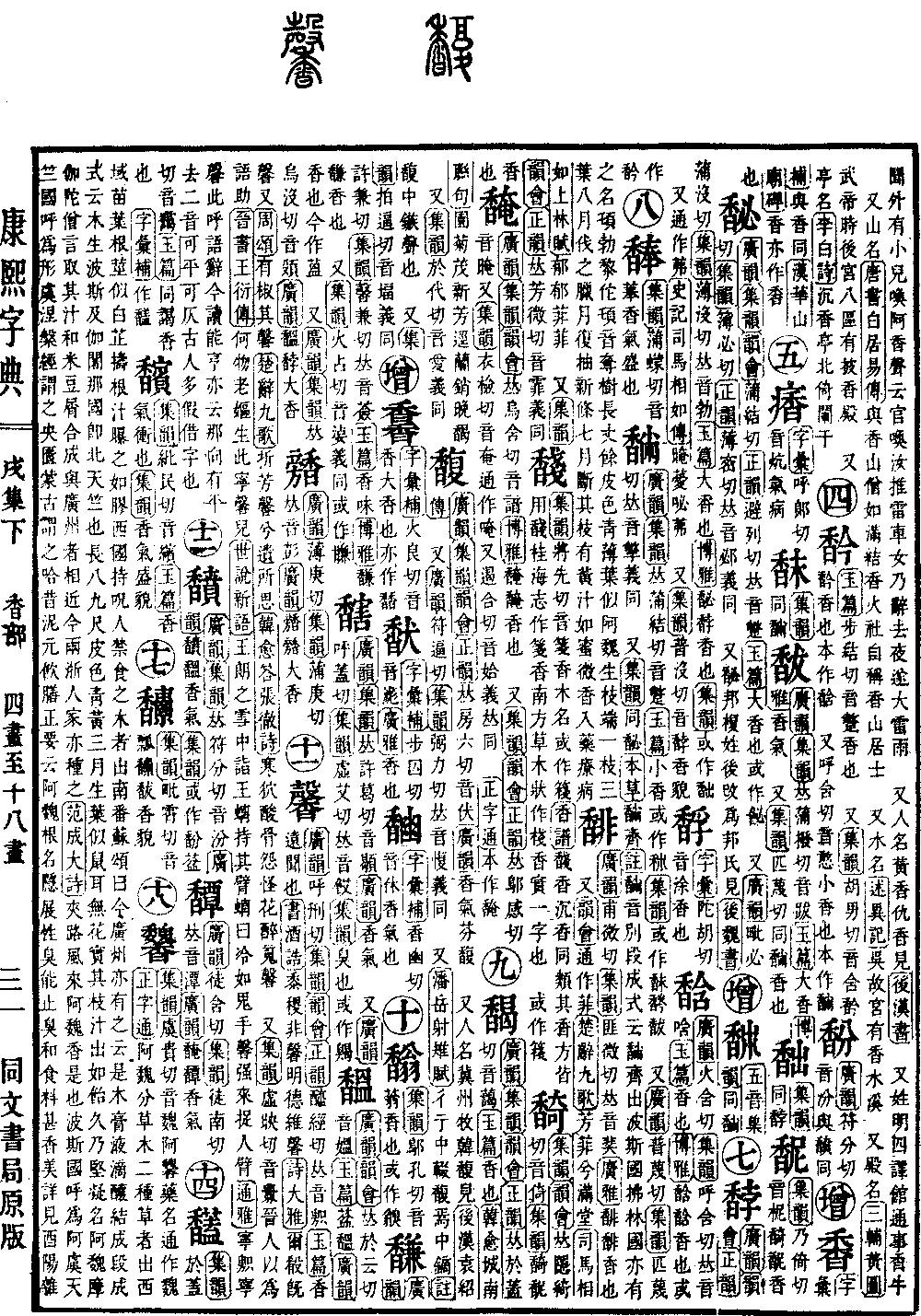
Xu Collection, Lower Volume
Radical: Fragrant (xiāng)
Kangxi Strokes: 20
Page 1429, Entry 30
Pronounced xing.
In the Comprehensive Rhymes (Guangyun), it is pronounced xing. In the Collected Rhymes (Jiyun), the Rhyme Assembly (Yunhui), and the Correct Rhymes (Zhengyun), it is pronounced xing.
According to the Jade Chapters (Yupian), it refers to a fragrance that spreads far.
Book of Documents (Shangshu), Wine Announcement (Jiugao): The fragrance of millet is not true fragrance; only bright virtue is true fragrance.
Book of Odes (Shijing), Great Odes (Daya): Your offerings already possess a fragrant aroma.
Also in the Zhou Odes (Zhousong): The fragrance of Sichuan pepper is thick and rich.
Songs of Chu (Chuci), Nine Songs (Jiuge): Plucking fragrant flowers and herbs to present to the one I cherish.
Han Yu, Answer to Zhang Che: The mournful cries of monkeys in the cold make one's bones ache with resentment, while the scent of exotic flowers intoxicates the senses.
Also, according to the Collected Rhymes (Jiyun), pronounced xin.
Used by people of the Jin dynasty as a modal particle.
Book of Jin (Jinshu), Biography of Wang Yan: What kind of old woman gave birth to such a child?
New Account of Tales of the World (Shishuo Xinyu): Wang Lang went to visit Wang Chi in the snow and grabbed his arm. Wang Chi said: Your hand is as cold as a ghost's, yet you insist on grabbing my arm.
General Expositions (Tongya): Ningxin is an interjection, now pronounced nengheng; it is also said to mean that. Historically, it has both level and departing tones, making it versatile in prosody; the ancients frequently used loan characters for it.