Wei Collection, Lower Volume
Radical: Meat (ròu)
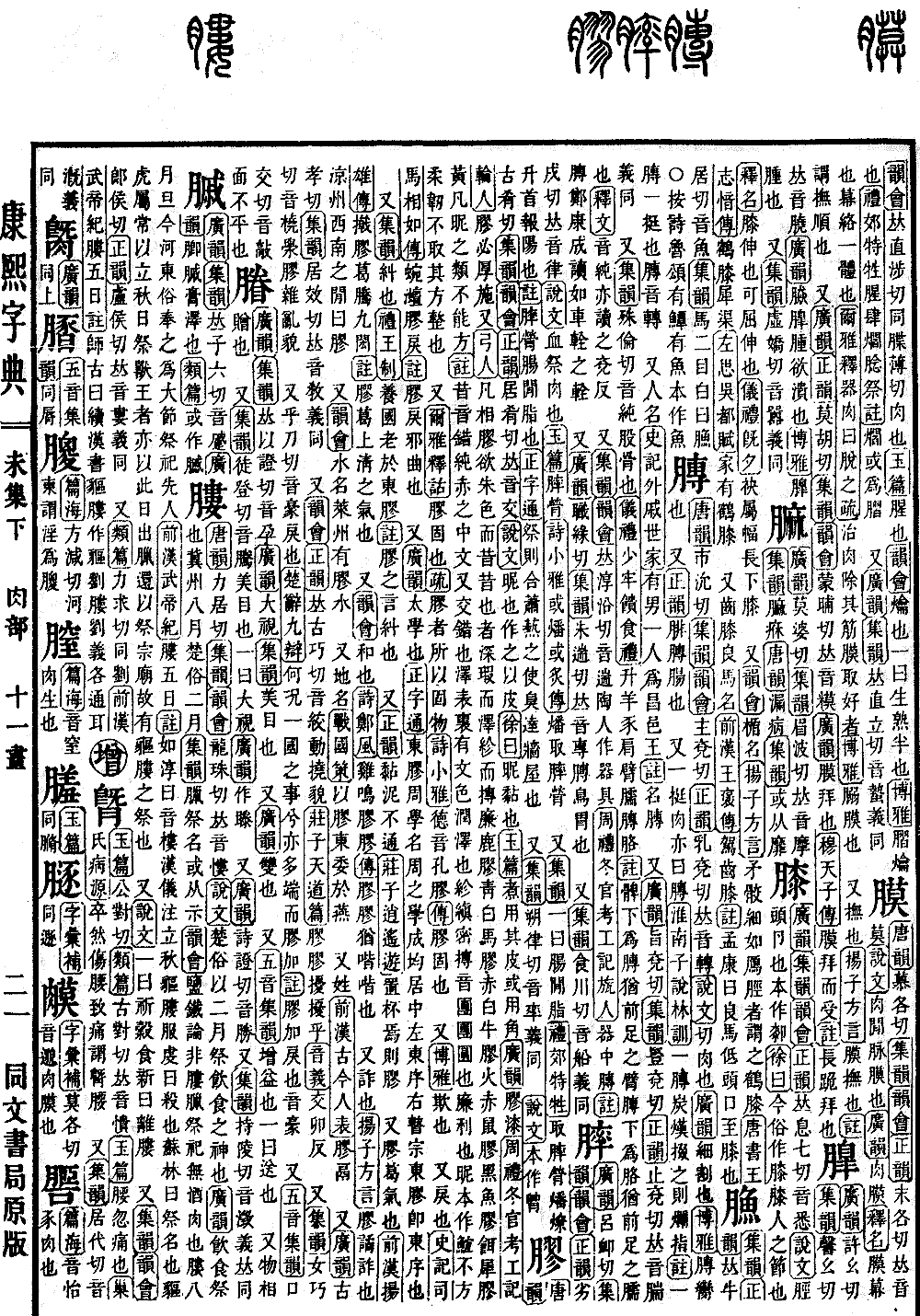
Knee
Kangxi strokes: 17
Page 993, Entry 04
Pronounced xi.
According to the Explanations of Characters (Shuowen Jiezi), this refers to the joint of the shin. Originally written as the variant form (xī). According to Xu, it is commonly written as knee (xī) today. The knee is a joint of the human body. According to the Explanations of Names (Shiming), the knee is so named because it allows one to stretch, as it can be bent and extended. According to the Ceremonial Rites (Yili), the sleeves are attached, and the cloth width extends down to the knee.
Also, according to the Compilation of Rhymes (Yunhui), it is the name of a shield component. According to the Dialect (Fangyan) by Yang Xiong, a spear ferrule that is thin like a goose shin is called a crane knee. According to the History of Tang (Tangshu), in the Biography of Wang Zhiyin, it mentions crane knee rhinoceros-hide channels. According to the Rhapsody on the Capital of Wu (Wudu Fu) by Zuo Si, houses have crane knees.
Also, Nienie, the name of a fine horse. According to the History of the Former Han (Qian Hanshu), in the Biography of Wang Bao, it mentions driving a Nienie. The commentary by Meng Kang states that it is a fine horse that lowers its head such that its mouth reaches its knees.
Textual research: Also known as Chixi, the name of a fine horse. According to the History of the Former Han (Qian Hanshu), in the Biography of Wang Bao, it mentions driving a Chixi. Careful comparison with the original text indicates that both instances of the character chi should be corrected to nie.