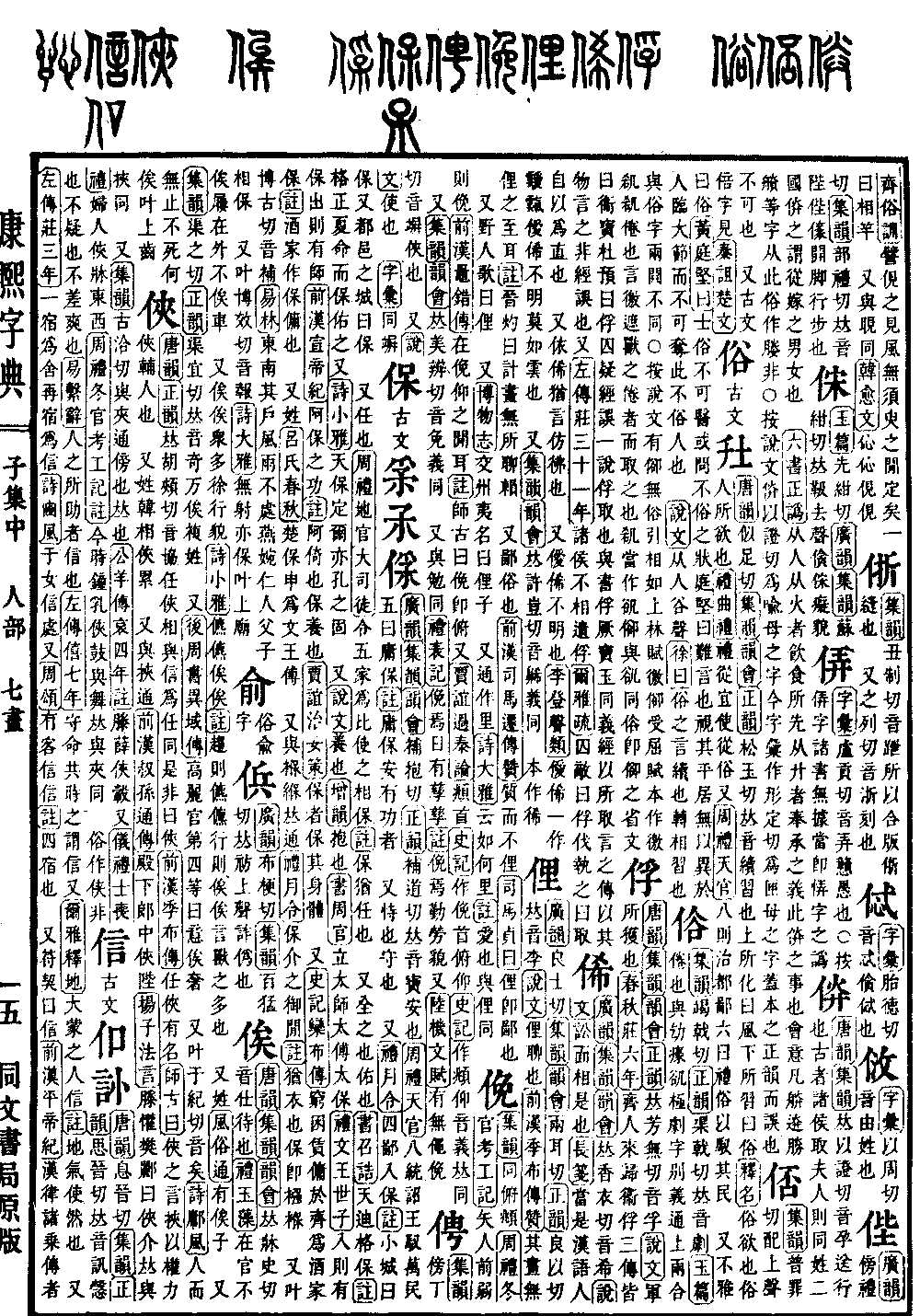
Zi Collection, Middle Volume
Radical: Person (rén)
Kangxi Strokes: 9
Page Number: Page 105, Position 25
Ancient form
Tang Dynasty Rhymes (Tangyun): Pronounced xìn. Collected Rhymes (Jiyun) and Correct Rhymes (Zhengyun): Pronounced xìn, sounding like xùn.
Honesty and sincerity, without suspicion or error. That which people assist is sincerity and trust — Book of Changes (Yijing).
To follow orders and adapt to the times is called trust — Zuo Commentary (Zuozhuan).
Also, the people of the Dameng region are honest and sincere — Approaching the Refined (Erya). Note: This is caused by the geographic influence of that land.
Also, staying for one night is called shè, and staying for two nights is called xìn — Zuo Commentary. Staying at your place for two nights — Book of Odes (Shijing).
Also, the guests stayed for four nights — Zhou Hymns (Zhou Song). Note: This refers to staying for four nights.
Also, a tally or credential is called xìn. According to the laws of the Han Dynasty, those riding post-carriages must hold a wooden tally measuring one foot and five inches — History of the Former Han (Hanshu). Note: These were written on silk and divided in two, with each party holding one half. At passes and checkpoints, they had to match before passage was allowed. Some were also made of wood.
Also, using tallies to close various palace gates — History of the Later Han (Houhanshu). Note: A qǐ is a halberd kept in a sleeve.
Also, ancient people called messengers xìn. This is interchangeable with the term xùn. Chen Zhen persuaded the King of Chu and dispatched messengers with more carriages and heavier gifts — Records of the Grand Historian (Shiji). Therefore, messengers were sent to inform the common people — Proclamation to the People of Ba and Shu (Yu Bashu Xi) by Sima Xiangru.
Also the name of a prefecture. The Tang Dynasty established Xin Prefecture, which is the current Guangxin Prefecture.
Also a surname. Descendants of Lord Xinling, Wuji. Also a compound surname. There are the surnames Xindu and Xinping — Dictionary of Surnames by He (He Shi Xingyuan).
Also, Collected Rhymes and Correct Rhymes: Pronounced like shēn. Same as the word for stretch (shēn). That which has passed is contracted; that which is coming is stretched — Book of Changes. Alas, it is truly distant, and I am not allowed to stretch — Book of Odes.
Also same as the word for body (shēn). A Marquis holds a xìn-gui tablet, and a Count holds a gōng-gui tablet — Rites of Zhou (Zhouli). Note: The xìn-gui is carved with the image of a human in a stretched posture. The gōng-gui is carved with the image of a human in a bent posture.
Also rhyming with xīn. The common people do not believe — Book of Odes. This rhymes with the word for relatives (qīn) in the preceding line. According to Correct Rhymes, the King of Han named Xin originally had the same name as the Marquis of Huaiyin, and to avoid confusion, his name was pronounced xīn. In the Narrations and Biographies (Xuzhuan), Han Xin's name is read as xīn. This indicates that the character xìn originally had both the level and departing tones, and the level tone was its original pronunciation, not merely a temporary adjustment for rhyming.