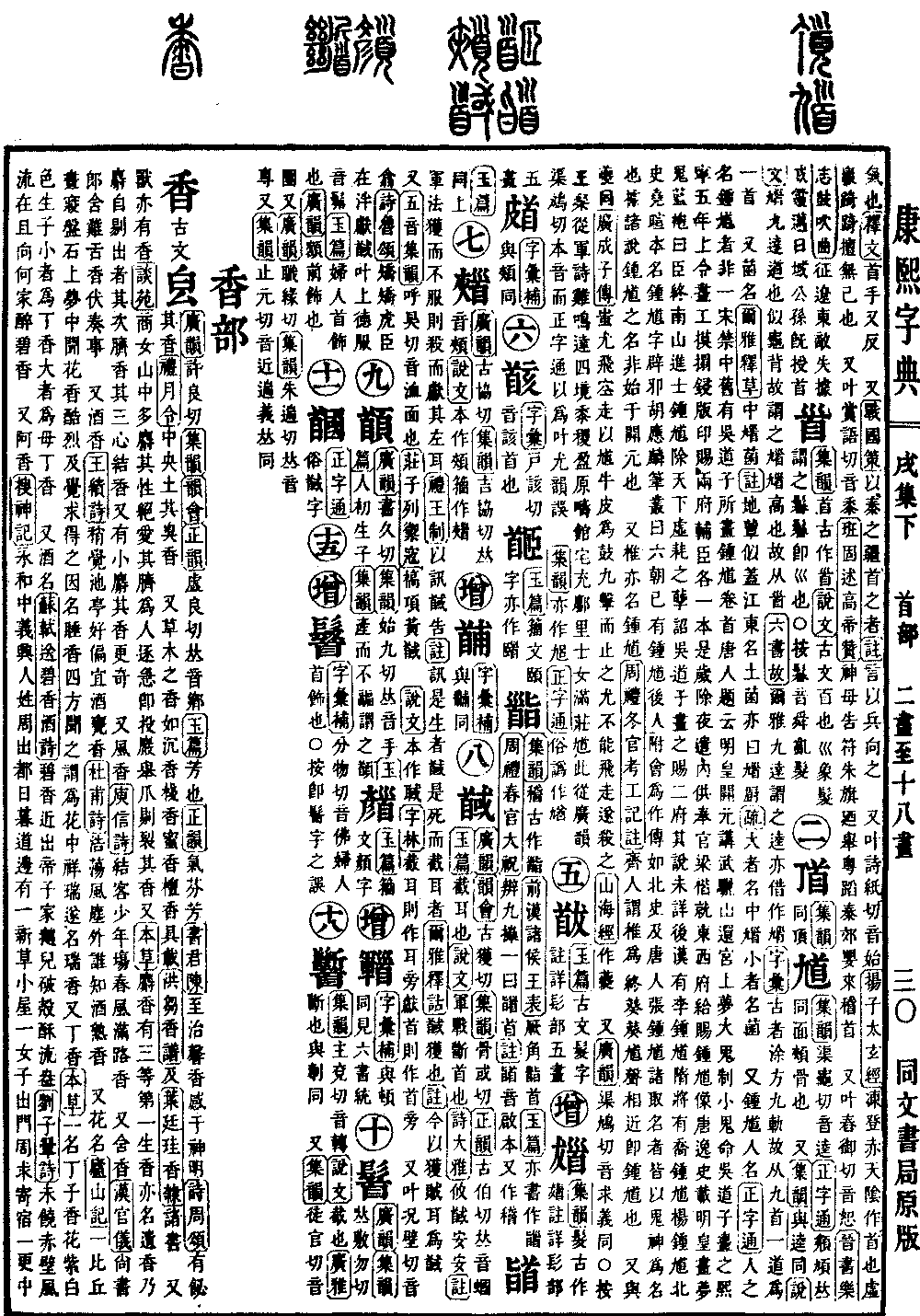
Xu Collection, Lower Volume
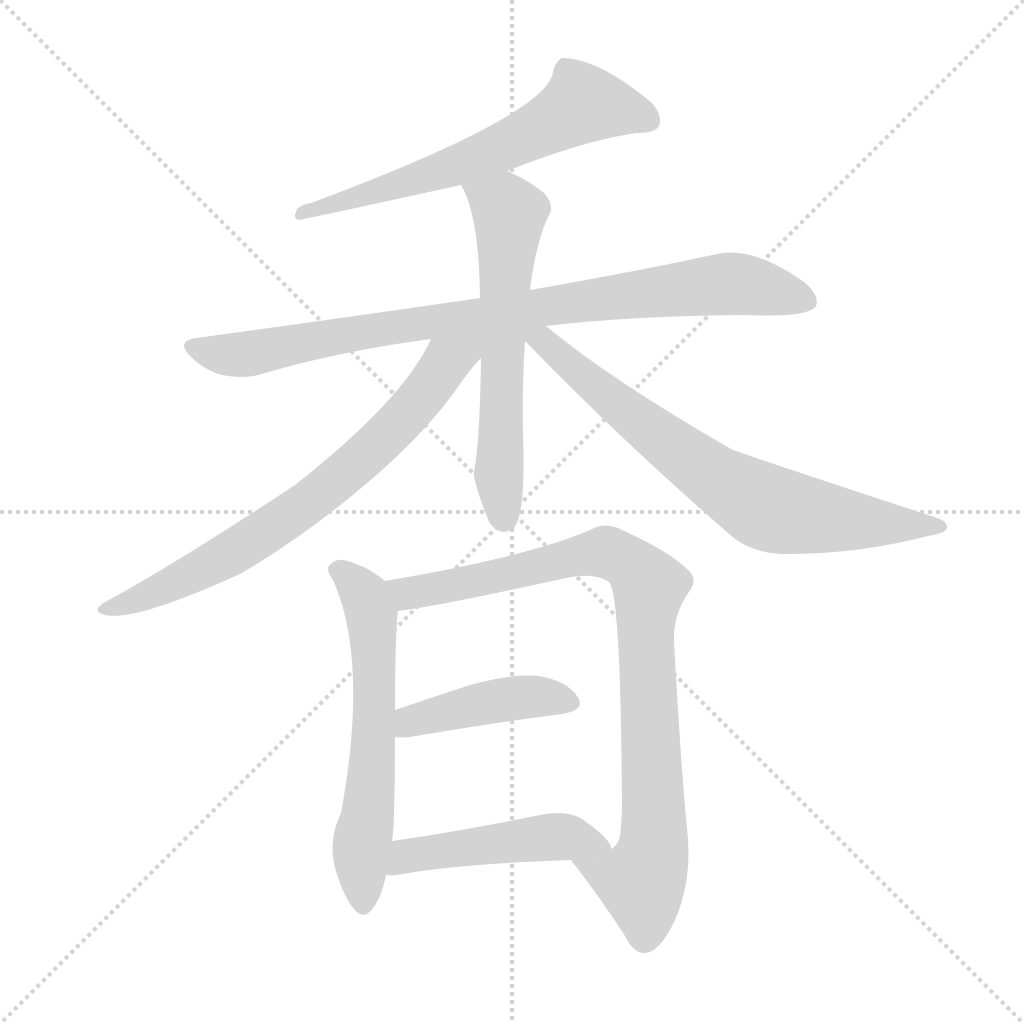
Radical: Fragrant (xiāng)
Page 1428, Entry 21
Ancient form. Guangyun (Dictionary of Rhymes): Pronounced xiang. Jiyun (Compilation of Rhymes), Yunhui (Collection of Rhymes), and Zhengyun (Correct Rhymes) all record it as pronounced xiang. Yupian (Jade Chapters): Fragrant. Zhengyun: A pleasant scent. Book of Documents (Shangshu): Perfect governance has a fragrant scent that touches the spirits. Book of Odes (Shijing): Its fragrance is plentiful. Book of Rites (Liji): In the center is earth, and its scent is fragrant.
Also refers to the fragrance of plants and trees, such as agarwood, zhan wood, honey incense, and sandalwood, all of which are documented in the Fragrance Manual (Xiangpu) by Hong Chu and the Fragrance Records (Xiangli) by Ye Yangui.
Also, some animals possess fragrance. According to the Garden of Conversations (Tanyuan), the musk deer is abundant in the Shangnü mountains. It cherishes its own navel; when pursued urgently by men, it will leap off cliffs and use its claws to excise its fragrance.
According to the Compendium of Materia Medica (Bencao), there are three grades of musk: the first is raw musk, also known as abandoned musk, which is what the deer removes itself. The second is navel musk. The third is heart-clotted musk. There is also the small musk deer, whose fragrance is even more extraordinary.
Also, the fragrance of the wind. Yu Xin's poem: Associating with youths, the spring breeze fills the road with fragrance.
Also, holding fragrance in the mouth. Records of Han Officials (Hanguanyi): The ministers of the imperial secretariat held clove spice in their mouths while prostrating to report matters.
Also, the fragrance of wine. Wang Ji's poem: Gradually feeling that the garden pavilion is pleasant, especially suitable for the fragrance of the wine jars. Du Fu's poem: Vast and distant from the dusty world, who knows the fragrance of ripened wine.
Also, names of flowers. Records of Mount Lu (Lushanji): A monk was napping on a rock during the day and in his dream smelled a fragrance of flowers so intense it was bitter. Upon waking, he searched for it and found it; it was therefore named sleeping fragrance. People everywhere heard of it and called it an auspicious sign among flowers, so it was named auspicious fragrance.
Also, clove. Compendium of Materia Medica: Also known as clove spice; the flowers are purple-white, it produces fruit, the small ones are called cloves, and the large ones are called mother cloves.
Also, names of wines. Su Shi's poem on sending green fragrant wine: Green fragrant wine has recently come from the imperial house, like a goose egg shell breaking, the rich liquor flows into the vessel. Liu Zihui's poem: Not inferior to the romance of the Red Cliff, one may get drunk on green fragrant wine at any home.
Also, A-Xiang. In Search of the Supernatural (Soushenji): During the Yonghe era, a man named Zhou from Yixing was heading to the capital. At dusk, he found a new hut by the roadside. A woman came out, and Zhou asked for a place to stay. In the first watch of the night, he heard someone outside calling the name A-Xiang, saying: The official calls you to push the thunder chariot. The woman then apologized and left. That night there was a great thunderstorm.
Also, personal names. Huang Xiang and Qiu Xiang, see the Book of the Later Han (Hou Hanshu).
Also, a surname. Xiang Niu, an interpreter at the Ming Dynasty Bureau of Translators.
Also, a mountain name. Old Book of Tang (Tangshu), Biography of Bai Juyi: He formed a incense-burning brotherhood with the monk Ruman of Fragrant Mountain, and called himself the Fragrant Mountain Layman.
Also, a water name. Records of Extraordinary Things (Shuyiji): The old palace of Wu had a Fragrant Water Creek.
Also, a palace name. Three Supplements to the Yellow Chart (Sanfu Huangtu): During the time of Emperor Wu, the rear palace was divided into eight sections, among which was the Fragrant-Draping Palace.
Also, a pavilion name. Li Bai's poem: Leaning on the balustrade north of the Agarwood Pavilion.