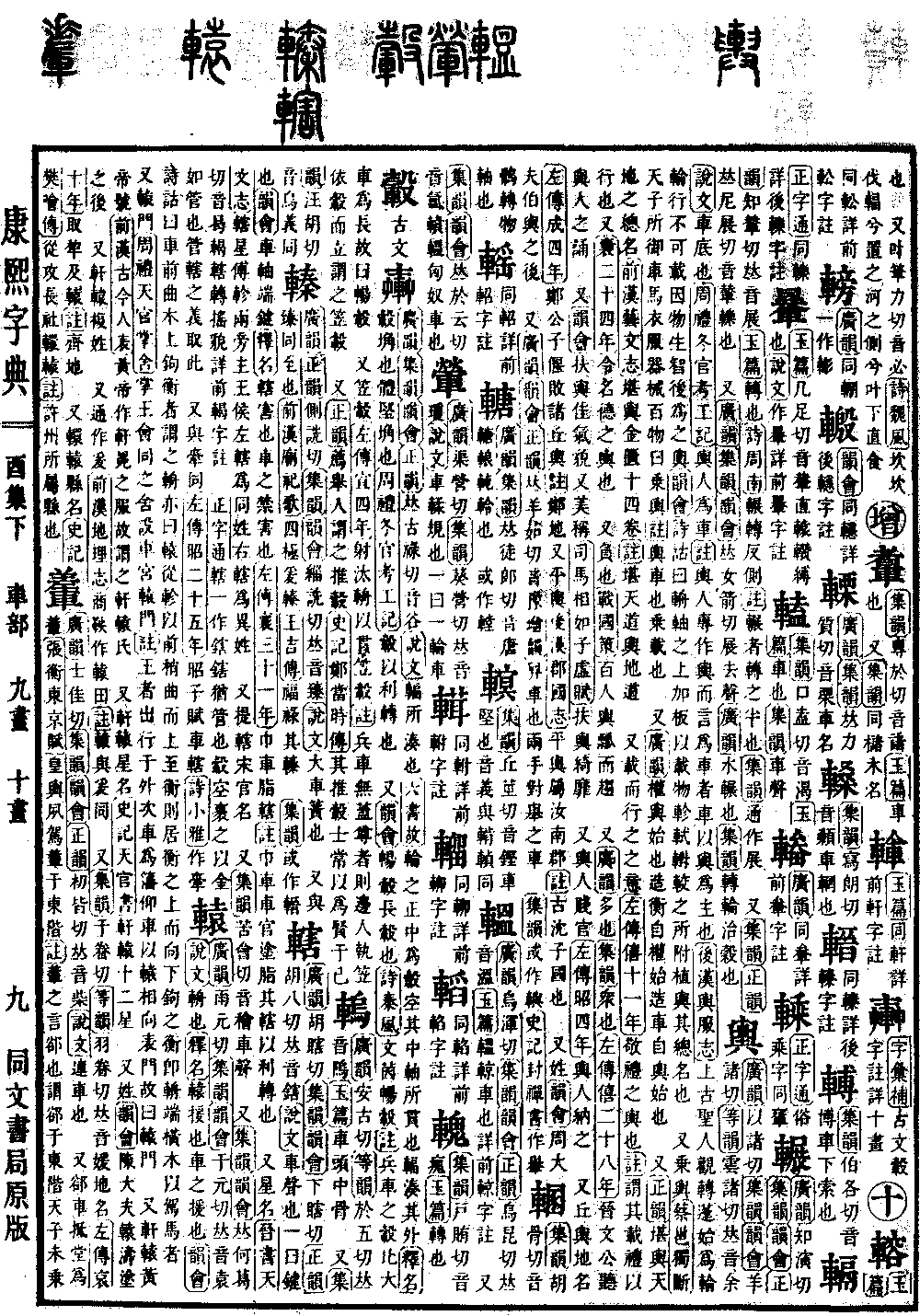
You Collection, Lower Volume
Radical: Carriage (chē)
Page 1247, Entry 17
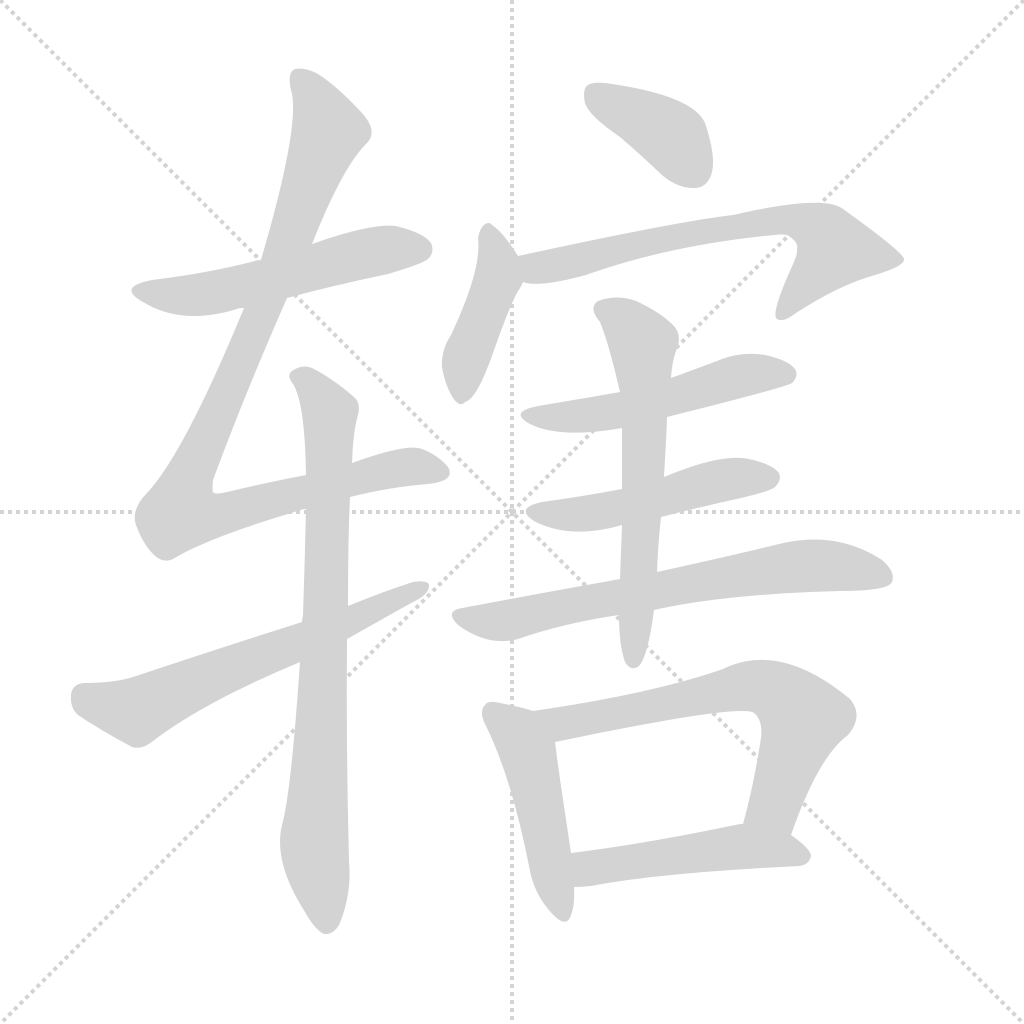
Pronounced xia. According to the Analytical Dictionary of Characters (Shuowen Jiezi), this refers to the sound made by a carriage. Another definition states it is a linchpin. According to the Compendium of Rhymes (Yunhui), it is the linchpin at the end of a carriage axle. According to the Explanation of Names (Shiming), the term refers to inhibiting or preventing harm to the carriage. In the Commentary on the Zuo (Zuo Zhuan), under the thirty-first year of Duke Xiang, it is written: The carriage official greased the linchpins. The commentary notes that the carriage official is an officer in charge of carriages, and greasing the linchpins facilitates the rotation of the wheels. It is also the name of a star. According to the Book of Jin (Jinshu), specifically the Treatise on Astronomy, the Linchpin stars are situated on both sides of the Chariot stars and govern princes; the left linchpin represents those of the same surname, and the right linchpin represents those of different surnames. It also refers to the title of a regulatory official during the Song Dynasty. Pronounced kuai. It refers to the sound of a carriage. Pronounced he. The term kuoxia describes the appearance of rotation and shaking. For more detail, see the previous entry under the character kuo. According to the Correct Meaning of Characters (Zhengzitong), this character is also written in a variant form (xia), which functions similarly to a pipe; the empty space within the wheel hub is lined with metal, resembling a pipe, and the concept of administrative oversight or jurisdiction is derived from this. It is also synonymous with the character (xia). In the Commentary on the Zuo (Zuo Zhuan), under the twenty-fifth year of Duke Zhao, it is written: Zhaozi recited the poem Carriage Linchpin. In the Book of Odes (Shijing), specifically the section Lesser Odes (Xiaoya), it is written as (xia).