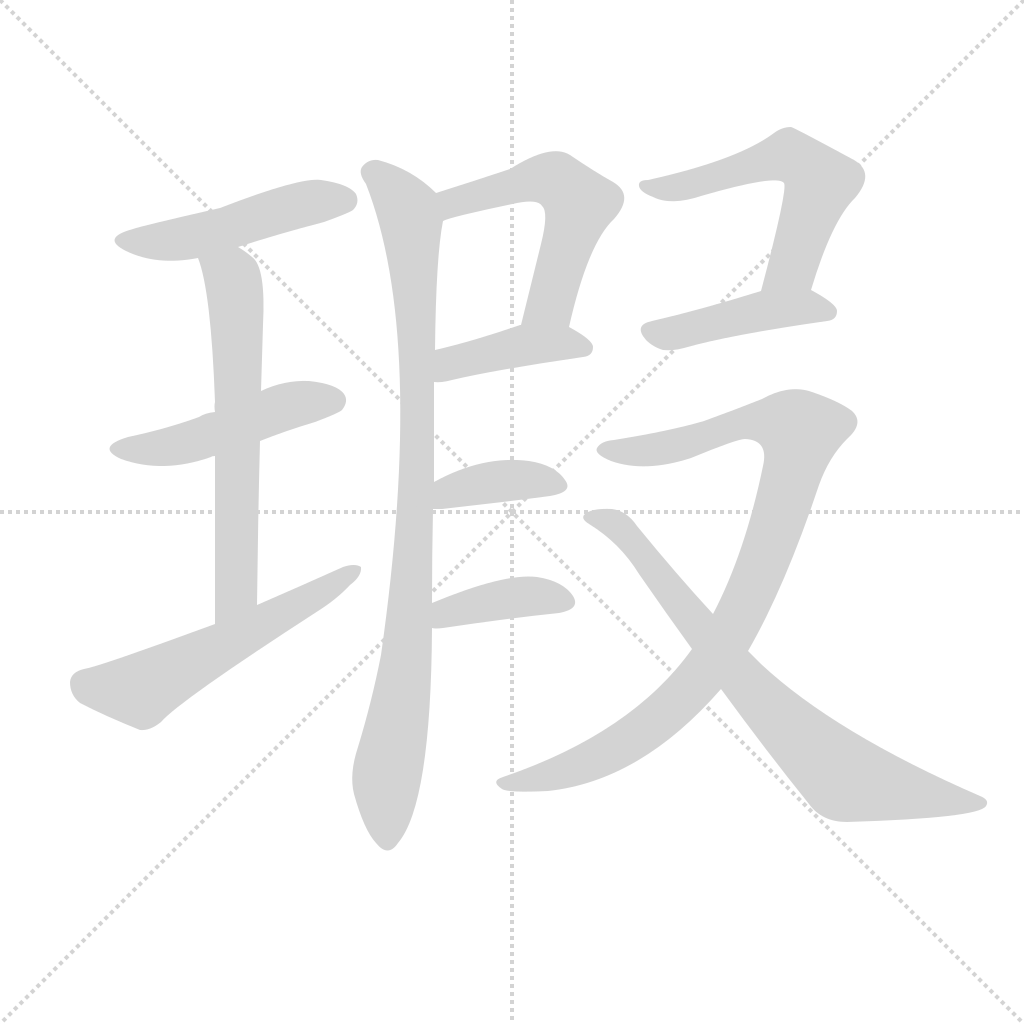
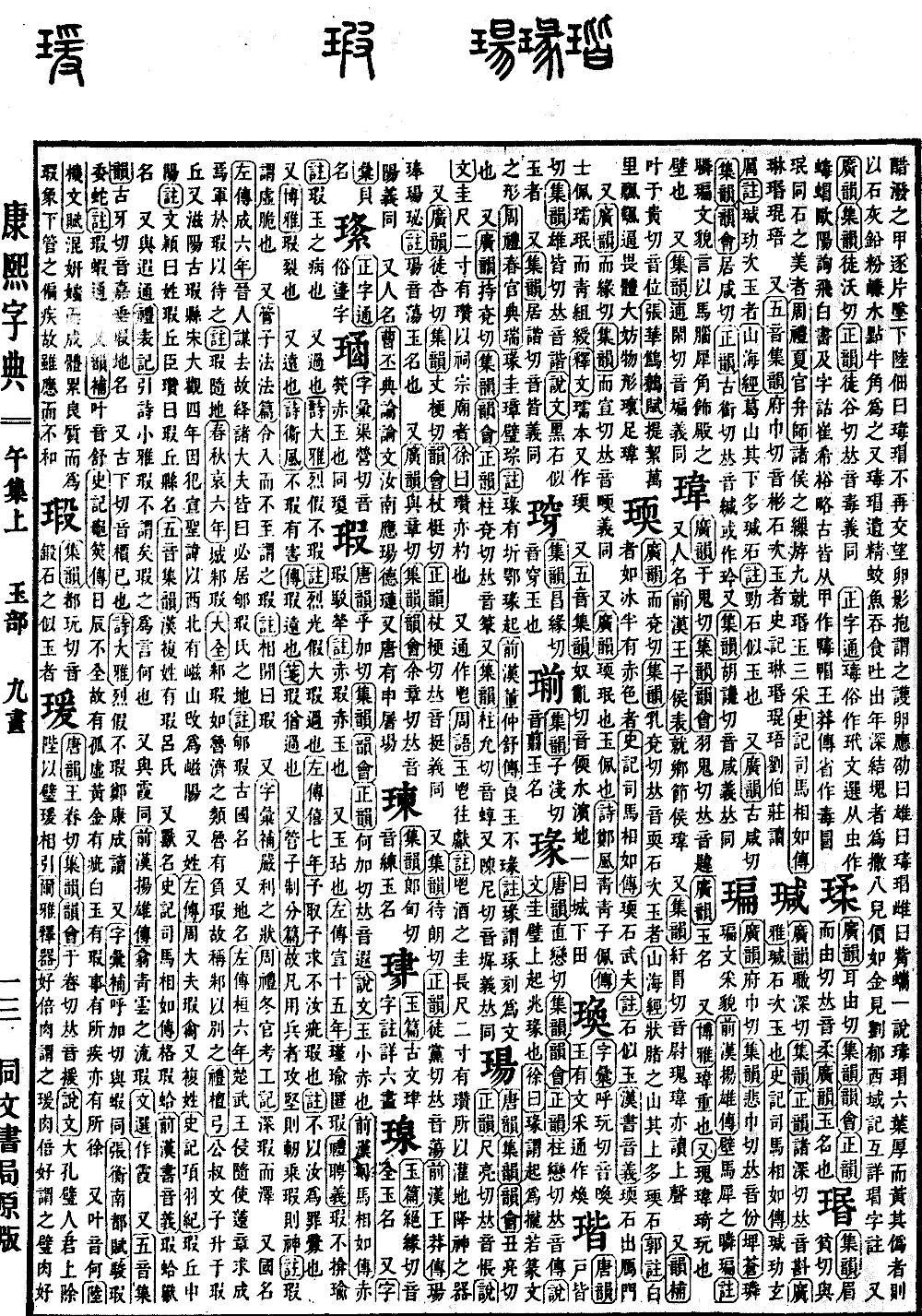
Wu Collection, Upper Volume
Radical: Jade (yù)
Kangxi Dictionary Stroke Count: 14
Page 737, Entry 18
Pronounced xia.
Pronounced xia, sound identical to xia (distant).
Explanation from Explaining Graphs and Analyzing Characters (Shuowen Jiezi): Refers to a reddish mark on jade.
Record in Biography of Sima Xiangru, Former Han History (Qian Han Shu): "Red flaw with mottled patterns." Note: Red flaw refers to red jade.
Also refers to spots or defects on jade.
From Zuo Tradition (Zuo Zhuan), Year 15 of Duke Xuan: "Fine jade conceals no flaw."
From Book of Rites (Liji), Meaning of Betrothal Gifts (Pinyi): "A flaw does not mask the jade's beauty." Note: Flaw refers to a defect in jade.
Also refers to errors or shortcomings.
From Book of Odes (Shijing), Greater Odes (Daya): "Glorious and great, without fault." Note: Lie means bright; jia means great; xia means fault.
From Zuo Tradition (Zuo Zhuan), Year 7 of Duke Xi: "I take what I need and I request what I want, yet you do not view me as having faults." Note: Do not treat you as someone who has committed a crime.
Also, according to the Explaining Glossaries (Boya), xia means to have cracks.
Also refers to distance.
From Book of Odes (Shijing), Odes of Wei (Weifeng): "It is not far and there is no harm." Commentary: Xia means distant. Annotation: Xia is like a mistake.
Also, from Master Guan (Guanzi), Chapter on Establishing Divisions (Zhifen Pian): "Therefore, those who wage war, if attacking the solid, be resilient; if riding upon a weakness, be spiritual." Note: Xia refers to weak or empty points.
Also, from Master Guan (Guanzi), Chapter on Laws (Fafa Pian): "If an order is received but not arrived, it is called a flaw." Note: An interval is called a flaw.
Also, according to the Supplement to the Collection of Characters (Zihui Bu), refers to a sharp appearance.
From Rites of Zhou (Zhouli), Winter Official, Artificers' Record (Kaogong Ji): "Deeply sharp and lustrous."
Also refers to the name of a state.
From Zuo Tradition (Zuo Zhuan), Year 6 of Duke Cheng: "The people of Jin planned to leave old Jiang; all the high officials said: 'We must reside in the land of the Xunxia clan.'" Note: Xunxia is the name of an ancient state.
Also refers to a place name.
From Zuo Tradition (Zuo Zhuan), Year 6 of Duke Huan: "The King Wu of Chu invaded Sui and sent Yuan Zhang to seek peace; he stationed his army at Xia to wait for him." Note: Xia is a location in the State of Sui.
From Spring and Autumn Annals (Chunqiu), Year 6 of Duke Ai: "Walled the Zhu-Xia." Comprehensive Exegesis (Daquan): Zhu-Xia is like place names such as the Ji River in the State of Lu; Lu has a Fuxia, so it is called Zhu-Xia to differentiate it.
From Book of Rites (Liji), Tan Gong: "Gongshu Wenzi ascended to Xiaqiu."
Also, Ziyang; in ancient times it was Xia County. In the fourth year of the Daguan era of the Song Dynasty, because it offended the taboo name of the Holy Sage (Confucius), and because there was Zi Mountain to the northwest of the county, it was renamed Ziyang.
Also a surname.
Zuo Tradition (Zuo Zhuan) records an official of the Zhou Dynasty named Xia Qin.
Also a double-character surname.
From Records of the Grand Historian (Shiji), Annals of Xiang Yu: "Xiaqiu Shenyang." Note: Wen Ying says: The surname is Xiaqiu. Chen Zan says: Xiaqiu is a county name.
The Collection of Characters of the Five Sounds (Wuyin Jiyun) records a Han Dynasty double-character surname, the Xialü clan.
Also refers to the name of a beast.
From Records of the Grand Historian (Shiji), Biography of Sima Xiangru: "Subduing the xia-ha." Former Han History (Qian Han Shu) Phonetic Annotations: Xia-ha is the name of a beast.
Also interchangeable with xia (distant).
From Book of Rites (Liji), Records of Expressions (Biaoji), citing Book of Odes (Shijing), Lesser Odes (Xiaoya): "Does one not speak of the flaw?" The annotation says the meaning of xia is "hu" (how/why).
Also interchangeable with xia (rosy clouds).
From Former Han History (Qian Han Shu), Biography of Yang Xiong: "Gathering the flowing rosy clouds of the blue sky." Anthology of Literature (Wenxuan) writes it as the character for rosy clouds.
Also, according to the Collection of Characters of the Five Sounds (Wuyin Jiyun), pronounced jia, sound identical to jia (praise). It is Chui-xia, a place name.
Also pronounced jia, sound identical to jia (a type of tree). It means to stop or to finish.
From Book of Odes (Shijing), Greater Odes (Daya): "Glorious and great, without fault." Zheng Kangcheng (Zheng Xuan) reads it this way.
Also, according to the Supplement to the Collection of Characters (Zihui Bu), pronounced xia. Interchangeable with xia (shrimp).
From Zhang Heng, Southern Capital Rhapsody (Nandu Fu): "The swift shrimp twists and turns." Note: Xia is interchangeable with the character for shrimp.
Also, in rhyme supplement works, leveled to rhyme with shu.
From Records of the Grand Historian (Shiji), Biography of Turtle and Yarrow Divination: "The days and signs are not complete, thus there are loneliness and emptiness. Gold has defects, white jade has flaws. Affairs have their urgency, but also have their delays."
Also leveled to rhyme with he.
From Lu Ji, Rhapsody on Literature (Wenfu): "Blending the beautiful and the ugly to form a body, piling up fine qualities to create a flaw. Like the unevenness of the lower pipes, even if they respond, they do not harmonize."