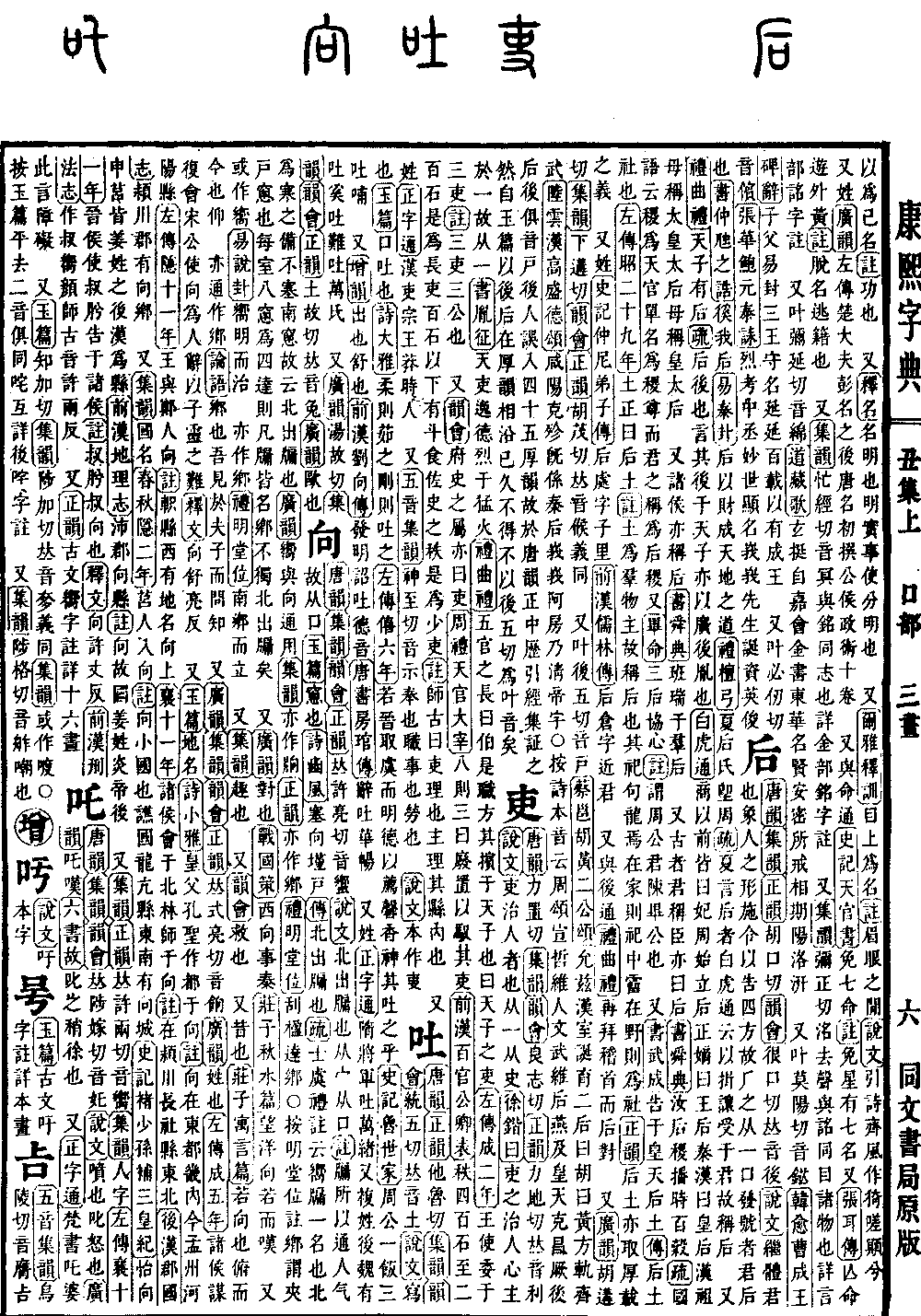
Chou Collection, Upper Volume Radical: Mouth (kǒu); Kangxi strokes: 6; Page 176, Entry 04
Tang Rhymes (Tangyun), Collection of Rhymes (Jiyun), Rhyme Meetings (Yunhui), and Orthodox Rhymes (Zhengyun) pronounce this character as xiang. It sounds the same as xiang.
Explaining Graphs and Analyzing Characters (Shuowen Jiezi) defines this as a window facing north. The character structure is composed of the roof radical and the mouth radical. Annotation: Windows are used for air circulation, hence the use of the mouth radical.
Jade Chapters (Yupian) defines this as a window.
Book of Odes (Shijing), Odes of Bin (Binfeng), contains the phrase: Seal the north-facing windows and plaster the doors. Commentary: Defined as a window facing north. Sub-commentary: Citing the notes for the Rituals of the Officers (Shiyuli), it states: The characters for window and the alternative form for window are different names for the same object. To guard against the northern chill, one does not seal the windows facing south, hence it is specifically called a window facing north.
Extensive Rhymes (Guangyun) records that the characters for xiang (variant) and xiang (the entry) can be used interchangeably.
Collection of Rhymes (Jiyun) also writes it as a variant form.
Orthodox Rhymes (Zhengyun) also writes it as a variant form.
Book of Rites (Liji), The Hall of Distinction (Mingtangwei), contains the phrase: Scrape the pillars and reach the side windows. According to the notes for The Hall of Distinction, the variant character refers to windows flanking the doors. Each room has eight windows, forming a path in all directions, so all windows can be called by this name, not merely those facing north.
Furthermore, Extensive Rhymes (Guangyun) defines this as facing or orienting toward.
Strategies of the Warring States (Zhanguoce) contains the phrase: Facing west to serve the State of Qin.
Zhuangzi, Autumn Floods (Qiushui), contains the phrase: Looked across the ocean toward the god of the sea and sighed.
Sometimes written in a variant form (xiang).
Book of Changes (Yijing), Treatise on the Hexagrams (Shuogua), contains the phrase: Facing the light to govern.
Also written in a variant form.
Book of Rites (Liji), The Hall of Distinction (Mingtangwei), contains the phrase: Stood facing south.
Furthermore, Collection of Rhymes (Jiyun) defines this as to trend toward.
Furthermore, Rhyme Meetings (Yunhui) defines this as to rescue or assist.
Furthermore, it is defined as formerly or in the past.
Zhuangzi, Metaphorical Language (Yuyan), contains the phrase: If previously one was bowed, now one is upright.
It is also commonly written in a variant form.
Analects (Lunyu) contains the phrase: Previously, I met with the Master and asked about wisdom.
Furthermore, Tang Rhymes (Tangyun), Collection of Rhymes (Jiyun), Rhyme Meetings (Yunhui), and Orthodox Rhymes (Zhengyun) pronounce this as xiang. It sounds the same as xiang.
Extensive Rhymes (Guangyun) defines this as a surname.
Zuo Tradition (Zuozhuan), Fifth Year of Duke Cheng, records: The feudal lords plotted to meet with the Duke of Song again, and the Duke of Song sent Xiang Weiren to decline on the grounds of the disturbance caused by Ziling. Explanation of Texts (Shiwen): Pronounced xiang.
Furthermore, Jade Chapters (Yupian) defines this as a place name.
Book of Odes (Shijing), Lesser Odes (Xiaoya), contains the phrase: Prince Huangfu was very wise, and established his capital at Xiang. Note: The land of Xiang is within the metropolitan territory of the Eastern Capital, which is present-day Heyang County in Mengzhou.
Zuo Tradition (Zuozhuan), Eleventh Year of Duke Yin, records: The King of Zhou gave the land of Xiang to the State of Zheng. Note: West of Zhi County there is a place called Xiangshang.
Zuo Tradition (Zuozhuan), Eleventh Year of Duke Xiang, records: The feudal lords met at Beilin, and the army was stationed at Xiang. Note: The land of Xiang is to the northeast of Changshe County in Yingchuan Commandery.
Book of the Later Han (Hou Hanshu), Treatise on Geography (Junguozhi), records: Yingchuan Commandery has Xiang Township.
Furthermore, Collection of Rhymes (Jiyun) defines this as the name of a state.
Spring and Autumn Annals (Chunqiu), Second Year of Duke Yin, records: The people of the State of Ju invaded the State of Xiang. Note: Xiang was a small state; there is a Xiang City southeast of Longkang County in the State of Qiao.
Records of the Grand Historian (Shiji), Supplement to the Three Sovereigns by Chu Shaosun, records: Yi, Xiang, Shen, and Ju were all descendants of the Jiang surname; in the Han Dynasty, they were established as counties.
Book of the Former Han (Qian Hanshu), Treatise on Geography (Dilizhi), records: Pei Commandery had Xiang County. Note: Xiang was a former feudal state of the Jiang surname, descendants of the Flame Emperor.
Furthermore, Collection of Rhymes (Jiyun) and Orthodox Rhymes (Zhengyun) pronounce this as xiang. It sounds the same as the variant form.
Collection of Rhymes (Jiyun) defines this as a character used in personal names.
Zuo Tradition (Zuozhuan), Eleventh Year of Duke Xiang, records: The Marquis of Jin sent Shu Xi to notify the feudal lords. Note: Shu Xi is Shu Xiang. Explanation of Texts (Shiwen): Pronounced xiang.
Book of the Former Han (Qian Hanshu), Treatise on Penal Law (Xingfazhi), writes it as a variant form, with phonetic notes by Yan Shigu pronounced as xiang.
Furthermore, Orthodox Rhymes (Zhengyun) identifies this as the ancient form of the variant character xiang. Detailed commentary is found under the sixteen-stroke section.
Textual verification: Zuo Tradition (Zuozhuan), Eleventh Year of Duke Xiang, records: The Marquis of Jin sent Shu Xi to notify the feudal lords. Note: Shu Xi is Shu Xiang. The original text has been carefully corrected, changing both instances of the character xi to xi.