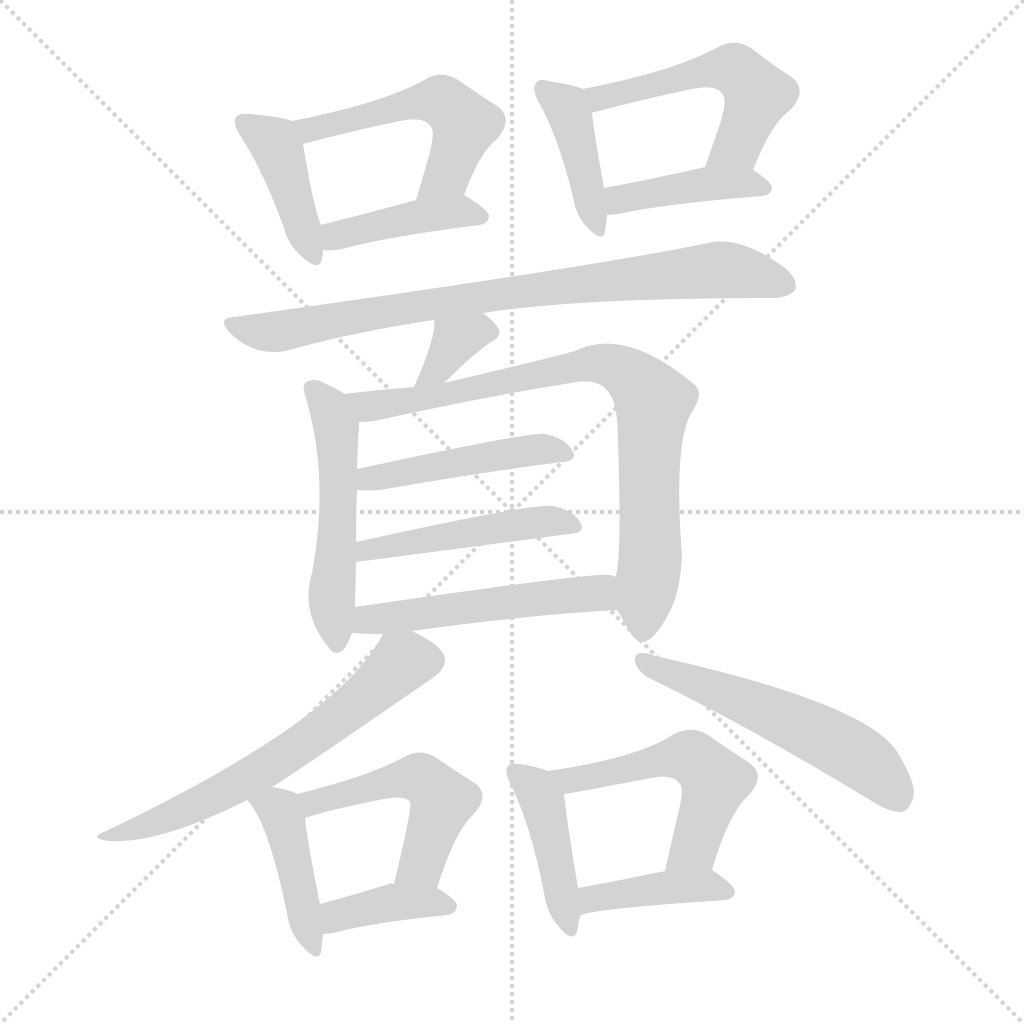
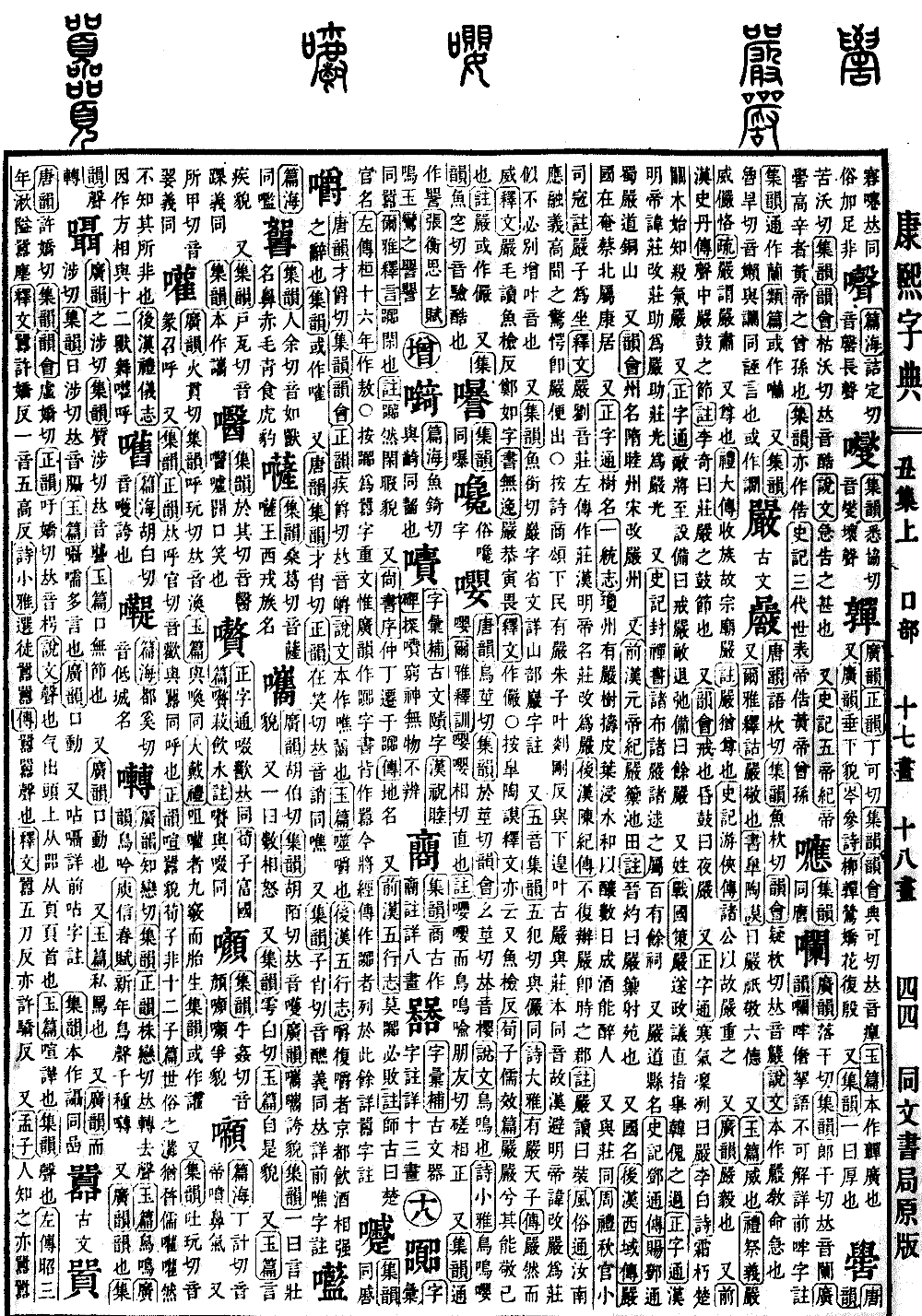
Chou Collection, Upper Volume
Radical: Mouth (kǒu)
Kangxi Strokes: 21
Page 214, Entry 32
Ancient form. Pronounced xiao.
Shuowen Jiezi (Shuowen) states it refers to sound, where breath exits above the head. Formed from the components for person and head. Head refers to the top.
Yupian states it means clamor or noisy.
Jiyun states it refers to sound.
Zuo Zhuan (Zuo Zhuan), Third Year of Duke Zhao: A swampy, narrow, noisy, and dusty place.
Interpretation: Pronounced xiao. Another pronunciation is gao.
Book of Odes (Shijing), Lesser Odes: Selecting troops with clamor.
Commentary: Clamor refers to sound.
Interpretation: Pronounced xiao. Also pronounced xiao.
Mencius (Mengzi): If people know him, he is calm and unconcerned; if people do not know him, he is also calm and unconcerned.
Annotation: Calm and unconcerned refers to the appearance of being self-satisfied and without desire.
Also used as a personal name. Records of the Grand Historian (Shiji), Annals of the Yellow Emperor: Leizu gave birth to two sons, one named Xiao, who was known as Qingyang.
Also pronounced ao. Meaning is the same.
Rites of Zhou (Zhouli), Autumn Official: The officer in charge of silence manages the control of clamor.
Annotation: One who inspects those who are noisy.
Interpretation: Pronounced ao.
Book of Odes (Shijing), Lesser Odes: Slanderous mouths are numerous.
Annotation: Numerous refers to the appearance of many.
Interpretation: Pronounced ao. In the Han version of the Odes, it is written as a variant form (ao).
History of the Former Han (Qianhan), Biography of Dong Zhongshu: This is why the people are numerous and suffer from insufficiency.
Annotation: Yan Shigu states it is equivalent to the variant form (ao).
Book of Odes (Shijing), Lesser Odes: I approach you for counsel, listen to my clamor.
Commentary: Clamor is the same as the variant form (ao).
Interpretation: Pronounced ao.
Zihui states a hollow in a mountain is called xiao.
Biography of Emperor Xuan of Liang, Rhapsody on the Seven Mountain Temples: The divine valley stands uniquely and prominently.
Also the name of a bird. Classic of Mountains and Seas (Shanhaijing): In Mount Liangqu there is a bird, shaped like a Kua Fu, with four wings, one eye, and a dog's tail, named Xiao.
Also the name of a beast. Classic of Mountains and Seas (Shanhaijing): In Mount Yuci there is a beast, shaped like a monkey, with long arms skilled at throwing, named Xiao.
Also the name of a river. Classic of Mountains and Seas (Shanhaijing): In Mount Bozhong, the Xiao River originates.
Also the name of a mountain. Classic of Mountains and Seas (Shanhaijing): Mount Beixiao has no rocks; its sunny side has much jasper and its shady side has much jade.
Also a place name. Interchangeable with the variant forms (ao) and (ao). See the previous note for the character Xiao.
Note: In the classics and their commentaries, Xiao is mostly read as Ao. Only in the Lesser Odes section of the Book of Odes (Shijing) and the Third Year of Duke Zhao in the Zuo Zhuan (Zuo Zhuan) do the interpretations provide both the Ao and Xiao pronunciations.
Textual Correction: In the History of the Former Han (Qianhan), Biography of Dong Zhongshu, where it reads this is why the people are numerous and suffer from insufficiency, the text has been corrected from suffer from insufficiency to suffer from insufficiency according to the original text.