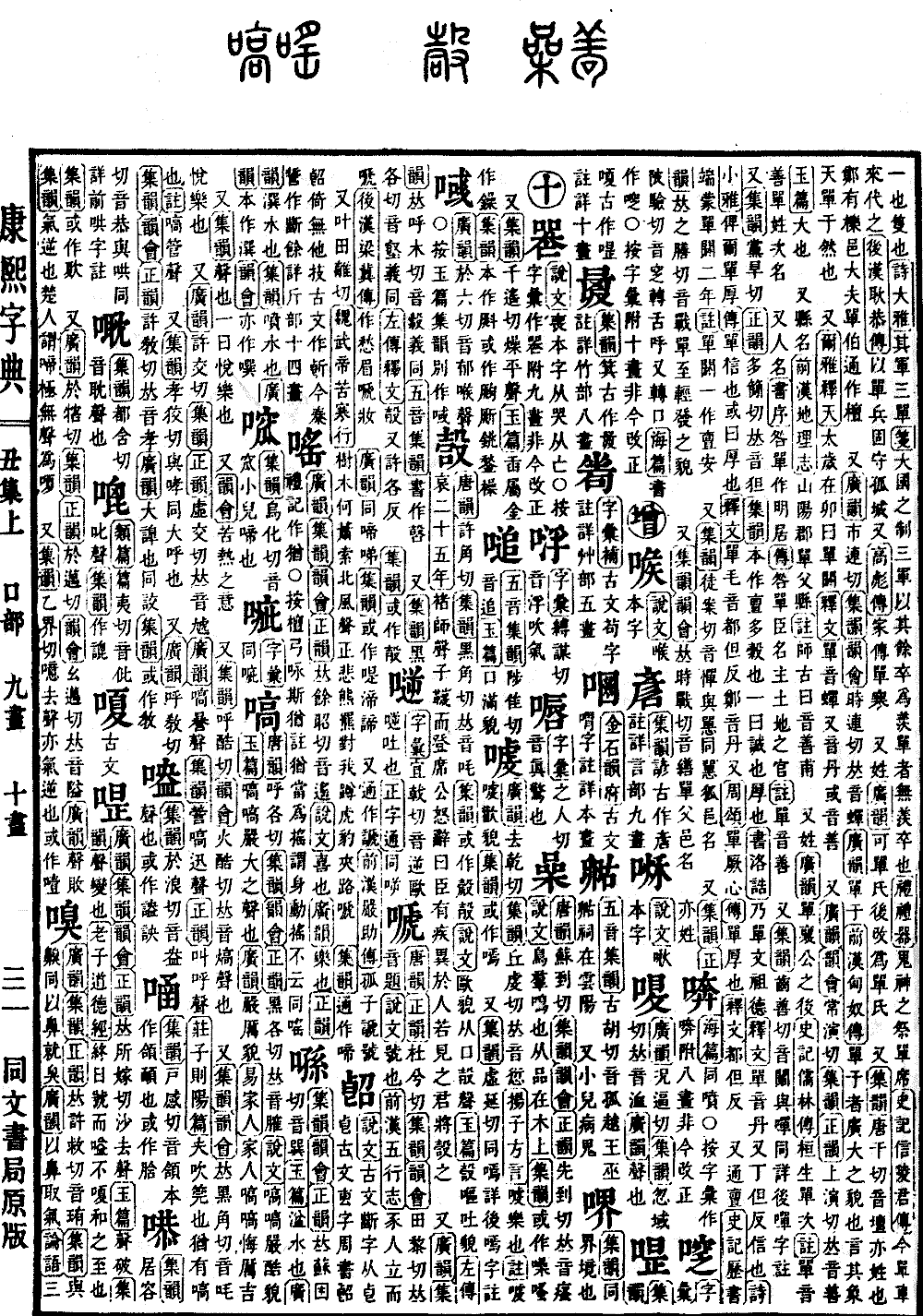
Chou Collection, Upper Volume
Radical: Mouth (kǒu)
Character: sha
Kangxi Stroke Count: 13
Page 201, Entry 34
Ancient textual records:
Broad Rhymes (Guangyun), Collected Rhymes (Jiyun), Rhyme Meetings (Yunhui), and Orthodox Rhymes (Zhengyun) indicate the pronunciation as sha (falling-rising tone).
Jade Chapters (Yupian) defines it as a hoarse voice.
Collected Rhymes (Jiyun) defines it as a change in voice.
Dao De Jing (Laozi) states: To cry all day and not become hoarse, this is the manifestation of the utmost harmony.
Collected Rhymes (Jiyun) records that this character is sometimes written in a variant form (zhuàn).
Additionally:
Broad Rhymes (Guangyun) indicates the pronunciation as ai (falling-rising tone).
Collected Rhymes (Jiyun) and Orthodox Rhymes (Zhengyun) indicate the pronunciation as ai (falling-rising tone).
Rhyme Meetings (Yunhui) indicates the pronunciation as ai (falling-rising tone).
Broad Rhymes (Guangyun) defines it as a failing voice.
Collected Rhymes (Jiyun) defines it as counterflow of breath.
In the Chu region, people refer to crying until one loses one's voice as sha.
Furthermore:
Collected Rhymes (Jiyun) indicates the pronunciation as yi (falling-rising tone).
It also refers to counterflow of breath. Sometimes also written in a variant form (yē).