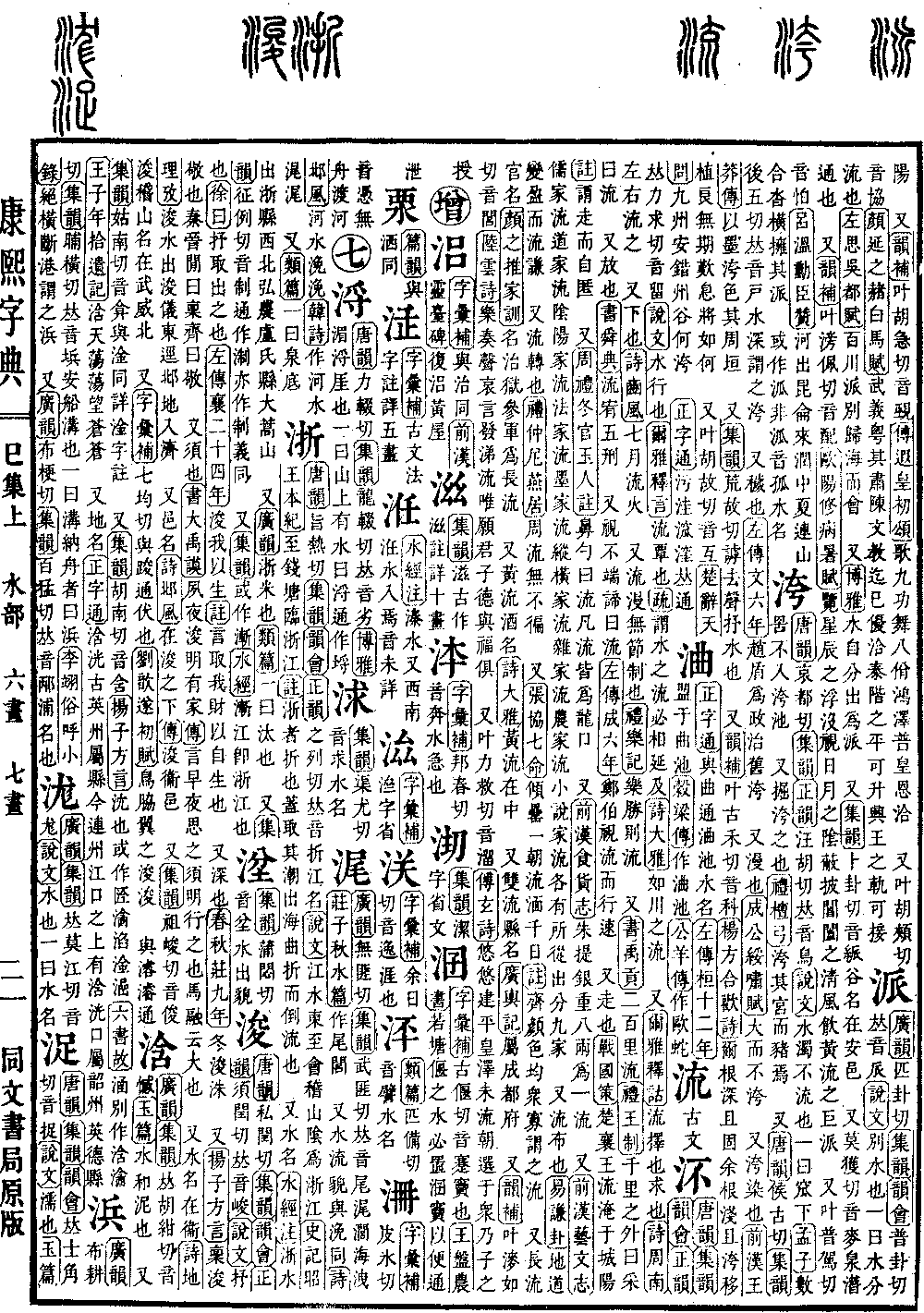
Si Collection, Upper Volume
Radical: Water (shuǐ)
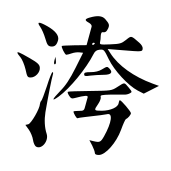
洿
Kangxi strokes: 10
Page 623, Entry 02
Pronounced wu.
According to the Explaining Graphs and Analyzing Characters (Shuowen Jiezi), it refers to stagnant, murky water. Another interpretation describes it as a low-lying area.
Mencius says: Fined-mesh nets are not to enter the low-lying pools.
Also refers to digging out a depression.
The Book of Rites (Liji), in the Tan Gong section, states: Excavate his living quarters to make it a place to store water.
Pronounced hu.
Deep water is called wu.
Also refers to filth.
The Zuo Tradition (Zuozhuan), in the sixth year of Duke Wen, states: Zhao Dun held the government, clearing away the old filth.
Also refers to overflowing or spreading.
Cheng Gongshui, in the Rhapsody on Whistling (Xiaofu), writes: Vast and grand, yet not overflowing.
Also refers to staining or smearing.
The History of the Former Han (Qianhanshu), in the Biography of Wang Mang, states: Using ink to smear the four surrounding walls.
Pronounced hu (falling tone).
Refers to scooping or draining water.
Pronounced ke.
From the Union of Joy Poem (Hehuan Shi) by Yang Fang: Your roots are deep and firm, mine are shallow and low. Transplants indeed have no set time, what can sighing achieve.
Pronounced hu.
From the Verses of Chu (Chuci), in the Heavenly Questions (Tianwen): How were the nine provinces arranged, why are the valleys of the provinces sunken.
The characters for dirty, depression, stagnant pool, and concave are used interchangeably.