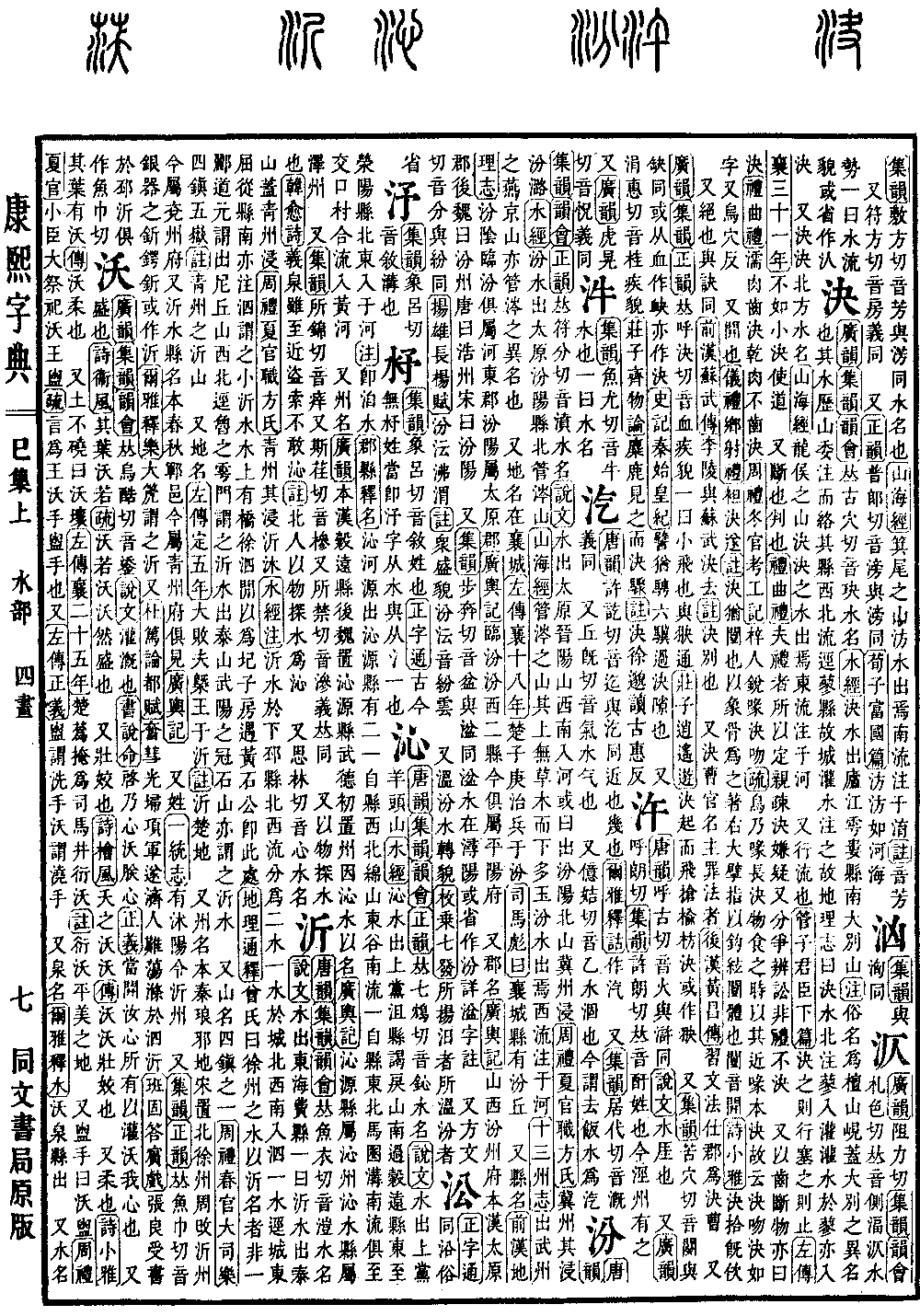
Si Collection, Upper Volume
Radical: Water (shuǐ)
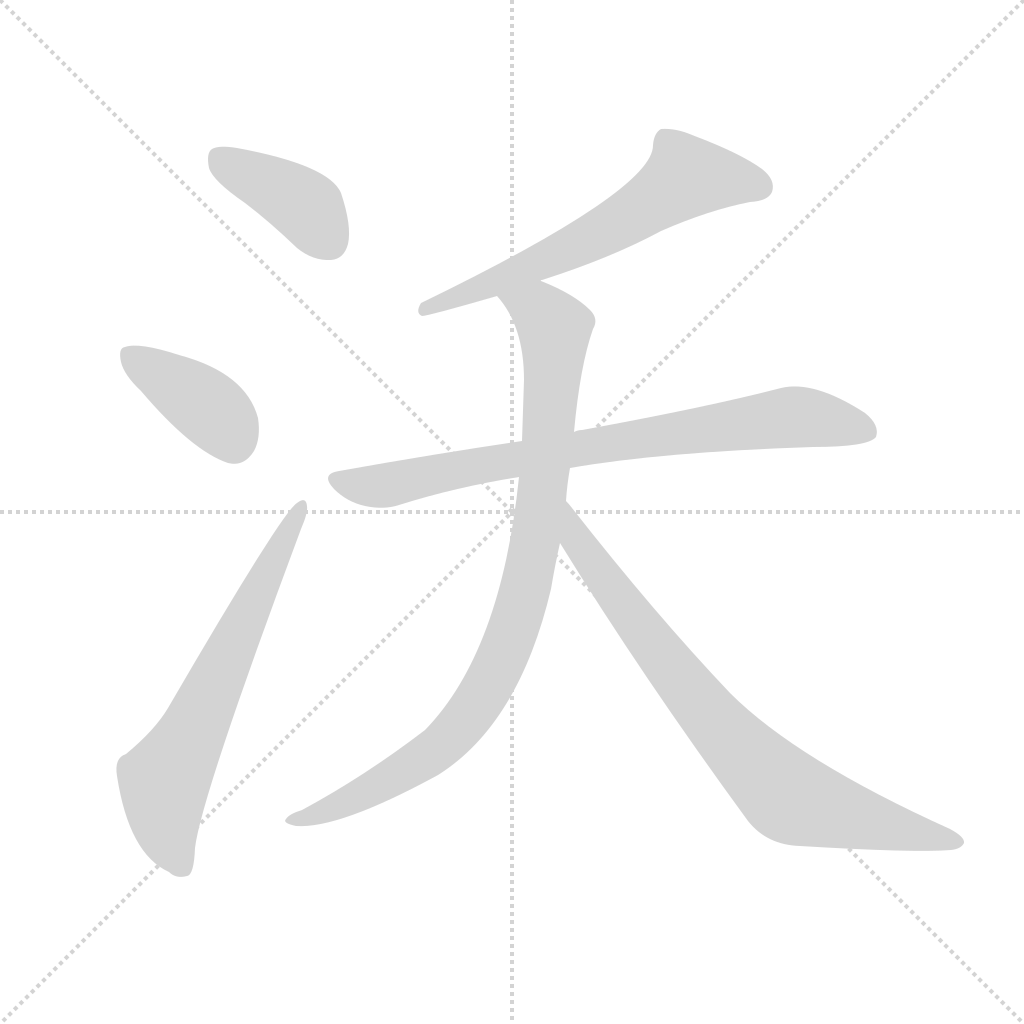
Wo; Kangxi strokes: 8; Page 609, Entry 13
Guangyun (Broad Rimes), Jiyun (Compendium of Rimes), and Yunhui (Collection of Rhymes) define it as pronounced wu, with the sound of wu.
Shuowen (Explaining Graphs) defines it as to irrigate.
Book of Documents (Shangshu): Open your heart to irrigate my heart.
Correct Interpretation (Zhengyi): It means one should open up all that is within one's heart to water and nourish my heart.
It also denotes abundance.
Book of Odes (Shijing): Its leaves are lush.
Commentary (Shu): Lush means the appearance of being flourishing.
It also denotes grand beauty.
Book of Odes (Shijing): Youthful and lush.
Commentary (Zhuan): Lush means the appearance of being robust and beautiful.
It also denotes soft and moist.
Book of Odes (Shijing): Its leaves are soft and moist.
Commentary (Zhuan): Soft and moist.
Land that is not barren is called fertile soil.
Zuo Tradition (Zuo Zhuan): In the twenty-fifth year of Duke Xiang, Wei Yan of Chu served as Minister of War, planning and leveling fertile land.
Note: Fertile and level, it refers to flat and rich land.
Washing hands is called woguan.
Rites of Zhou (Zhouli): The minor official pours water for the king to wash his hands during great sacrifices.
Commentary (Shu): It speaks of pouring water for the king, which means to wash the hands.
Zuo Tradition (Zuo Zhuan) Correct Interpretation (Zhengyi): Guan refers to washing the hands, and wo refers to pouring water to wash the hands.
It is the name of a spring.
Erya (Approaching Elegance): A wo spring is one that wells upward.
It is the name of a river. It is northwest of Woyang County.
Commentary on the Water Classic (Shuijingzhu): The Zhongling River flows east through Woyang County, then flows northwest into the Wo River.
It is one of the nine types of soil.
Huainanzi (Huainan Masters): The secondary province in the due south is called fertile soil.
People in Southern Min call rainfall wo. Found in Jingguan Suoyan (Trivial Observations from the Well) by Zheng Yuan.
It is the name of Quwo, a city-state of the Jin kingdom.
Book of Odes (Shijing): In white robes with red collars, I follow you to Quwo.
Guangyu Ji (Record of the Vast Territories): Quwo County belongs to Pingyang Prefecture in Shanxi.
It is a surname. A descendant of Woding. There was a person in the Wu state named Wojiao, who wrote the Biographies of Immortals (Shenxian Zhuan).
Jiyun (Compendium of Rimes): Pronounced yu. The appearance of being lush.
Book of Odes (Shijing): Its leaves are lush, as read by Xu Miao.
Shuowen (Explaining Graphs): Originally written with a different character, now simplified.