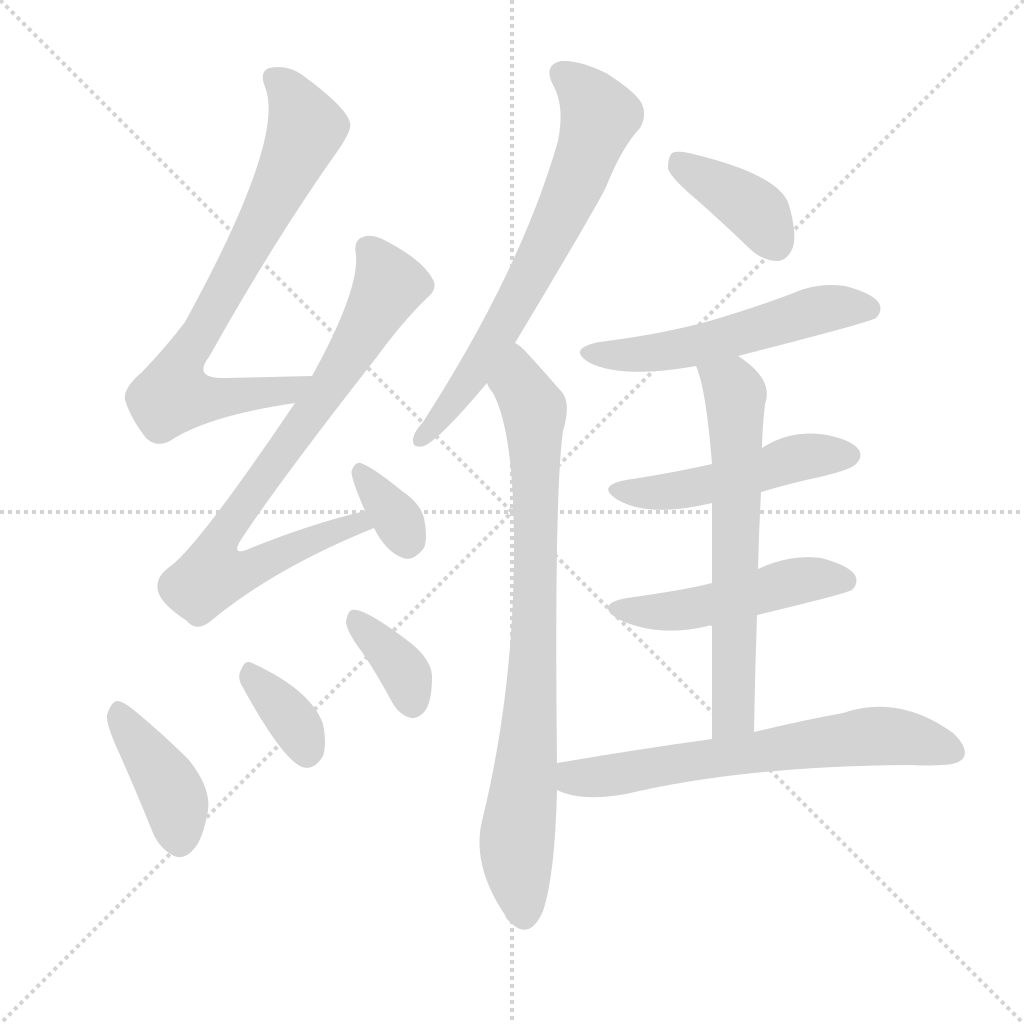
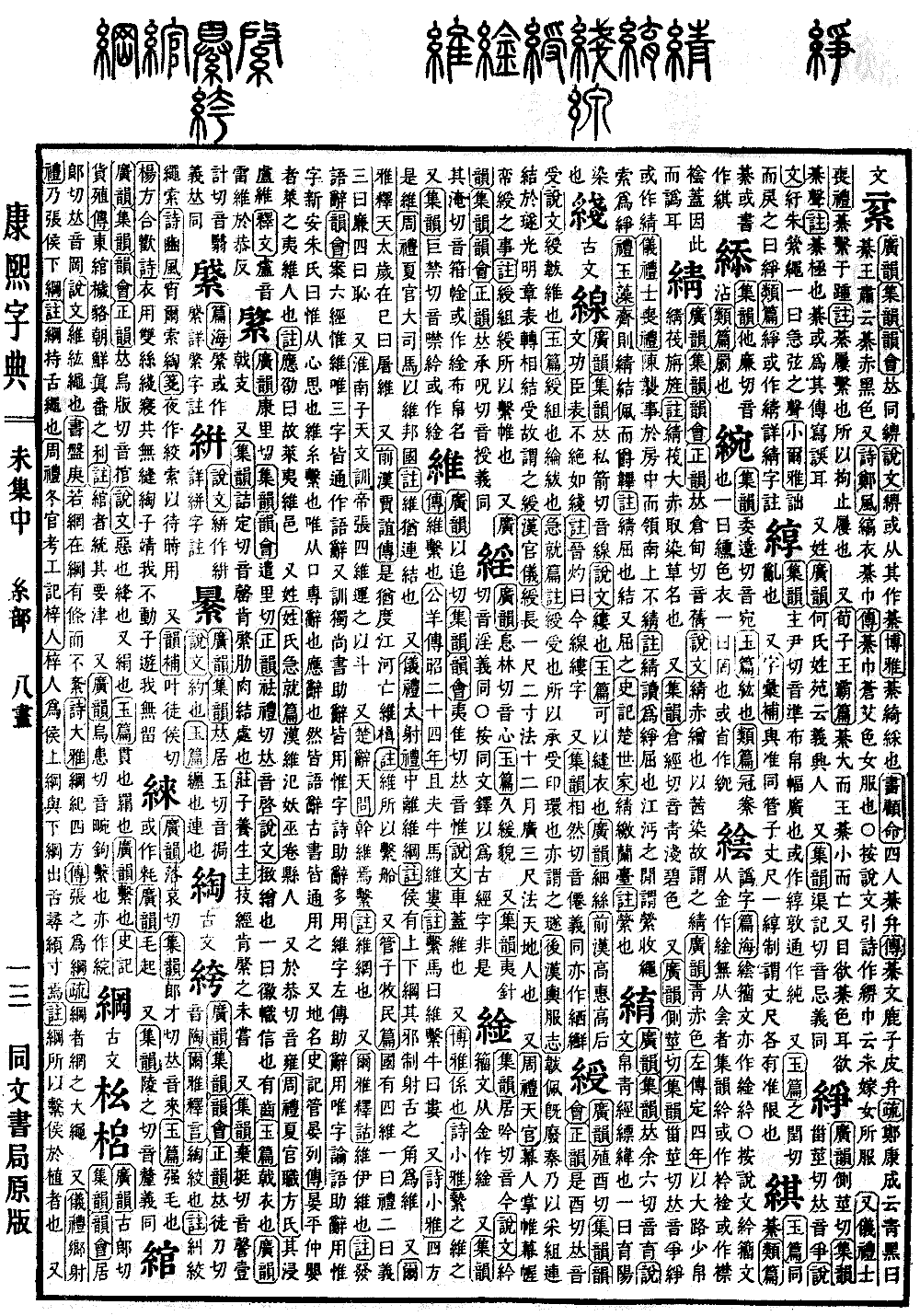
Wei Collection, Lower Volume
Radical: Silk (mì)
Kangxi strokes: 14
Page 927, Entry 15
Guangyun: Pronounced wei. Jiyun and Yunhui: Pronounced wei.
Shuowen Jiezi: The binding for a carriage cover.
Guangya: To tie or fasten.
Book of Odes (Shijing), Lesser Odes: To tether it, to bind it.
Commentary: Wei means to tie or fasten.
Gongyang Zhuan (Gongyang Commentary on the Spring and Autumn Annals), Year 24 of Duke Zhao: Moreover, for oxen and horses, use a wei and a lou.
Annotation: To tie a horse is called wei; to tie an ox is called lou.
Book of Odes (Shijing), Lesser Odes: It acts as the binding for the four quarters.
Rites of Zhou (Zhouli), Summer Offices, Grand Marshal: Thereby binding the states and kingdoms.
Annotation: Wei signifies connecting or linking.
Book of Etiquette and Ceremonial (Yili), Great Archery Rites: The middle is separated by the wei and gang.
Annotation: The target has upper and lower gang; the slanted parts that control the tongue of the target and the corners are called wei.
Erya, Explaining Heaven: When the Tai Sui star is in the position of Si, it is called Tuwei.
Book of Han (Hanshu), Biography of Jia Yi: This is like crossing a river without a tie or an oar.
Annotation: Wei is that which is used to tie a boat.
Guanzi, Herding the People: A state has four pillars; the first is ritual, the second is duty, the third is integrity, and the fourth is a sense of shame.
Huainanzi, Treatise on Astronomy: The Emperor spreads the four corners, turning them with the Dipper.
Songs of Chu (Chu Ci), Questions of Heaven: Where are the stems and pillars tied?
Annotation: Wei means a cord or net.
Erya, Explaining Words: Yi and wei are particles used to introduce a statement.
Annotation: Particles used at the beginning of a phrase.
Yunhui: Examination of the six classics shows that the three characters wei, wei, and wei are all used interchangeably as grammatical particles. They are also used to mean only or alone. The Book of Documents (Shangshu) uses wei for particles; the Book of Odes (Shijing) mostly uses wei; the Zuo Zhuan uses wei; and the Analects (Lunyu) uses wei. Master Zhu of Xin'an says: Wei (with the heart radical) denotes thought. Wei (with the silk radical) denotes tying or fastening. Wei (with the mouth radical) is a word of exclusive focus or a word of response. However, they are all grammatical particles, and in ancient texts, they were all used interchangeably.
Place name. Records of the Grand Historian (Shiji), Biographies of Guan and Yan: Yan Pingzhong Ying was a man of Yiwei in Lai.
Annotation: Ying Shao says: This was the former city of Yiwei in the state of Lai.
Surname. Xing shi ji jiu pian: Wei Si of the Han dynasty, a sorcerer from Juan County.
Pronounced yong.
Rites of Zhou (Zhouli), Summer Offices, Regional Officers: Its tributaries are the Lu and the Wei.
Commentary: Lu is pronounced lei. Wei is pronounced yong.
Textual Research: Songs of Chu (Chu Ci), Questions of Heaven: Where are the stems and pillars tied? Annotation: Wei means a net. Corrected according to the original text to mean a cord. Erya, Explaining Words: Wei is yi and wei. Corrected according to the original text to read yi wei hou ye.