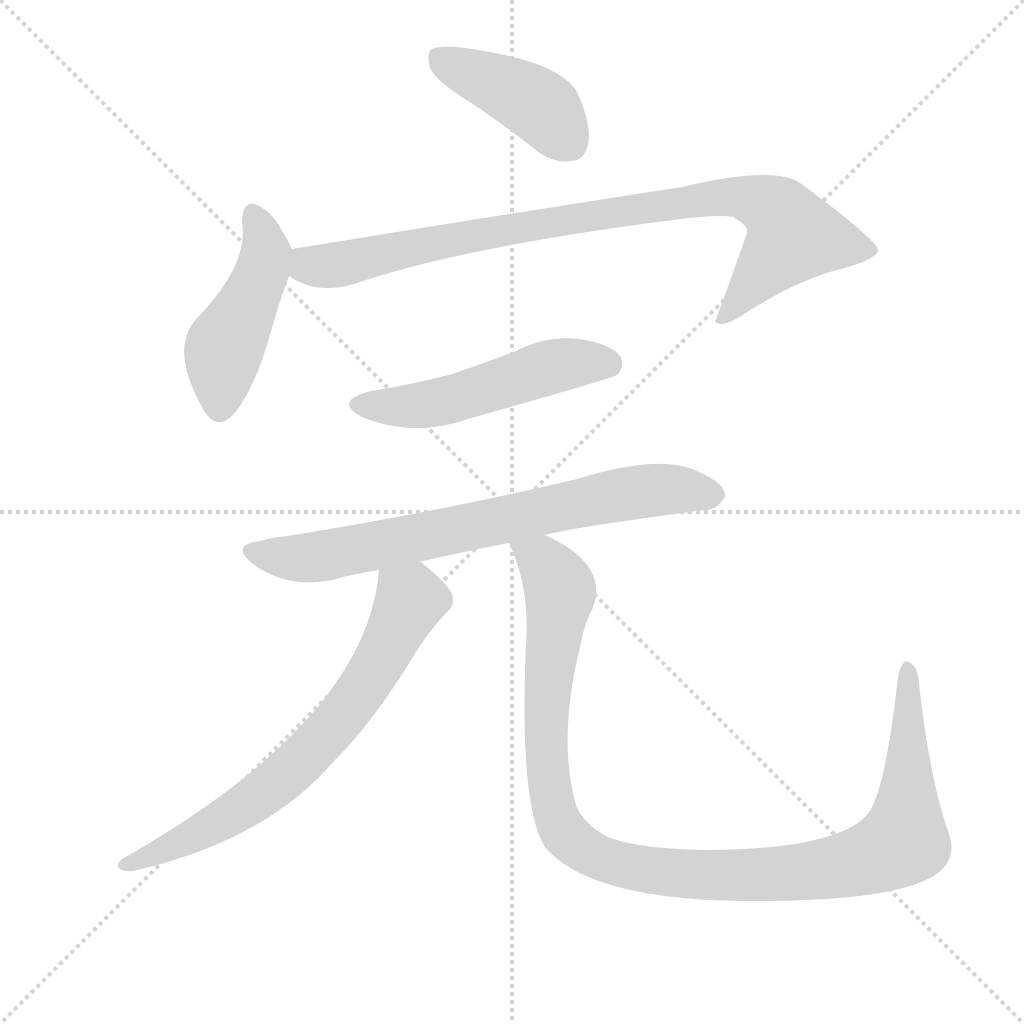
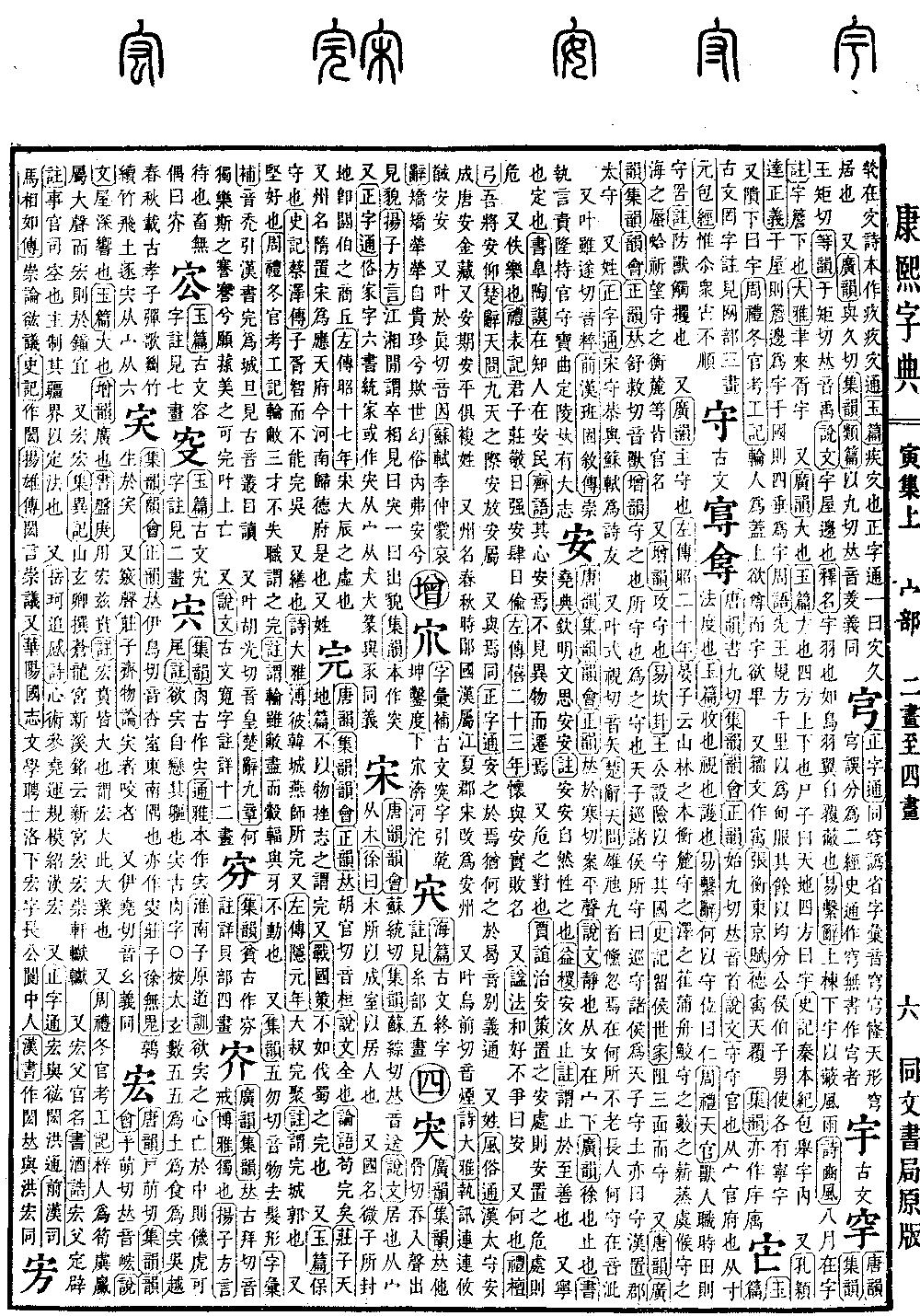
Yin Collection, Upper Volume
Radical: Roof (mián)
Kangxi stroke count: 7
Page 282, Entry 13
Tang Rhymes (Tangyun), Collected Rhymes (Jiyun), Rhyme Compendium (Yunhui), and Correct Rhymes (Zhengyun) state it is pronounced huan.
According to the Discussion of Writing (Shuowen), it means complete.
In the Analects (Lunyu), it is said, if one is complete.
In the Zhuangzi, Chapter on Heaven and Earth (Tiandi pian), it is said that not letting things thwart one's will is called completion.
Also, in the Strategies of the Warring States (Zhan Guo Ce), it is said, it is not as complete as the conquest of the Shu state.
Also, in the Jade Compendium (Yupian), it means to preserve or guard.
In the Records of the Grand Historian (Shiji), Biography of Cai Ze, it says Zixu was wise but could not preserve the Wu state.
Also, it means to repair or fortify.
In the Book of Odes (Shijing), Great Odes (Daya), it says, they were wide, those Han walls, repaired by the armies of Yan.
Also, in the Zuo Commentary (Zuo Zhuan), first year of Duke Yin, it says, the grand uncle repaired and gathered. The commentary notes this refers to repairing city walls.
Also, it means solid and good.
In the Rites of Zhou (Zhouli), Winter Officials, Record of Tradesmen (Kaogongji), it says, if a wheel is worn out but its three parts do not fail their function, it is called complete. The commentary notes this means although the wheel is worn, the hub, spokes, and felloe have not shifted.
Also, according to the Collected Rhymes (Jiyun), it is pronounced wu. It describes the shape of hair loss.
The Supplement to the Dictionary (Zihui bu) notes it is pronounced tu, citing the History of the Han (Hanshu) regarding the punishment of shaving the head and forced labor (wán wéi chéng dàn). See the Collected Observations on Ancient Sounds.
Also, in rhyme with huang (pronounced huang), in the Chu Songs (Chuci), Nine Chapters (Jiuzhang), it says, why alone delight in this bluntness; I desire that the beauty of the fragrant herb may be completed. It rhymes with the word for lost.
Also, according to the Discussion of Writing (Shuowen), this is the ancient form of the character for wide (kuan). See the detailed note under the twelve-stroke section.