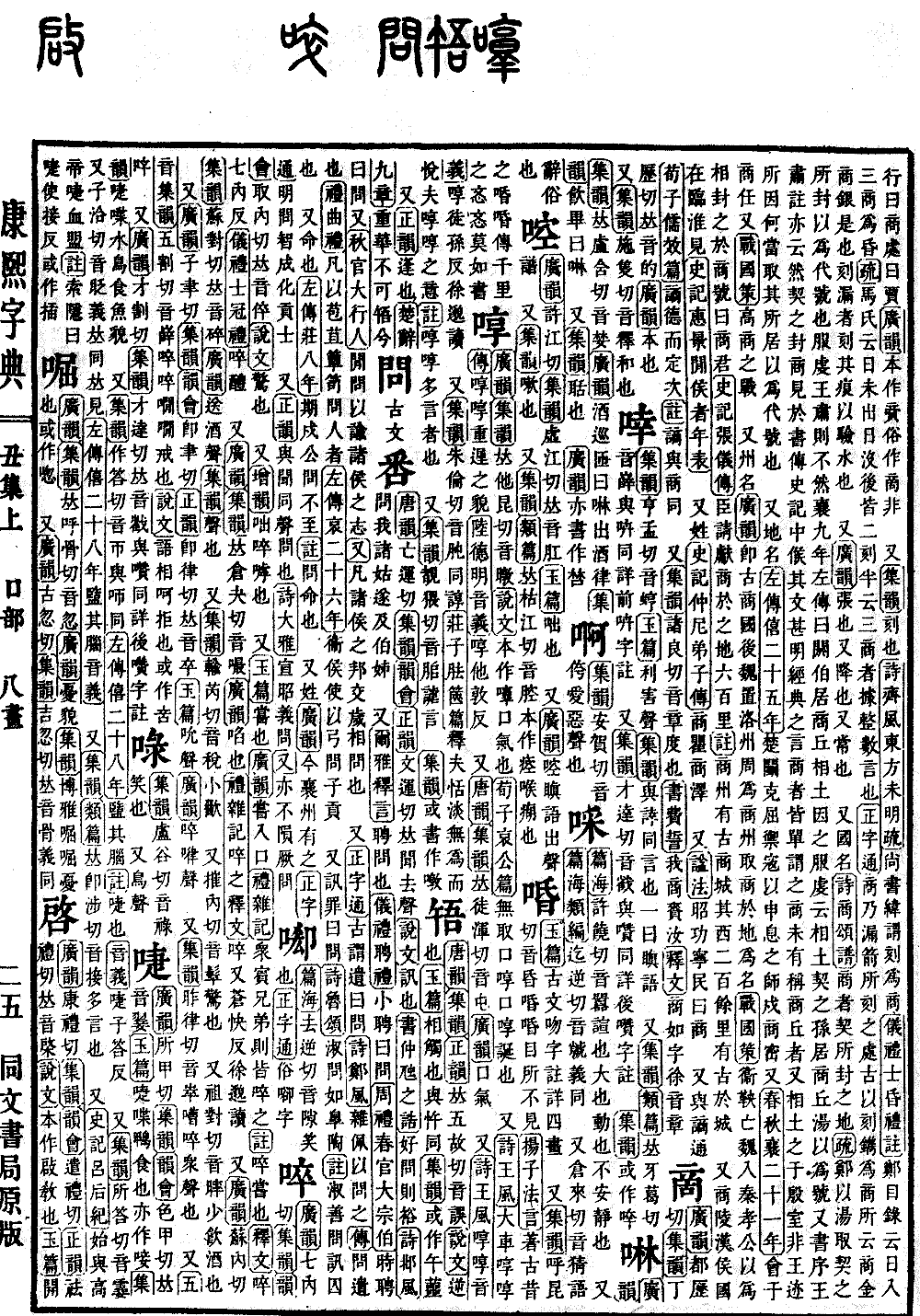
Chou Collection, Upper Volume
Radical: Mouth (kǒu)
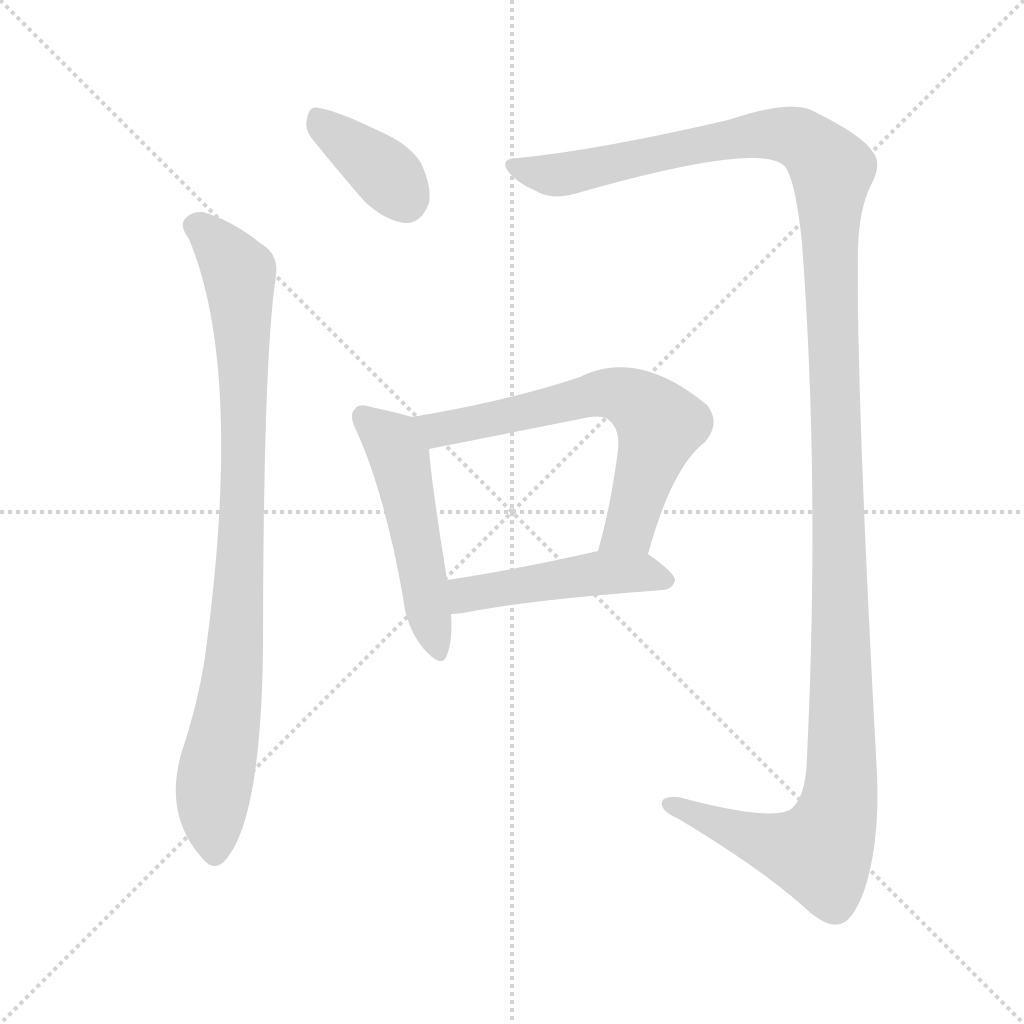
Character: wen
Kangxi strokes: 11
Page 195, Entry 01
Ancient character forms. Pronounced wèn (falling tone). As defined in the Shuowen Jiezi (Shuowen), it means to inquire. In the Book of Documents (Shujing), specifically the Announcement of Zhonghui (Zhonghuizhigao), it is written: To delight in inquiry leads to broad knowledge. In the Book of Odes (Shijing), in the Odes of Bei (Beifeng), it is written: I inquire after my aunts, and then I inquire after my eldest sister. Also, according to the Erya (Erya), in the chapter explaining terms, it means to pay a formal visit. In the Book of Etiquette and Ceremonial (Yili), in the chapter on visiting rites, a small-scale visit is called a wen. In the Rites of Zhou (Zhouli), in the chapter on the Ministry of Rites, an unscheduled visit is called a wen. In the same book, in the chapter on the Ministry of Justice, it refers to understanding the intentions of the feudal lords through unscheduled inquiries. Also, regarding all interactions between feudal states, they inquired after one another once a year.
Furthermore, according to the Zhengzitong (Zhengzitong), in ancient times, the act of giving a gift was called a wen. In the Book of Odes (Shijing), in the Odes of Zheng (Zhengfeng), it is written: I use variegated jade ornaments to present to him. The commentary states: Wen means to give a gift. In the Book of Rites (Liji), in the chapter on general rules of conduct, it mentions all bamboo vessels used to hold gifts when presenting them to others. In the Zuo Tradition (Zuozhuan), in the twenty-sixth year of Duke Ai, the Marquis of Wei sent someone with a bow to present to Zigong.
Also, the interrogation of criminals is called a wen. In the Book of Odes (Shijing), in the Odes of Lu (Lusong), it is written: Skilled at interrogation like Gao Yao. The commentary notes: Shu means skilled. Wen means the interrogation of prisoners.
Also, it means a command or order. In the Zuo Tradition (Zuozhuan), in the eighth year of Duke Zhuang, it is written: The agreed term of garrison service expired, but the command of the lord did not arrive. The commentary notes: Wen means command.
Also, a surname. According to the Guangyun (Guangyun), there is this surname in Xiangzhou today. According to the Zhengzitong (Zhengzitong), Wen Zhi of the Ming Dynasty was a tribute student during the Chenghua era.
Also, according to the Zhengyun (Zhengyun), it is the same as the character for hearing (wen), meaning fame or reputation. In the Book of Odes (Shijing), in the Odes of Da Ya (Daya), it is written: To spread glorious and beautiful fame. Also, it means not losing one’s reputation.
Textual research: In the Book of Rites (Liji), regarding the phrase about using bamboo baskets and mats to present gifts to others, the text has been corrected to use the proper characters for bamboo baskets and mats according to the original source.